Hole 3 at TPC Craig Ranch
- Par
- 4
- Yardage
- 420 yds
- Stroke index
- 5
- Hazards
- 3 bunkers · Water
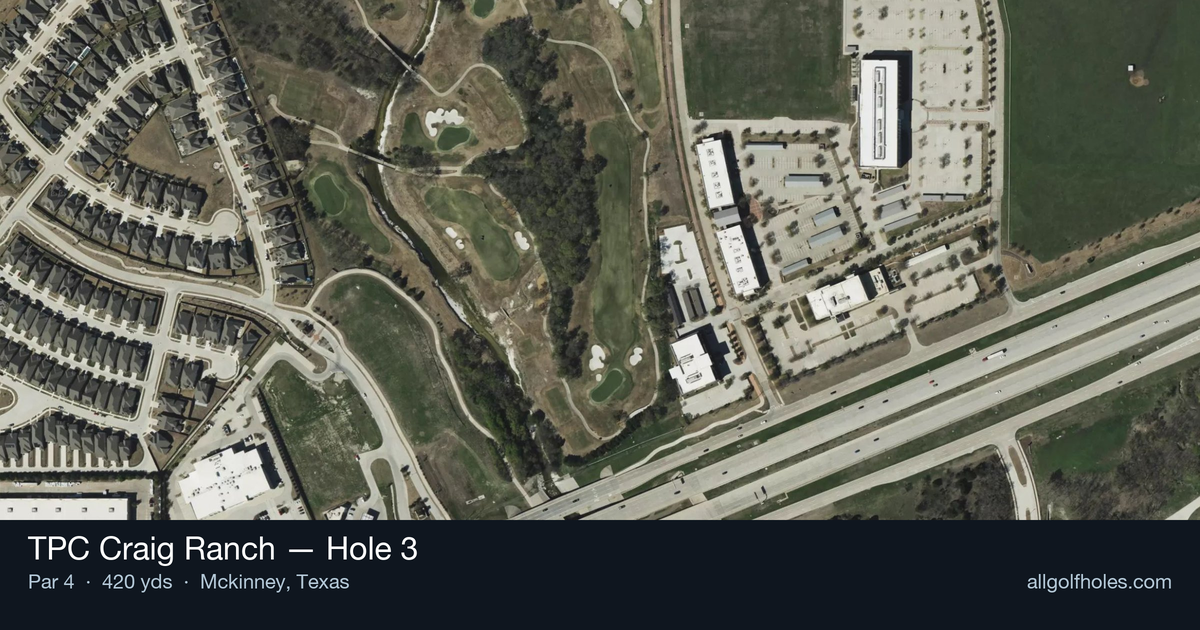
Aerial source not provided
Green size: 44 yds deep × 31 yds wide
Scorecard yardage is for Championship tees. The aerial shows its labeled reference position; distance rings measure to the green.
Championship tees · Par 4 · 420 yards
The plan for No. 3
The third hole at TPC Craig Ranch presents a deceptively challenging par 4 that demands both precision and course management from the championship tees at 420 yards. This straight-away hole, designed by Tom Weiskopf, exemplifies the strategic brilliance that has earned admiration from world-class players and press alike. The tee shot requires careful placement on a generous fairway, setting up a crucial approach shot to a small, well-protected green complex. With minimal hazards flanking the hole, the primary challenge lies in the green's compact target and subtle undulations that can confound even the most confident wedge players. The hole's deceptive simplicity masks its ability to quickly turn pars into bogeys, making it a true test of precision golf strategy at this acclaimed Texas championship venue.
Off the tee
The tee shot strategy centers on finding the ideal position in the landing zone to set up your approach. With the hole playing 420 yards, most players will want to hit driver or strong 3-wood to leave themselves with a manageable mid-iron into the green. The straight layout allows for an aggressive line down the center, but precision is more valuable than pure distance here. Focus on hitting the fairway rather than maximizing distance - a well-positioned drive from 250-270 yards out will leave you with better control on your approach than a longer drive from the rough. The absence of major hazards means you can commit to your swing, but don't let this fool you into becoming careless with your target line.
Approach & recovery
The approach shot is where this hole reveals its teeth. The small green demands pinpoint accuracy, making club selection and distance control critical. From the optimal driving position, you'll likely face a mid-iron to long-iron shot, requiring precise yardage calculation and commitment to your club choice. Pay careful attention to pin position, as the small green leaves little margin for error. Aim for the center of the green unless you're completely confident in your distance control. The compact target means that being slightly long or short can leave challenging recovery shots, so err on the side of caution and take one more club if you're between distances.
On the green
The small green at TPC Craig Ranch's 3rd hole places a premium on approach shot accuracy, as you'll have fewer options for recovery if you miss the putting surface. Once on the green, focus on speed control and reading the subtle breaks that Tom Weiskopf's design likely incorporates. With limited green real estate, lag putting becomes essential when facing longer putts. The key is leaving yourself in the lower portion of the green when possible, as uphill putts are generally easier to control on smaller surfaces. Take time to read the green carefully, as the compact size means every subtle break will be magnified. ## RISK VS REWARD This hole presents a classic risk/reward scenario in club selection rather than target selection. The temptation exists to take an aggressive line or try to overpower the hole, but the small green punishes such approaches. The reward for precise, conservative play is a legitimate birdie opportunity, while aggressive mistakes can quickly lead to bogey or worse. The straight layout removes positional risk/reward decisions, focusing the challenge entirely on execution. This makes it a hole where patience and precision pay dividends over power and aggression. ## DIFFERENT SKILL LEVELS **High-Handicap Players:** Focus on hitting fairways and greens rather than attacking pins. Use one more club on the approach and aim for the center of the green regardless of pin position. A bogey here is acceptable - avoid the big number by staying conservative and playing within your abilities. **Low-Handicap Players:** This hole offers a scoring opportunity with precise execution. You can be more aggressive with pin hunting, but only when you're confident in your distance control. Consider the risk of missing the small green versus the reward of a close birdie look. The absence of major hazards allows for more aggressive play, but the small green still demands respect. The 5-handicap rating suggests this hole plays tougher than its yardage indicates, largely due to the precision required on the approach shot to the small green.
Watch for
- Course conditioning and mapped hazards may affect line selection; confirm from the aerial.
Hole 3 Green Complex
Mapped green boundary
Green size: 6,653 sq ft
Course coverage
Tournament and creator videos about TPC Craig Ranch — shared course coverage, not hole-specific clips.
Tournament coverage
CJ CUP Byron Nelson highlights
THE CJ CUP Byron Nelson | Final Round Highlights
2025
Featured by these creators
Creator videos about this course
YouTube creators who filmed or featured TPC Craig Ranch. · Stats as of Oct 12, 2026 · 5d ago
A new-look TPC Craig Ranch, LIV’s cost cutting, & U.S. Open qualifying starts | The Shotgun Start
How did Hole 3 play?
How did this hole play today?
Frequently asked questions
Yardage reference: Championship tees · 420 yards.
What's the best strategy off the tee?
↓
For this 420-yard par 4, most players will hit driver to set up a comfortable approach.
How difficult is hole 3?
↓
This hole is a moderate challenge for most golfers. Key challenges include: water in play.
What hazards should I watch out for on hole 3?
↓
Key hazards include: water at 69.7 yards. Plan your shots to avoid these trouble spots.
How big is the green on hole 3?
↓
The green is fairly large with multiple pin positions. The green is deeper than wide, so club selection is crucial. Lag putting becomes important on longer putts.