Hole 11 at TPC Craig Ranch
- Par
- 4
- Yardage
- 457 yds
- Stroke index
- 6
- Hazards
- 2 bunkers · Water
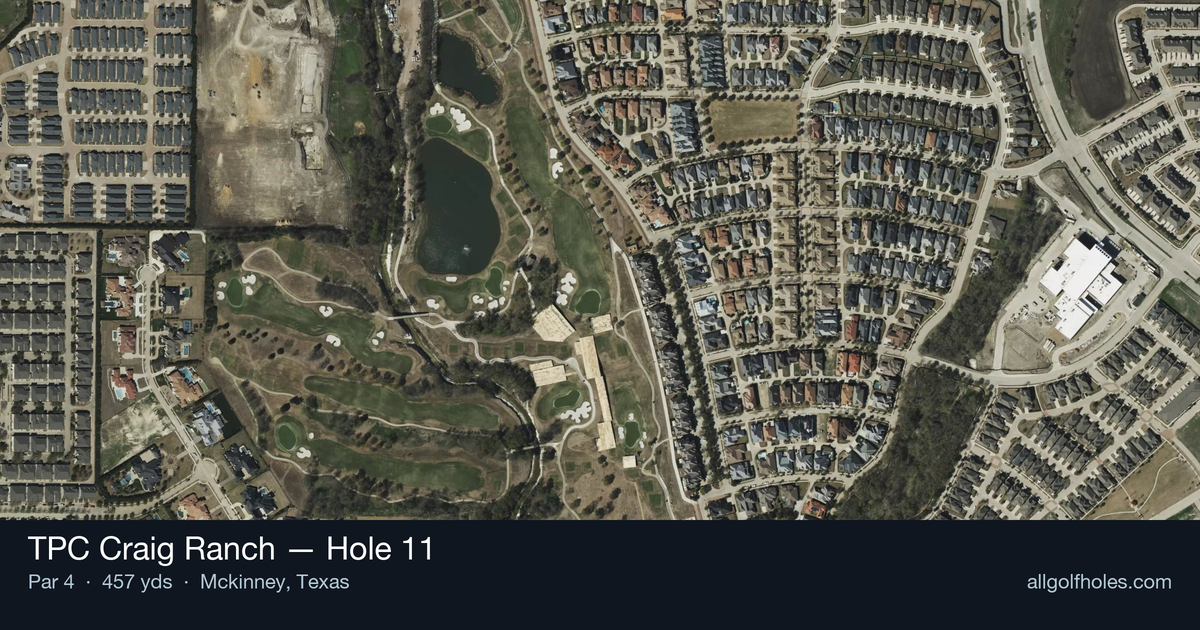
Aerial source not provided
Green size: 27 yds deep × 37 yds wide
Scorecard yardage is for Championship tees. The aerial shows its labeled reference position; distance rings measure to the green.
Championship tees · Par 4 · 457 yards
The plan for No. 11
TPC Craig Ranch hole 11 presents a demanding 457-yard par 4 that exemplifies Tom Weiskopf's strategic design philosophy on the relatively flat Texas terrain. This straight-away hole challenges golfers with a precise tee shot that must navigate strategically placed fairway bunkers, setting up the approach to a compact, well-defended green complex. The key to success lies in avoiding those fairway hazards, which allows players to attack the small green with confidence. With its designation as the sixth-handicap hole, this par 4 rewards thoughtful course management over raw power. The hole's deceptive simplicity masks its true test: demanding accuracy from tee to green while punishing wayward shots that find the sand.
Off the tee
Your tee shot strategy should focus on positioning for the best approach angle while avoiding the fairway bunkers. Driver is often the right choice here given the hole's length, but accuracy is paramount. Target the center-right portion of the fairway to give yourself the widest margin for error. Pay attention to wind conditions - this hole typically plays downwind, which can help with distance but may also carry your ball into trouble if you're not careful with your target line. The key is finding the optimal balance between distance and position. A well-struck 3-wood or driving iron might be the smarter play if you're struggling with driver accuracy, as leaving yourself a longer approach shot is preferable to playing from the sand.
Approach & recovery
With the small green as your target, precision trumps power on your approach shot. Depending on your tee shot success, you'll likely face a mid to long-iron into the green. The compact putting surface demands that you hit your number exactly - coming up short or flying the green will leave you with challenging recovery shots. Focus on the center of the green regardless of pin position, as the small target makes going for flags a risky proposition. Club selection is critical here; take one more club if you're between options, as missing long is typically better than coming up short on most small greens.
On the green
The small green size means every putt becomes crucial for your score. While specific break patterns aren't detailed, approach each putt with extra care given the premium real estate. Focus on lag putting to the center of the cup from longer distances, as three-putting on a small green can be particularly frustrating. Pay attention to how your approach shot reacts on the putting surface, as this will give you valuable information about green firmness and potential slopes. ## RISK VS REWARD This hole offers a clear risk/reward scenario with the fairway bunkers. The reward for successfully navigating past them is a shorter, more manageable approach shot to the small green. However, the penalty for finding sand can be severe, potentially leading to bogey or worse. Conservative players might consider laying up short of the bunkers with their tee shot, accepting a longer approach in exchange for a guaranteed good lie. Aggressive players will challenge the bunkers for better positioning, but must execute precisely. ## DIFFERENT SKILL LEVELS **High Handicappers:** Focus on avoiding the fairway bunkers at all costs. Consider using a 3-wood or hybrid off the tee to ensure you stay in the short grass. From there, accept that you might need two shots to reach the green, and prioritize finding the putting surface rather than attacking pins. **Low Handicappers:** You can be more aggressive with driver, but still respect the bunker placement. Your superior ball-striking ability allows you to attack the small green with confidence, but don't get overly aggressive with pin-hunting unless you're striking the ball exceptionally well. **Mid Handicappers:** This hole rewards smart course management. Use the club you're most confident with off the tee, even if it means a longer approach. The small green will challenge your iron play, so focus on solid contact and center-green targets. The 11th hole exemplifies how Tom Weiskopf maximized the strategic potential of relatively flat terrain, using well-placed bunkers to create meaningful decisions and test every aspect of your game.
Watch for
- Course conditioning and mapped hazards may affect line selection; confirm from the aerial.
Hole 11 Green Complex
Mapped green boundary
Green size: 5,400 sq ft
Course coverage
Tournament and creator videos about TPC Craig Ranch — shared course coverage, not hole-specific clips.
Tournament coverage
CJ CUP Byron Nelson highlights
THE CJ CUP Byron Nelson | Final Round Highlights
2025
Featured by these creators
Creator videos about this course
YouTube creators who filmed or featured TPC Craig Ranch. · Stats as of Oct 12, 2026 · 6d ago
A new-look TPC Craig Ranch, LIV’s cost cutting, & U.S. Open qualifying starts | The Shotgun Start
How did Hole 11 play?
How did this hole play today?
Frequently asked questions
Yardage reference: Championship tees · 457 yards.
What's the best strategy off the tee?
↓
For this 457-yard par 4, most players will hit driver to set up a comfortable approach.
How difficult is hole 11?
↓
This hole is one of the tougher holes on the course for most golfers. Key challenges include: long par 4, water in play.
What hazards should I watch out for on hole 11?
↓
Key hazards include: 2 greenside bunkers; water at 117.0 yards. Plan your shots to avoid these trouble spots.
How big is the green on hole 11?
↓
The green is medium-sized with moderate targets. The green is deeper than wide, so club selection is crucial. Pay attention to pin placement when selecting your approach club.
What's a good score on hole 11?
↓
This hole is one of the tougher holes where par feels like birdie. A challenging par 4. Accept that bogey happens and avoid big numbers.