Hole 4 at TPC of Louisiana
- Par
- 4
- Yardage
- 482 yds
- Stroke index
- 3
- Hazards
- 10 bunkers · Water
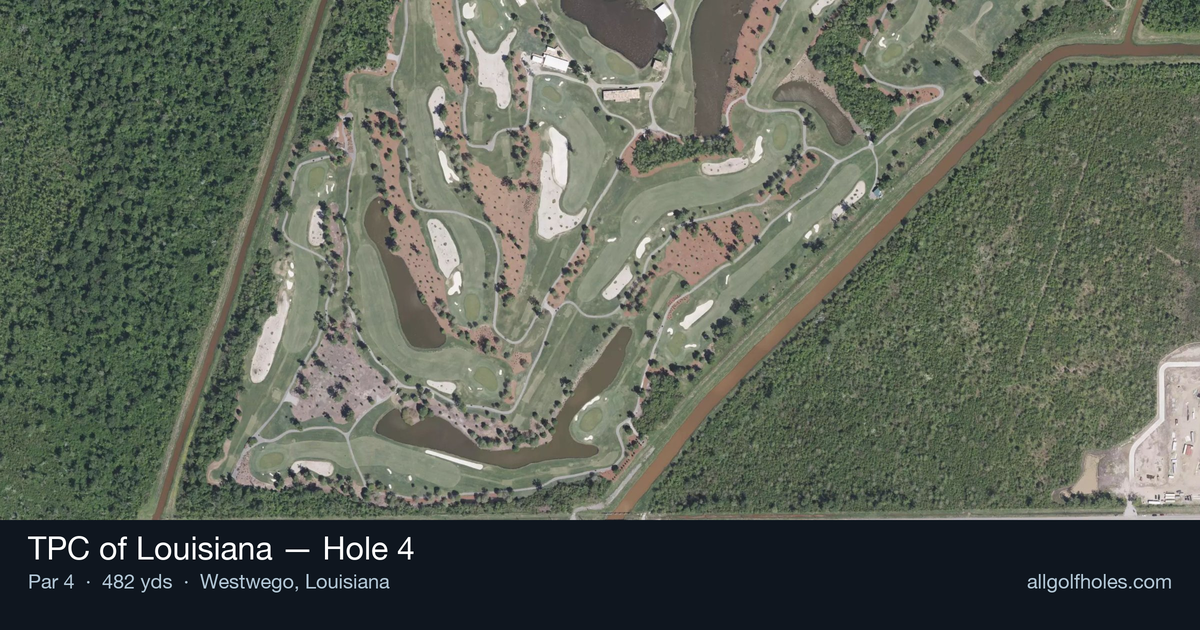
Aerial source not provided
Green size: 35 yds deep × 23 yds wide
Scorecard yardage is for Championship tees. The aerial shows its labeled reference position; distance rings measure to the green.
Championship tees · Par 4 · 482 yards
The plan for No. 4
TPC of Louisiana hole 4 stands as the course's third-most challenging par 4, demanding both distance and precision from this 482-yard test. Pete Dye's strategic design philosophy shines through on this straight, uncompromising layout that requires a powerful tee shot to set up a manageable approach to the small, well-protected green. The absence of major hazards doesn't diminish the hole's difficulty—instead, it places premium emphasis on accuracy and course management. Players must navigate the generous fairway while positioning themselves for the optimal angle into the compact green complex. This hole exemplifies why TPC Louisiana earned recognition as Golf Digest's "#4 best upscale public golf course," rewarding strategic thinking over pure aggression in true Pete Dye fashion.
Off the tee
Your tee shot strategy should focus on finding the center of the fairway while maximizing distance for a manageable approach. Driver is typically the play here given the hole's length, but accuracy cannot be sacrificed for distance. Target the center-left portion of the fairway to set up the best angle to the small green. Be aware that Pete Dye's design likely includes strategically placed bunkers in the landing zone around the 250-yard mark. A well-struck drive that finds the short grass is essential, as playing from the rough will make the already challenging approach shot even more difficult.
Approach & recovery
With a small green as your target, precision becomes critical on your approach shot. Expect to hit anything from a mid-iron to a long-iron depending on your tee shot position and pin location. The compact green size means there's little margin for error - focus on hitting the center of the green rather than attacking specific pin positions. Given Pete Dye's design tendencies and the hole's difficulty rating, expect the green to be well-defended by bunkers. Take one extra club and swing smoothly rather than forcing a shot that could find the sand or miss the green entirely. The small putting surface makes distance control more important than direction.
On the green
The small green demands respect with your putter. Expect subtle breaks and firm conditions typical of TPC courses that host PGA Tour events. Focus on lag putting to avoid three-putts, as the compact surface can make longer putts tricky to judge. Pay attention to pin position - when the flag is tucked near edges of the small green, aim for the center and take your two-putt par. The green's size means even well-struck putts can run off the surface if you're not careful with speed control. ## RISK VS REWARD This hole offers limited risk/reward opportunities, instead demanding steady, strategic play. The primary decision point comes with tee shot club selection - while driver gives you the best chance at a shorter approach, a slightly shorter but more accurate tee shot with a 3-wood might leave you in better position. The approach shot offers no real shortcuts - the small green and surrounding hazards mean the conservative play to the center of the green is usually the smart choice, regardless of pin position. ## DIFFERENT SKILL LEVELS **Low Handicappers:** Focus on finding the fairway with driver and attacking the green aggressively with your approach. Your length advantage should leave you with a mid-iron, allowing you to be more precise with your target selection. **Mid Handicappers:** Consider a conservative tee shot with 3-wood if driver accuracy is inconsistent. Aim for the center of the green regardless of pin position, and don't be afraid to take an extra club on your approach. **High Handicappers:** Play this hole as a three-shot hole if necessary. A hybrid or long iron off the tee followed by a layup to your favorite wedge distance can be more effective than forcing two long shots. The small green rewards accuracy over aggression. This hole exemplifies the strategic challenge that made TPC Louisiana Golf Digest's #4 best upscale public course - success comes from smart course management rather than heroic shots.
Watch for
- Course conditioning and mapped hazards may affect line selection; confirm from the aerial.
Hole 4 Green Complex
Mapped green boundary
Green size: 4,140 sq ft
How did Hole 4 play?
How did this hole play today?
Frequently asked questions
Yardage reference: Championship tees · 482 yards.
What's the best strategy off the tee?
↓
For this 482-yard par 4, most players will hit driver to set up a comfortable approach.
How difficult is hole 4?
↓
This hole is one of the tougher holes on the course for most golfers. Key challenges include: long par 4, water in play, heavily bunkered, small green.
How big is the green on hole 4?
↓
The green is small and requires precision. The green is wider than it is deep, rewarding shots that find the correct tier. Expect challenging pin positions with limited room for error.
What's a good score on hole 4?
↓
This hole is one of the tougher holes where par feels like birdie. A challenging par 4. Accept that bogey happens and avoid big numbers.