Hole 3 at TPC of Louisiana
- Par
- 3
- Yardage
- 221 yds
- Stroke index
- 13
- Hazards
- 4 bunkers · Water
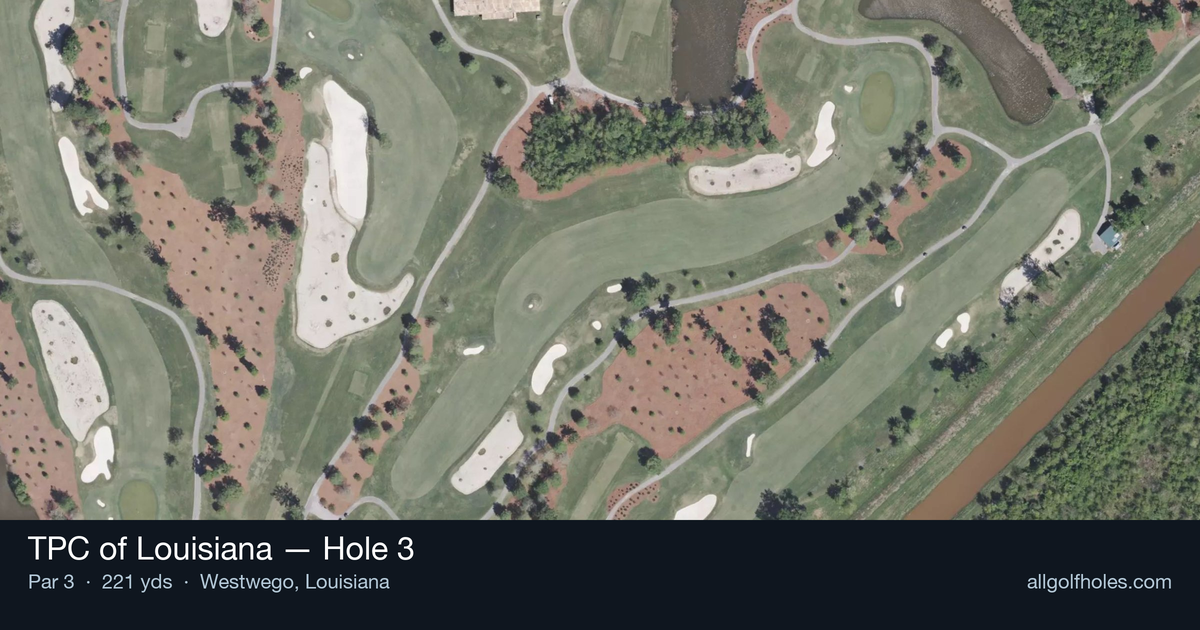
Aerial source not provided
Green size: 38 yds deep × 25 yds wide
Scorecard yardage is for Championship tees. The aerial shows its labeled reference position; distance rings measure to the green.
Championship tees · Par 3 · 221 yards
The plan for No. 3
TPC of Louisiana hole 3 presents a formidable par 3 challenge at 221 yards, demanding precision and power from the elevated tee. This lengthy one-shotter requires golfers to commit fully to their club selection, as the small green offers little margin for error on approach shots. The straight-forward design may appear deceptively simple, but the combination of distance and target size creates a mental test that separates confident ball-strikers from tentative players. With no significant hazards to navigate, success hinges entirely on execution and distance control. This hole exemplifies the strategic design philosophy that has made TPC of Louisiana one of the finest courses in the state, rewarding aggressive, well-struck tee shots while punishing indecision.
Off the tee
Club selection is the most critical decision on this tee. Most golfers will be looking at anything from a long iron to a hybrid, depending on conditions and pin position. Take extra time to assess wind direction and strength, as the elevated nature of most par 3s can make wind effects more pronounced than they appear from the tee. Commit fully to your club choice and swing smoothly rather than trying to muscle a shorter iron. The small green means there's little margin for error, so focus on tempo and balance throughout your swing. Aim for the center of the green unless you're confident in your distance control and the pin position offers a clear advantage.
Approach & recovery
Since this is a par 3, your tee shot IS your approach shot. The key is selecting a club that allows you to make a confident, committed swing. Consider taking one more club than you think you need and making a smooth three-quarter swing rather than forcing a shorter iron. Pay close attention to pin position on the small green. When the flag is tucked in a corner, the smart play is often to aim for the center of the green and take your two-putt par. The small green size means even a well-struck shot can leave you with a challenging putt if you get too aggressive with pin-seeking.
On the green
The small green typically means steeper slopes and more dramatic breaks than you might expect. Take time to read the putt from multiple angles, especially from below the hole. Speed control becomes even more critical on smaller greens, as there's less room for error on both short and long putts. Focus on getting your first putt to the hole with good pace. On a small green, three-putts often result from being too tentative with the first putt, leaving yourself another challenging read from an awkward distance. ## RISK VS REWARD This hole offers limited risk/reward opportunities, which is actually the strategic challenge. The reward for aggressive play is minimal - you're unlikely to make eagle, and even birdie requires precise execution. The risk of missing the small green entirely can lead to difficult up-and-downs. The smart approach is to play conservatively to the center of the green and rely on your putting to create scoring opportunities. This hole rewards patience and course management over heroic shot-making. ## DIFFERENT SKILL LEVELS **High Handicappers:** Focus on getting the ball on the green, regardless of pin position. Choose a club you're confident with and aim for the largest part of the green. Don't be afraid to take an extra club to ensure you reach the putting surface. A bogey from the green is much better than a double bogey from short of the green. **Low Handicappers:** You can be more aggressive with pin positions, but still respect the small green size. Consider the risk/reward carefully - is going for a tucked pin worth the potential for missing the green entirely? Your short game skills give you more recovery options, but prevention is still better than cure. **Mid Handicappers:** Play to your strengths. If you're more confident with a 6-iron than a 4-iron, don't hesitate to take the longer club and swing within yourself. The goal is to avoid the big number that can derail your round. The 3rd hole at TPC Louisiana exemplifies how a seemingly straightforward par 3 can present significant strategic challenges. Success here comes from smart club selection, committed execution, and realistic expectations about scoring opportunities.
Watch for
- Course conditioning and mapped hazards may affect line selection; confirm from the aerial.
Hole 3 Green Complex
Mapped green boundary
Green size: 4,864 sq ft
How did Hole 3 play?
How did this hole play today?
Frequently asked questions
Yardage reference: Championship tees · 221 yards.
What club should I use on this par 3?
↓
At 221 yards, most golfers will need a fairway wood or hybrid to reach this green. Adjust for elevation, wind, and pin position.
How difficult is hole 3?
↓
This hole is one of the tougher holes on the course for most golfers. Key challenges include: long par 3, water in play, heavily bunkered.
What hazards should I watch out for on hole 3?
↓
Key hazards include: 4 greenside bunkers; water at 203.8 yards. Plan your shots to avoid these trouble spots.
How big is the green on hole 3?
↓
The green is medium-sized with moderate targets. Pay attention to pin placement when selecting your approach club.
What's a good score on hole 3?
↓
This hole is a challenging par where bogey is acceptable. This longer par 3 will test your long iron or hybrid game. Par is a good score.