Hole 15 at TPC of Louisiana
- Par
- 4
- Yardage
- 490 yds
- Stroke index
- 4
- Hazards
- 5 bunkers
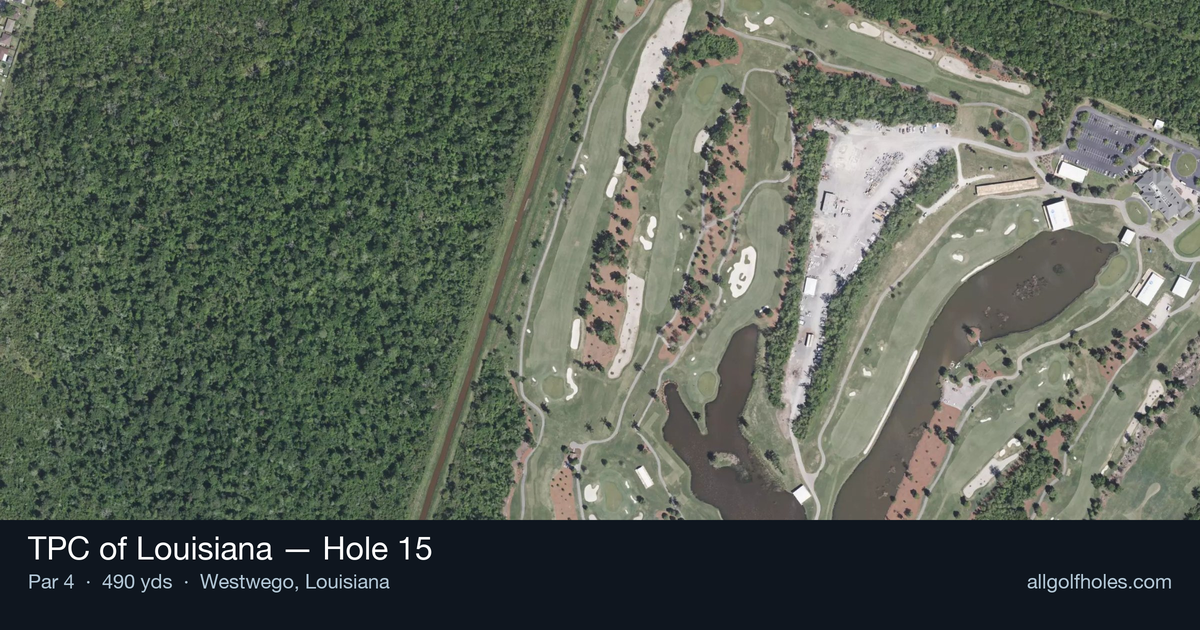
Aerial source not provided
Green size: 39 yds deep × 23 yds wide
Scorecard yardage is for Championship tees. The aerial shows its labeled reference position; distance rings measure to the green.
Championship tees · Par 4 · 490 yards
The plan for No. 15
TPC of Louisiana hole 15 stands as one of Pete Dye's most demanding tests, stretching 490 yards and earning its reputation as one of the course's most challenging par 4s. This lengthy straight-away hole demands precision from tee to green, with the architect's signature strategic design elements creating multiple decision points. The tee shot requires both power and accuracy to reach an optimal position for the demanding approach shot to the small, intricately contoured green complex. Dye's masterful integration of natural Louisiana terrain becomes evident as golfers navigate this formidable hole, where course management and shot execution are paramount. The elevated difficulty and strategic complexity make this hole a true championship test that separates skilled players from the field.
Off the tee
The tee shot strategy centers on finding the optimal position in the landing zone while avoiding the trouble that Pete Dye has strategically placed. Given the hole's length, most golfers will need to use driver to have a reasonable approach shot remaining. Focus on the center-left portion of the fairway as your target line, which typically provides the best angle for your approach shot. The key is committing to an aggressive but controlled swing - you need distance here, but accuracy remains crucial. Avoid the temptation to overswing, as this often leads to errant shots that compound the hole's difficulty. Consider the wind conditions carefully, as they can significantly impact both distance and direction on this exposed hole.
Approach & recovery
Your approach shot will likely require a mid-iron to long-iron depending on driving distance and conditions. The small green demands precision, making club selection critical. Take one extra club and swing smoothly rather than forcing a shorter iron - the green's size leaves little margin for error. Aim for the center of the green regardless of pin position, as Pete Dye's contoured greens can create challenging recovery shots from the wrong side. The green's small size means that being slightly long or short is far preferable to missing left or right. Pay attention to the wind, which can dramatically affect ball flight on this lengthy approach.
On the green
The small, contoured green typical of Pete Dye designs requires careful reading and conservative putting strategy. Expect subtle breaks that can be deceptive, particularly on longer putts. The green's size means most approach shots will leave reasonable putting distances, but the contours can create challenging two-putts if you're on the wrong tier. Focus on lag putting to the correct level of the green, then trust your read on the shorter second putt. Avoid aggressive putts that could run well past the hole on this smaller target - par is an excellent score here. ## RISK VS REWARD This hole presents a classic Pete Dye risk-reward scenario where aggressive play can yield rewards but conservative strategy often produces better scores. The primary risk-reward decision comes with tee shot positioning - playing aggressively for optimal approach angles versus ensuring you find the fairway. The reward for precise execution is a legitimate birdie opportunity, but the risks of missing fairways or greens are severe given the hole's length and design. Most golfers should prioritize avoiding big numbers rather than chasing birdies. ## DIFFERENT SKILL LEVELS **Low-Handicap Players:** Can play aggressively off the tee to set up shorter approach shots, but must still respect the small green. Consider drawing or fading the tee shot based on optimal approach angles. Attack pins only when the approach shot is from ideal distance and angle. **Mid-Handicap Players:** Should focus on finding the fairway with driver, then playing conservatively to the center of the green. Accept that this is a challenging hole where par represents success. Avoid forcing shots and prioritize course management. **High-Handicap Players:** Consider using a 3-wood or hybrid off the tee if driver accuracy is inconsistent. Play for the center of the green with every approach shot, and don't be discouraged by the hole's difficulty - even experienced players struggle here. Focus on avoiding penalty strokes and keeping the ball in play. This hole rewards patience, precision, and smart course management while punishing overly aggressive play - hallmarks of Pete Dye's strategic design philosophy that make TPC Louisiana such a compelling test of golf.
Watch for
- Course conditioning and mapped hazards may affect line selection; confirm from the aerial.
Hole 15 Green Complex
Mapped green boundary
Green size: 4,738 sq ft
How did Hole 15 play?
How did this hole play today?
Frequently asked questions
Yardage reference: Championship tees · 490 yards.
What's the best strategy off the tee?
↓
For this 490-yard par 4, most players will hit driver to set up a comfortable approach.
How difficult is hole 15?
↓
This hole is a moderate challenge for most golfers. Key challenges include: long par 4, heavily bunkered.
How big is the green on hole 15?
↓
The green is medium-sized with moderate targets. The green is deeper than wide, so club selection is crucial. Pay attention to pin placement when selecting your approach club.
What's a good score on hole 15?
↓
This hole is one of the tougher holes where par feels like birdie. A challenging par 4. Accept that bogey happens and avoid big numbers.