Hole 15 at Valhalla Golf Club
- Par
- 4
- Yardage
- 435 yds
- Hazards
- 3 bunkers · Water
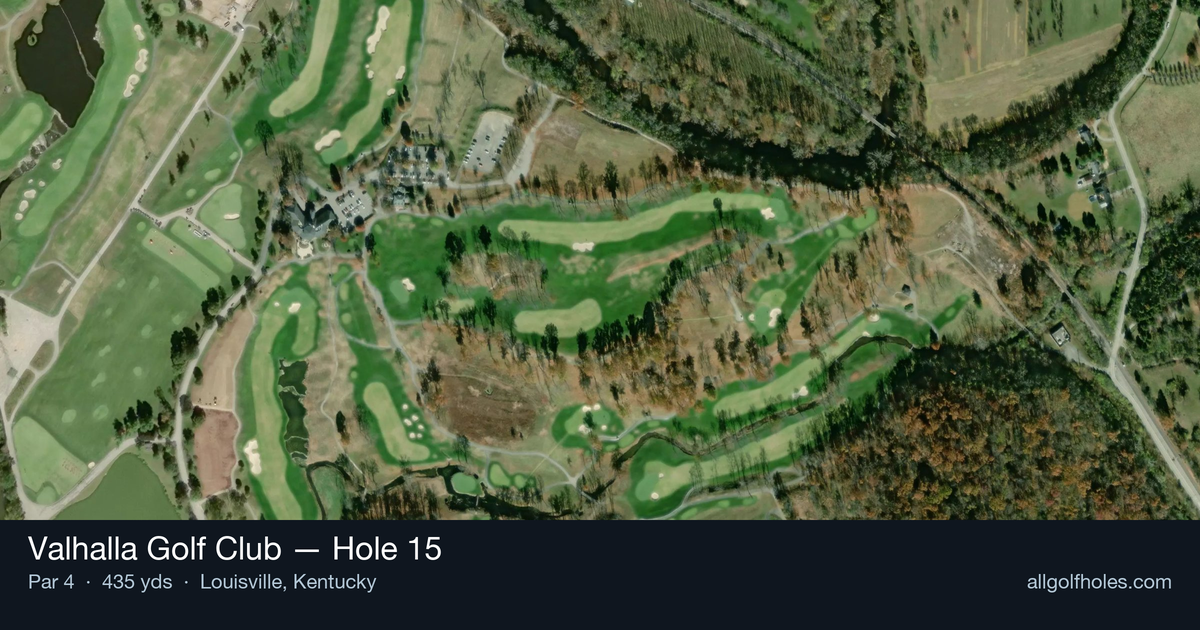
Aerial source not provided
Green size: 40 yds deep × 22 yds wide
Scorecard yardage is for Championship tees. The aerial shows its labeled reference position; distance rings measure to the green.
Championship tees · Par 4 · 435 yards
The plan for No. 15
Valhalla Golf Club hole 15 stands as one of the course's most demanding tests, earning recognition among the toughest tee shots at this legendary Louisville venue. This straight par 4 stretches 435 yards and demands both power and precision from the championship tees. The hole's deceptive simplicity masks its true challenge - finding the optimal position for the approach shot to a compact, well-protected green complex. With no room for error and a small target awaiting, golfers must commit fully to both the tee shot and approach. The 15th exemplifies Jack Nicklaus's design philosophy at Valhalla, where strategic thinking and execution under pressure separate champions from contenders in major championship play.
Off the tee
The tee shot on this hole requires your best swing of the day. With no significant hazards listed, the challenge lies in finding the optimal position in the fairway for your approach angle. Aim for the center of the fairway with your driver, focusing on a smooth, controlled swing rather than maximum distance. The straight layout allows you to be aggressive with your target line, but accuracy remains paramount. Consider the wind conditions and pin position when selecting your landing zone, as positioning yourself properly here will determine your approach shot options.
Approach & recovery
After a solid drive, you'll likely face a mid-iron to long-iron approach shot to a small green that demands precision. The compact green size leaves little margin for error, making club selection and commitment to your swing crucial. Favor the center of the green regardless of pin position, as the small target makes going flag-hunting extremely risky. Pay attention to the firmness of the green and adjust your trajectory accordingly - a higher, softer landing shot will give you the best chance of holding this small surface.
On the green
The small green creates challenging putting scenarios, as proximity to the hole becomes even more important. Focus on lag putting to avoid three-putts, as the compact surface can create deceptive breaks and speeds. When reading putts, remember that smaller greens often play faster than they appear, so err on the side of leaving putts short rather than racing them past the hole. Pin positions on the edges of this small green can create particularly tricky approach shots and subsequent putts. ## RISK VS REWARD This hole offers limited risk/reward opportunities, instead demanding solid, fundamental golf. The primary reward comes from executing both shots well - a good drive followed by a precise approach can yield birdie opportunities. However, the risk of missing the small green is significant, potentially leading to difficult up-and-down situations. The straight design eliminates many strategic options, making execution the key factor in scoring. ## DIFFERENT SKILL LEVELS **Low-Handicap Players:** Attack this hole with confidence, using driver to get as close to the green as possible. Your precision with mid-irons should allow you to target specific areas of the small green based on pin position. This represents a genuine birdie opportunity if you execute both shots well. **Mid-Handicap Players:** Focus on finding the fairway with your most reliable tee shot, even if that means using a 3-wood or hybrid for accuracy. Aim for the center of the green on your approach, accepting par as a good score on this challenging hole. **High-Handicap Players:** Consider using a fairway wood or hybrid off the tee to ensure you stay in play. The small green makes precision more important than distance on your approach shot - choose a club you're confident with and aim for the largest part of the green. A bogey here isn't a disaster given the hole's difficulty rating.
Watch for
- Sand 1 (crossing) influences line and recovery options.
- Sand 2 (crossing) influences line and recovery options.
- Sand 3 (greenside) influences line and recovery options.
- Water (crossing) influences line and recovery options.
- Woods 1 (crossing) influences line and recovery options.
- Woods 2 (crossing) influences line and recovery options.
- Woods 3 (greenside) influences line and recovery options.
Hole 15 Green Complex
Mapped green boundary
Green size: 4,730 sq ft
Course coverage
Tournament and creator videos about Valhalla Golf Club — shared course coverage, not hole-specific clips.
Featured by these creators
Creator videos about this course
YouTube creators who filmed or featured Valhalla Golf Club. · Stats as of Oct 12, 2026 · 6d ago
Can We Make Cut @ Valhalla?! (2024 PGA Championship)
Ride along while I analyze the front nine of Valhalla for the 2024 PGA Championship
How did Hole 15 play?
How did this hole play today?
Frequently asked questions
Yardage reference: Championship tees · 435 yards.
What's the best strategy off the tee?
↓
For this 435-yard par 4, most players will hit driver to set up a comfortable approach.
How difficult is hole 15?
↓
This hole is a moderate challenge for most golfers. Key challenges include: water in play.
How big is the green on hole 15?
↓
The green is medium-sized with moderate targets. The green is wider than it is deep, rewarding shots that find the correct tier. Pay attention to pin placement when selecting your approach club.
What's a good score on hole 15?
↓
This hole is a demanding hole where bogey is not unusual. This longer par 4 will test most golfers. Focus on position over distance.