Hole 3 at Valhalla Golf Club
- Par
- 3
- Yardage
- 210 yds
- Hazards
- 2 bunkers · Water
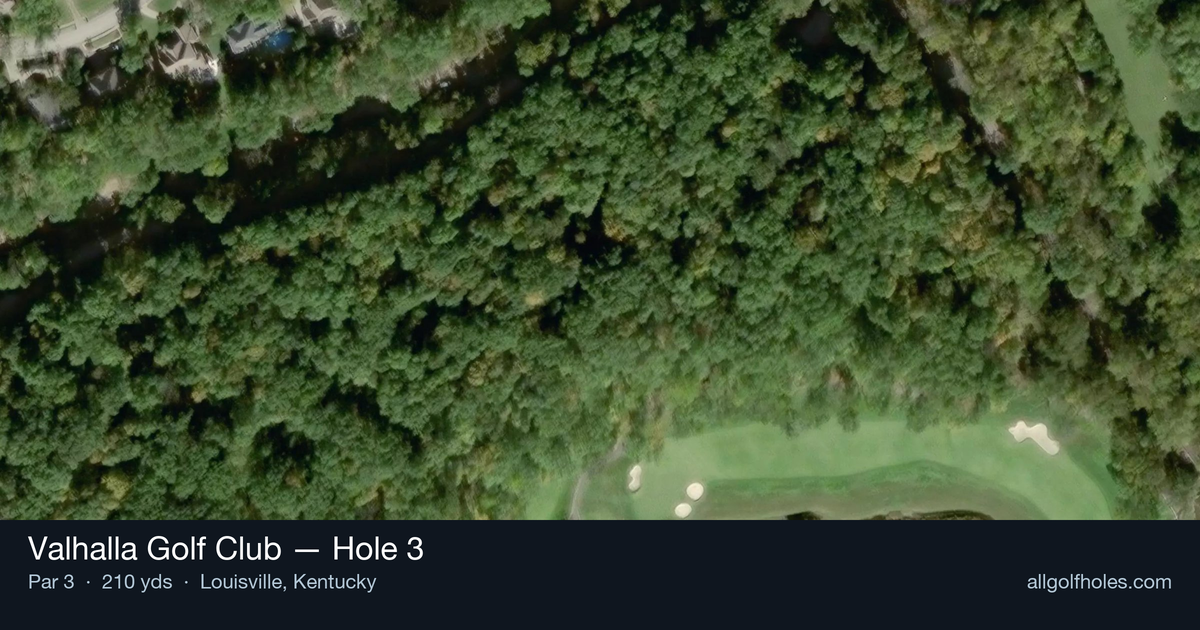
Aerial source not provided
Green size: 36 yds deep × 27 yds wide
Scorecard yardage is for Championship tees. The aerial shows its labeled reference position; distance rings measure to the green.
Championship tees · Par 3 · 210 yards
The plan for No. 3
Known as "Floyd's Fork" at Valhalla Golf Club, this 210-yard par 3 presents a deceptively challenging test over water. The tee shot must carry Floyd's Fork creek, which guards the front and right side of the small, elevated green complex. This signature hole demands precision club selection and unwavering commitment, as any hesitation or mishit finds the water. The compact green offers little margin for error, requiring golfers to trust their yardage and swing with confidence. What makes Floyd's Fork particularly memorable is its ability to separate the field during major championships - a hole where major dreams can be realized or crushed with a single swing at this storied Louisville venue.
Off the tee
Your club selection is critical on this hole - take one more club than you think you need and commit to a smooth, controlled swing. The 210-yard distance typically calls for anything from a 5-iron to a hybrid, depending on wind conditions and pin position. Aim for the center of the green rather than chasing pins, as the small target and water hazard make aggressive play extremely risky. The straight layout means there's no need for creative shot-making - just solid fundamentals and smart course management.
Approach & recovery
Since this is a par-3, your tee shot IS your approach shot. Focus on landing the ball on the putting surface rather than trying to get close to challenging pin positions. The creek running in front and along the right side of the green creates a severe penalty for any shot that comes up short or drifts right. Take dead aim at the center of the green and let your putting take care of the rest.
On the green
The small green size means you won't face extremely long putts if you hit your target, but it also means precision is required around the cup. Read the slopes carefully, as subtle breaks can be magnified on a smaller putting surface. Any pin position near the water side of the green should be treated with extra respect - lag putting to ensure you stay dry is often the smart play. ## RISK VS REWARD This hole offers limited risk/reward opportunities due to the water hazard and small green. The primary decision is club selection - taking enough club to clear the hazard comfortably versus trying to dial in the perfect distance. The smart play is always to take sufficient club and focus on the center of the green. Aggressive pin-hunting rarely pays off when water is in play. ## DIFFERENT SKILL LEVELS **High-handicap players** should focus entirely on clearing the water hazard. Take an extra club, aim for the back center of the green, and accept a longer putt rather than risking a penalty stroke. Consider using a hybrid or fairway wood if needed to ensure you get the ball airborne and over the creek. **Low-handicap players** can be more precise with their distance control but should still respect the water hazard. You have the skill to work the ball to different pin positions, but always ensure you have a comfortable margin over the creek. This is a hole where par is always a good score, and birdie opportunities should only be pursued when conditions are ideal. The key to mastering Floyd's Fork is understanding that this hole rewards patience and precision over aggression. With Floyd's Fork creek creating such a definitive hazard, smart course management and solid execution will serve you far better than trying to manufacture something special.
Watch for
- Sand 1 (greenside) influences line and recovery options.
- Sand 2 (greenside) influences line and recovery options.
- Water (greenside) influences line and recovery options.
- Woods 1 (crossing) influences line and recovery options.
- Woods 2 (crossing) influences line and recovery options.
Hole 3 Green Complex
Mapped green boundary
Green size: 4,918 sq ft
Course and tournament history
Historical context for the course and venue. Each entry identifies the event or course it describes.
2024 · Rory McIlroy
Known as the "Limestone Hole", ... is the signature hole on property. It's been ten years since Valhalla last hosted a PGA Championship, and the course will look quite
Source →
Course coverage
Tournament and creator videos about Valhalla Golf Club — shared course coverage, not hole-specific clips.
Featured by these creators
Creator videos about this course
YouTube creators who filmed or featured Valhalla Golf Club. · Stats as of Oct 12, 2026 · 6d ago
Can We Make Cut @ Valhalla?! (2024 PGA Championship)
Ride along while I analyze the front nine of Valhalla for the 2024 PGA Championship
How did Hole 3 play?
How did this hole play today?
Frequently asked questions
Yardage reference: Championship tees · 210 yards.
What club should I use on this par 3?
↓
At 210 yards, most golfers will need a fairway wood or hybrid to reach this green. Adjust for elevation, wind, and pin position.
How difficult is hole 3?
↓
This hole is one of the tougher holes on the course for most golfers. Key challenges include: long par 3, water in play.
What hazards should I watch out for on hole 3?
↓
Key hazards include: 2 greenside bunkers; water at 161.2 yards. Plan your shots to avoid these trouble spots.
How big is the green on hole 3?
↓
The green is medium-sized with moderate targets. Pay attention to pin placement when selecting your approach club.
What's a good score on hole 3?
↓
This hole is a challenging par where bogey is acceptable. This longer par 3 will test your long iron or hybrid game. Par is a good score.