Hole 15 at Tiburon Golf Club (Black)
- Par
- 5
- Yardage
- 560 yds
- Stroke index
- 14
- Hazards
- 4 bunkers · Water
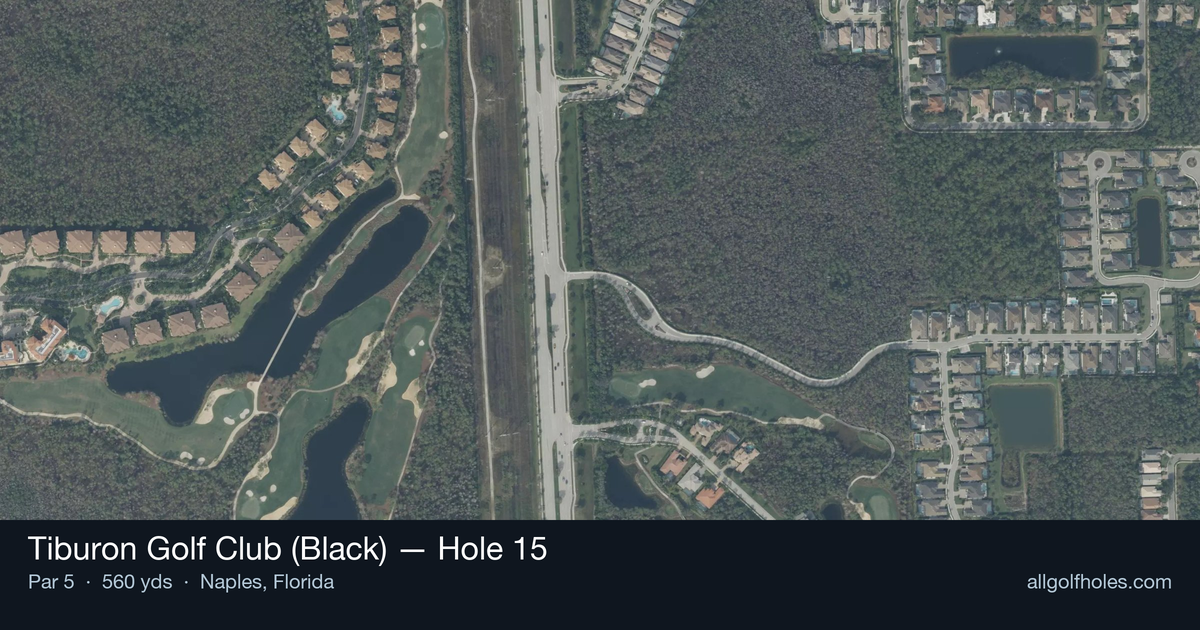
Aerial source not provided
Green size: 29 yds deep × 32 yds wide
Scorecard yardage is for Championship tees. The aerial shows its labeled reference position; distance rings measure to the green.
Championship tees · Par 5 · 560 yards
The plan for No. 15
The 15th hole at Tiburon Golf Club (Black) showcases Greg Norman's strategic brilliance in a deceptively straightforward par 5 that stretches 560 yards through the Florida landscape. This straight-away design invites aggressive play from the tee shot, offering longer hitters the tantalizing prospect of reaching the green in two. The generous fairway provides ample room for drivers, but the real test emerges on the approach to the compact green complex. Without significant hazards to intimidate, golfers must rely on precise distance control and club selection to navigate the small target. The Great White Shark's architectural philosophy shines through in this risk-reward hole, where smart course management often trumps raw power in securing birdie opportunities.
Off the tee
Your tee shot strategy should prioritize finding the fairway and setting up the ideal angle for your second shot. With the fairway relatively open, focus on hitting your most reliable driver or 3-wood to establish position. The key is avoiding any rough that could complicate your approach to the green. Aim for the center-left portion of the fairway to give yourself the best angle into the small green. Course management is crucial here - don't let the absence of obvious trouble lure you into an overly aggressive swing that could find the rough or trees.
Approach & recovery
Your approach shot strategy will largely depend on whether you're going for the green in two or laying up for a wedge. For longer hitters attempting to reach in two, the small green demands pinpoint accuracy with a long iron or hybrid. Target the center of the green regardless of pin position, as the limited surface area leaves little room for error. If laying up, position your second shot to leave a full wedge distance - typically around 100-120 yards - rather than an awkward half-shot. This gives you the best chance to attack the pin with your third shot.
On the green
The small green at the 15th requires careful attention to speed control and read selection. With limited surface area, approach putts that run past the hole can easily roll off the green or leave difficult comeback putts. Focus on getting your first putt close to the hole rather than being overly aggressive with the target line. Pay particular attention to any subtle slopes, as they'll be magnified on this compact putting surface. When the pin is tucked near an edge, aim for the fat part of the green and rely on solid putting rather than risky approach shots. ## RISK VS REWARD The primary risk/reward decision comes on your second shot. Attempting to reach the green in two offers obvious birdie and eagle opportunities, but the small target requires exceptional precision. Missing the green in regulation can leave difficult up-and-down chances that could lead to bogey or worse. The safer play of laying up virtually guarantees a birdie opportunity with a short iron in hand, making this often the smarter choice for most golfers. Consider wind conditions, lie quality, and your current round momentum when making this decision. ## DIFFERENT SKILL LEVELS **High Handicappers:** Focus on keeping the ball in play and setting up a manageable third shot. Use your most reliable club off the tee, lay up to your favorite wedge distance, and aim for the center of the green. This conservative approach maximizes your chances of making par while keeping big numbers off the scorecard. **Low Handicappers:** You have the option to be more aggressive, potentially going for the green in two when conditions favor it. However, even skilled players should respect the small green size and consider laying up when the pin position is particularly challenging. Your superior short game skills make the three-shot approach a reliable birdie opportunity. The 15th hole at Tiburon's Black Course embodies Norman's design principle of rewarding smart golf strategy over pure power, making it a true test of course management skills for players of all abilities.
Watch for
- Course conditioning and mapped hazards may affect line selection; confirm from the aerial.
Hole 15 Green Complex
Mapped green boundary
Green size: 3,412 sq ft
How did Hole 15 play?
How did this hole play today?
Frequently asked questions
Yardage reference: Championship tees · 560 yards.
Can this par 5 be reached in two?
↓
At 560 yards, A true three-shot hole for most players. Position your layup to leave a comfortable wedge distance.
How difficult is hole 15?
↓
This hole is one of the tougher holes on the course for most golfers. Key challenges include: long par 5, water in play, heavily bunkered, small green.
What hazards should I watch out for on hole 15?
↓
Key hazards include: water at 38.2 yards. Plan your shots to avoid these trouble spots.
How big is the green on hole 15?
↓
The green is small and requires precision. The green is deeper than wide, so club selection is crucial. Expect challenging pin positions with limited room for error.
What's a good score on hole 15?
↓
This hole is a true three-shot hole where birdie requires execution. This longer par 5 demands patience. Two good shots set up the scoring opportunity.