Hole 17 at Seminole Golf Club
- Par
- 3
- Yardage
- 175 yds
- Hazards
- 9 bunkers
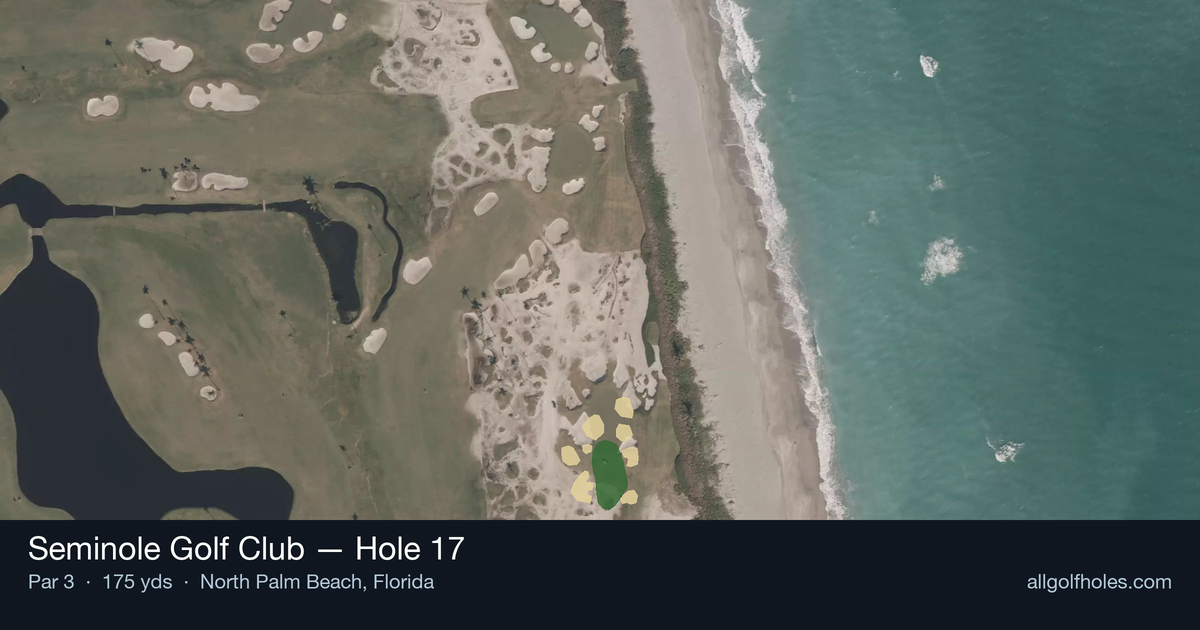
Aerial source not provided
Green size: 43 yds deep × 23 yds wide
Scorecard yardage is for Championship tees. The aerial shows its labeled reference position; distance rings measure to the green.
Championship tees · Par 3 · 175 yards
The plan for No. 17
Seminole Golf Club hole 17 presents a deceptively challenging par 3 that epitomizes the strategic brilliance of this legendary North Palm Beach layout. From the elevated tee, golfers face a precise 175-yard carry to a small, well-guarded green that demands both accuracy and proper club selection. The absence of major hazards might suggest simplicity, but the compact target and coastal winds that frequently sweep across this Donald Ross masterpiece create their own formidable challenge. The green's subtle contours punish wayward approaches, making distance control paramount. This hole perfectly captures Seminole's reputation for rewarding precise shotmaking while penalizing the overconfident, serving as a stern test before the dramatic finishing hole that has challenged champions for nearly a century.
Off the tee
From the tee, your primary focus should be the center of the green rather than chasing pin positions. A mid-iron to long-iron depending on conditions and your personal distances is typically the play here. The key is committing to a smooth, controlled swing that prioritizes solid contact over maximum distance. Given the small green, aim for the heart of the putting surface and let good putting take care of scoring. Pay close attention to wind direction and strength, as coastal breezes can significantly affect ball flight on this exposed hole.
Approach & recovery
Since this is a par 3, your tee shot is your approach. The straight layout simplifies alignment, but the small green demands pinpoint accuracy. Focus on your pre-shot routine and club selection - it's better to be in the middle of the green with a longer putt than short-sided with a difficult chip. Consider the pin position only if you're feeling confident with your iron play; otherwise, dead center of the green is always the smart play.
On the green
Seminole's greens are known for their subtle breaks and firm conditions. On this small putting surface, lag putting becomes crucial - getting your first putt close is more important than being aggressive toward the hole. Read the green carefully, as even seemingly flat putts can have subtle breaks that affect ball roll. The compact size means most putts will be makeable, but respect the green's contours and focus on two-putting at worst. ## RISK VS REWARD The primary risk/reward decision here is pin hunting versus playing safe to the center. While the lack of major hazards might tempt aggressive play, the small green punishes misses severely. The reward for finding the green is a legitimate birdie opportunity, but the risk of missing the putting surface entirely often outweighs the benefit of getting a few feet closer to a tucked pin. Conservative play to the center typically yields better scoring results. ## DIFFERENT SKILL LEVELS **High-handicap players** should focus entirely on finding the green with whatever club gives them confidence from 175 yards. Don't worry about pin positions - aim for the biggest part of the green and celebrate making par. Consider taking one more club than you think you need to ensure you reach the putting surface. **Low-handicap players** can be more aggressive with pin positions, especially when the flag is in the center portion of the green. However, even skilled players should resist the temptation to attack extremely tucked pins on this small target. Your superior putting skills will create birdie opportunities from anywhere on this green, so prioritize finding the putting surface first. The 17th at Seminole rewards patience and precision over power, making it a true test of course management and iron play execution.
Watch for
- Mapped sand (greenside) roughly 130 yards from the tee reference.
- Mapped sand (greenside) roughly 142 yards from the tee reference.
- Mapped sand (greenside) roughly 145 yards from the tee reference.
- Mapped sand (greenside) roughly 161 yards from the tee reference.
- Mapped sand (greenside) roughly 157 yards from the tee reference.
Hole 17 Green Complex
Mapped green boundary
Green size: 4,812 sq ft
Course coverage
Tournament and creator videos about Seminole Golf Club — shared course coverage, not hole-specific clips.
Featured by these creators
Creator videos about this course
YouTube creators who filmed or featured Seminole Golf Club. · Stats as of Oct 12, 2026 · 6d ago
Restoring Donald Ross's Seminole Golf Club
How did Hole 17 play?
How did this hole play today?
Frequently asked questions
Yardage reference: Championship tees · 175 yards.
What club should I use on this par 3?
↓
At 175 yards, most golfers will need a mid-iron (7-iron to 8-iron) to reach this green. Adjust for elevation, wind, and pin position.
How difficult is hole 17?
↓
This hole is a good scoring opportunity for most golfers.
How big is the green on hole 17?
↓
The green is medium-sized with moderate targets. The green is deeper than wide, so club selection is crucial. Pay attention to pin placement when selecting your approach club.
What's a good score on hole 17?
↓
This hole is a solid par with birdie chances for precise approach shots. Making par is a good result here. Focus on hitting the green and avoiding three-putts.