Hole 16 at Seminole Golf Club
- Par
- 4
- Yardage
- 410 yds
- Hazards
- 16 bunkers
Aerial source not provided
Green size: 35 yds deep × 23 yds wide
Scorecard yardage is for Championship tees. The aerial shows its labeled reference position; distance rings measure to the green.
Championship tees · Par 4 · 410 yards
The plan for No. 16
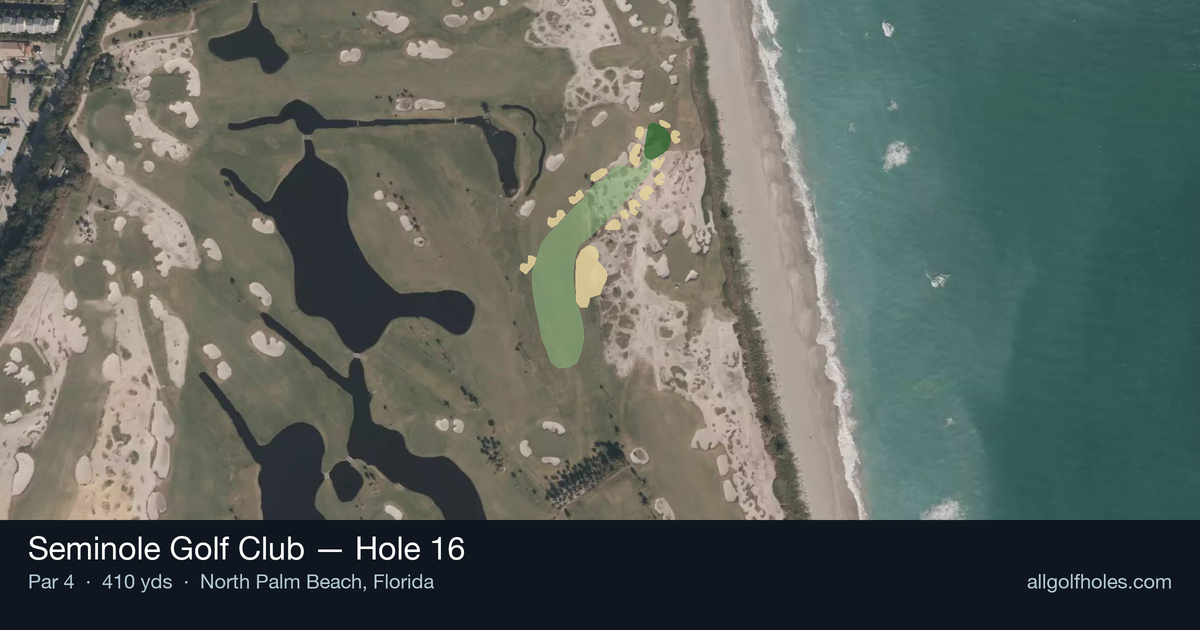
The 16th hole at Seminole Golf Club presents a deceptively challenging par 4 that epitomizes the strategic brilliance of this legendary North Palm Beach layout. At 410 yards, this straight hole demands precision over power, with its small green serving as the primary defense against scoring. The absence of traditional hazards places premium emphasis on course management and approach shot accuracy. Players must navigate a relatively generous fairway before facing the hole's true test – a diminutive green that punishes anything but the most precise iron play. The green's compact dimensions require golfers to commit fully to their club selection and execution, as missing the putting surface often results in challenging recovery shots. This hole exemplifies Seminole's reputation for rewarding thoughtful strategy and penalizing aggressive play, making it a memorable examination of precision golf.
Off the tee
The tee shot strategy centers on finding the optimal position for your approach angle. With no significant hazards off the tee, the focus shifts to distance control and fairway positioning. Most players should favor a controlled tee shot with a 3-wood or driver, aiming for the center-left portion of the fairway to set up the best angle into the small green. The key is avoiding the temptation to overpower the tee shot - position trumps distance on this hole. Wind direction will be crucial in club selection, as Seminole's coastal location can create challenging conditions that affect ball flight.
Approach & recovery
The approach shot is where this hole shows its teeth. With a small green as your target, precision becomes everything. Depending on your tee shot position, you'll likely face a mid-iron to long-iron approach. The key is committing fully to your club selection based on wind conditions and pin position. Favor the center of the green regardless of pin placement - the small putting surface leaves little margin for error. Take one extra club if there's any doubt, as coming up short or missing the green entirely will leave you with a challenging recovery shot.
On the green
Seminole's greens are known for their subtle breaks and firm conditions. On this small green, lag putting becomes crucial - getting your first putt close is more important than being aggressive with longer putts. Read the grain carefully, as the coastal bermuda grass can significantly affect ball roll. Focus on speed control above all else, as three-putts can quickly derail a good score on such a compact putting surface. ## RISK VS REWARD This hole presents a classic risk/reward scenario in club selection rather than target selection. The reward for aggressive play is minimal given the small green size, while the risk of missing the putting surface entirely is significant. The smart play is conservative course management - take the center of the green, make your par, and move on. Birdie opportunities will come from excellent execution rather than aggressive strategy. ## DIFFERENT SKILL LEVELS **High Handicappers:** Focus entirely on finding the fairway with your tee shot, even if it means using a 3-wood or hybrid. For the approach, take plenty of club and aim for the center of the green. Don't worry about pin hunting - just find the putting surface and two-putt for par. **Low Handicappers:** You can be more aggressive off the tee with driver, but the approach requires the same disciplined thinking. Use your distance control skills to attack pins only when conditions are perfect. Your advantage comes from better execution of the conservative strategy rather than taking on additional risk. The 16th at Seminole rewards patience and precision over power, making it a true test of golf strategy and course management skills.
Watch for
- Mapped sand (greenside) roughly 369 yards from the tee reference.
- Mapped sand (crossing) roughly 304 yards from the tee reference.
- Mapped sand (crossing) roughly 288 yards from the tee reference.
- Mapped sand (crossing) roughly 286 yards from the tee reference.
- Mapped sand (crossing) roughly 276 yards from the tee reference.
Hole 16 Green Complex
Mapped green boundary
Green size: 4,401 sq ft
Course coverage
Tournament and creator videos about Seminole Golf Club — shared course coverage, not hole-specific clips.
Featured by these creators
Creator videos about this course
YouTube creators who filmed or featured Seminole Golf Club. · Stats as of Oct 12, 2026 · 5d ago
Restoring Donald Ross's Seminole Golf Club
How did Hole 16 play?
How did this hole play today?
Frequently asked questions
Yardage reference: Championship tees · 410 yards.
What's the best strategy off the tee?
↓
For this 410-yard par 4, most players will hit driver to set up a comfortable approach.
How difficult is hole 16?
↓
This hole is a moderate challenge for most golfers. Key challenges include: small green.
How big is the green on hole 16?
↓
The green is small and requires precision. The green is deeper than wide, so club selection is crucial. Expect challenging pin positions with limited room for error.