Hole 12 at Doral Golf Resort and Spa 'The Blue monster'
- Par
- 5
- Yardage
- 603 yds
- Stroke index
- 8
- Hazards
- 12 bunkers
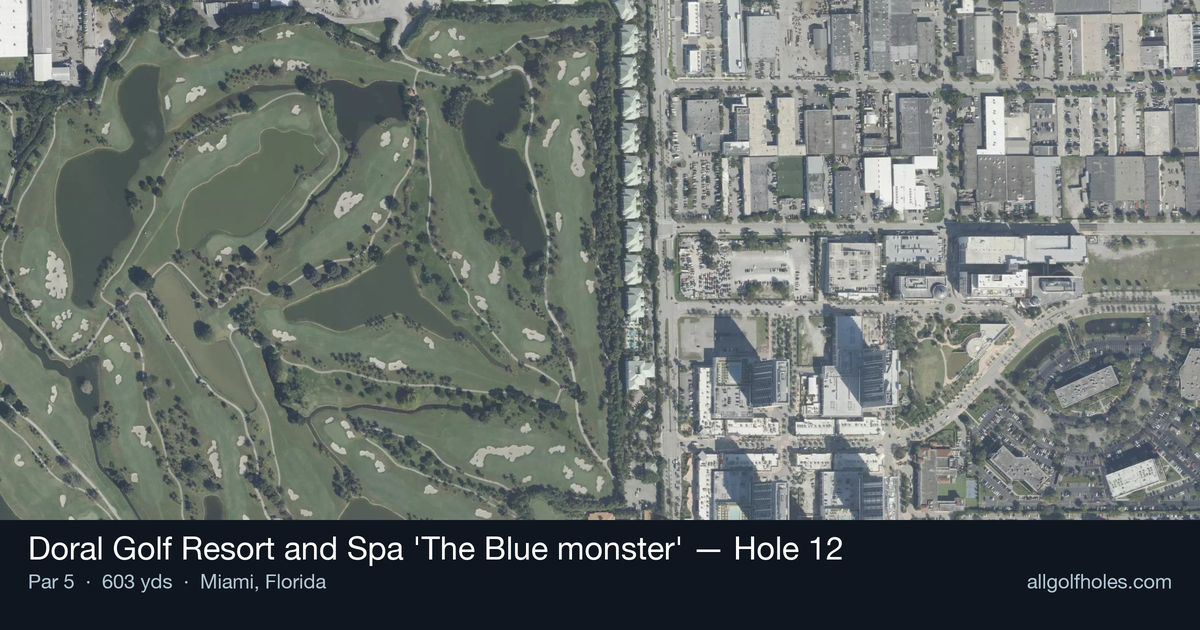
Aerial source not provided
Green size: 30 yds deep × 32 yds wide
Scorecard yardage is for Championship tees. The aerial shows its labeled reference position; distance rings measure to the green.
Championship tees · Par 5 · 603 yards
The plan for No. 12
The 12th hole at Doral Golf Resort and Spa 'The Blue Monster' presents a demanding 603-yard par 5 that epitomizes the strategic complexity this legendary course is known for. This straight but deceptive hole challenges players with its length and precise positioning requirements. The tee shot demands careful navigation, as the generous fairway can be misleading - finding the optimal angle for the approach shot is crucial. With no significant water hazards to intimidate, golfers can focus on distance and accuracy, though the small green complex requires pinpoint precision on the final approach. The hole's straightforward appearance belies its strategic depth, rewarding thoughtful course management over pure power. As players work toward the compact green, they experience the Blue Monster's signature blend of accessibility and challenge that has tested professionals and amateurs alike since 1962.
Off the tee
Your opening shot sets up the entire hole, and club selection should prioritize finding the fairway over maximum distance. Based on historical insights from the Blue Monster, playing a right-to-left shot shape from the tee provides the optimal angle and maximizes the effective landing area. Driver is the obvious choice for most players given the hole's length, but ensure you're committed to your target line down the left-center of the fairway. The palm trees mentioned in tournament descriptions can come into play for wayward drives, so accuracy trumps pure distance here. Focus on a smooth, controlled swing that finds the short grass and leaves you in position for your second shot approach.
Approach & recovery
Your second shot strategy depends heavily on your driving distance and current lie. Longer hitters may attempt to reach the putting surface in two, but the small green makes this a high-risk proposition. Most golfers should treat this as a positioning shot, advancing the ball 150-180 yards to set up an ideal wedge distance for the third shot. Target the center-left portion of the fairway to provide the best angle into the small green. Avoid the temptation to force a long iron or fairway wood if you're between clubs - taking one less club and ensuring solid contact will serve you better than a mishit longer club.
On the green
The small green demands precision on your approach shot and careful speed control with your putter. Without specific hazards protecting the putting surface, the primary challenge becomes hitting and holding this compact target. Focus on getting your approach shot to the correct level of the green, as even small greens can have subtle tiers that affect putting. Once on the green, prioritize getting your first putt close rather than being overly aggressive with longer attempts. The small size means most putts will be relatively straight, but don't underestimate the importance of reading the grain, especially in South Florida conditions. ## RISK VS REWARD The risk/reward decision comes primarily on the second shot. Longer hitters who can carry their second shot 220+ yards may consider going for the green in two, but the small target makes this a low-percentage play. The reward of a potential eagle or easy birdie must be weighed against the risk of missing the green entirely and facing a difficult up-and-down. For most golfers, the smarter play involves laying up to your favorite wedge distance, typically 80-120 yards from the pin. This conservative approach maximizes your chances of hitting the small green and gives you the best opportunity for birdie. ## DIFFERENT SKILL LEVELS **Low Handicappers:** Can be more aggressive with driver off the tee and may consider going for the green in two with favorable conditions. Focus on precise distance control with wedges to attack the small green. Your short game skills make the risk/reward calculation more favorable for aggressive play. **High Handicappers:** Should prioritize keeping the ball in play on all three shots. Use whatever club gives you confidence off the tee, even if it's a 3-wood or hybrid. Lay up to a comfortable wedge distance rather than forcing longer approaches. Accept par as a good score and don't let the par 5 designation pressure you into risky shots. **Mid Handicappers:** Can play aggressively off the tee with driver but should generally lay up on the second shot unless perfectly positioned. Focus on hitting the green in regulation with your third shot rather than trying to get close to difficult pin positions. The 12th hole rewards patience and precision over pure power, making it a true test of complete golf course management on one of America's most respected tournament venues.
Watch for
- Mapped bunkers guard landing areas and greenside recovery lines.
Hole 12 Green Complex
Mapped green boundary
Green size: 5,027 sq ft
How did Hole 12 play?
How did this hole play today?
Frequently asked questions
Yardage reference: Championship tees · 603 yards.
Can this par 5 be reached in two?
↓
At 603 yards, A true three-shot hole for most players. Position your layup to leave a comfortable wedge distance.
How difficult is hole 12?
↓
This hole is a moderate challenge for most golfers. Key challenges include: long par 5, heavily bunkered.
How big is the green on hole 12?
↓
The green is medium-sized with moderate targets. Pay attention to pin placement when selecting your approach club.
What's a good score on hole 12?
↓
This hole is a true three-shot hole where birdie requires execution. This longer par 5 demands patience. Two good shots set up the scoring opportunity.