Hole 5 at TPC San Antonio (Oaks Course)
- Par
- 4
- Yardage
- 342 yds
- Stroke index
- 15
- Hazards
- 5 bunkers
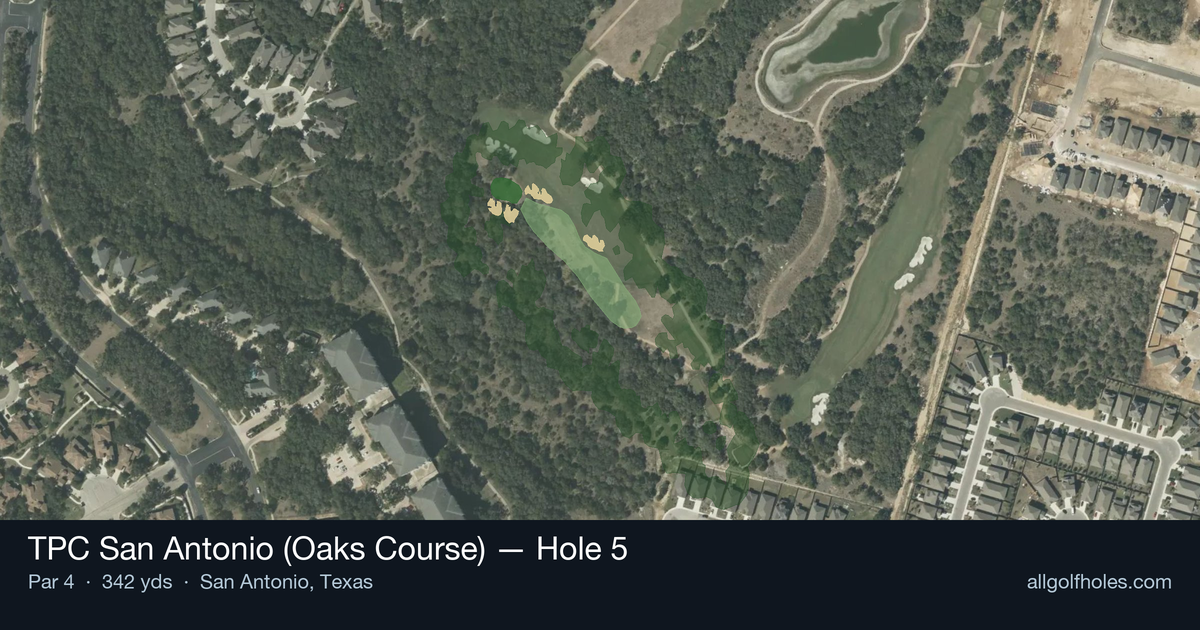
Aerial source not provided
Green size: 31 yds deep × 26 yds wide
Scorecard yardage is for Championship tees. The aerial shows its labeled reference position; distance rings measure to the green.
Championship tees · Par 4 · 342 yards
The plan for No. 5
The fifth hole at TPC San Antonio's Oaks Course presents a deceptively strategic par 4 that rewards precision over power. At 342 yards, this straight-away layout invites aggressive play, but the small green demands careful consideration. With minimal hazards protecting the hole, the primary challenge lies in positioning for the ideal approach angle to the compact putting surface. The generous fairway allows golfers to focus on distance control rather than accuracy off the tee, making this an excellent scoring opportunity for players who can dial in their wedge game. Smart course management and a confident short iron separate good scores from great ones on this seemingly straightforward hole that plays shorter than many expect.
Off the tee
Your tee shot strategy should prioritize setting up the ideal approach distance rather than maximizing distance. Most players will benefit from hitting a controlled driver or strong 3-wood, leaving a comfortable wedge or short iron into the green. The key target line runs down the center of the fairway, giving you the best angle to attack any pin position. For longer hitters, consider throttling back to ensure you don't get too close to the green, which could leave an awkward half-wedge distance. The ideal landing zone sits somewhere between 80-120 yards from the green, depending on your comfort level with different wedges. Avoid the temptation to get overly aggressive off the tee - positioning trumps distance on this hole.
Approach & recovery
The approach shot is where this hole's true challenge reveals itself. That small green demands pinpoint accuracy, especially when the pin is tucked in challenging positions. Your club selection should err on the side of taking enough club to reach the back of the green, as short approaches often find trouble or leave difficult up-and-downs. Focus on the center of the green unless you're feeling particularly confident with your wedge play. The small target means there's little room for error, so commit fully to your yardage and swing with conviction. Wind conditions will play a significant role in club selection, so factor in any breeze when making your decision.
On the green
With a small putting surface, you won't face extremely long putts, but the compact nature means subtle breaks can be deceiving. Take extra time to read the green carefully, as seemingly straight putts often have more movement than expected on smaller greens. Speed control becomes crucial - you can't afford to be overly aggressive with birdie attempts since three-putts are costly on a hole where par should be your worst score. When the pin is near an edge, focus on getting your approach to the fat part of the green to ensure manageable two-putt opportunities. ## RISK VS REWARD The primary risk/reward decision comes off the tee: how aggressive to be with your driver versus laying back for perfect position. Aggressive players might consider trying to drive the green or get very close in favorable conditions, but this strategy requires exceptional accuracy and carries significant penalty if you miss the small target. The more conservative approach of positioning your tee shot for a full wedge offers better control and consistency. This hole rewards patience and precision over power, making the conservative strategy the percentage play for most golfers. ## DIFFERENT SKILL LEVELS **High-Handicap Players:** Focus on finding the fairway with whatever club gives you confidence off the tee. Don't worry about getting too close - a 7 or 8-iron approach is perfectly fine if it means avoiding trouble. Aim for the center of the green regardless of pin position, and take your par happily while staying alert for birdie opportunities. **Low-Handicap Players:** You can be more aggressive with pin hunting, but respect the small green size. Consider the risk/reward of driver versus 3-wood based on your wedge distances and confidence level. This is a hole where your short game skills should shine - take advantage of your precision with wedges to attack pins and convert birdie chances. The key for all skill levels is recognizing this as a clear scoring opportunity while respecting the precision required to capitalize on it.
Watch for
- Course conditioning and mapped hazards may affect line selection; confirm from the aerial.
Hole 5 Green Complex
Mapped green boundary
Green size: 3,808 sq ft
Course coverage
Tournament and creator videos about TPC San Antonio (Oaks Course) — shared course coverage, not hole-specific clips.
Tournament coverage
Valero Texas Open highlights
Valero Texas Open | Final Round Highlights
2025
How did Hole 5 play?
How did this hole play today?
Frequently asked questions
Yardage reference: Championship tees · 342 yards.
What's the best strategy off the tee?
↓
For this 342-yard par 4, most players will hit 3-wood or driver to set up a comfortable approach.
How difficult is hole 5?
↓
This hole is a good scoring opportunity for most golfers. Key challenges include: small green.
How big is the green on hole 5?
↓
The green is small and requires precision. Expect challenging pin positions with limited room for error.
What's a good score on hole 5?
↓
This hole is a birdie opportunity if you find the fairway. This shorter par 4 rewards accuracy off the tee with a short iron approach.