Hole 16 at TPC Craig Ranch
- Par
- 4
- Yardage
- 492 yds
- Stroke index
- 4
- Hazards
- 4 bunkers · Water
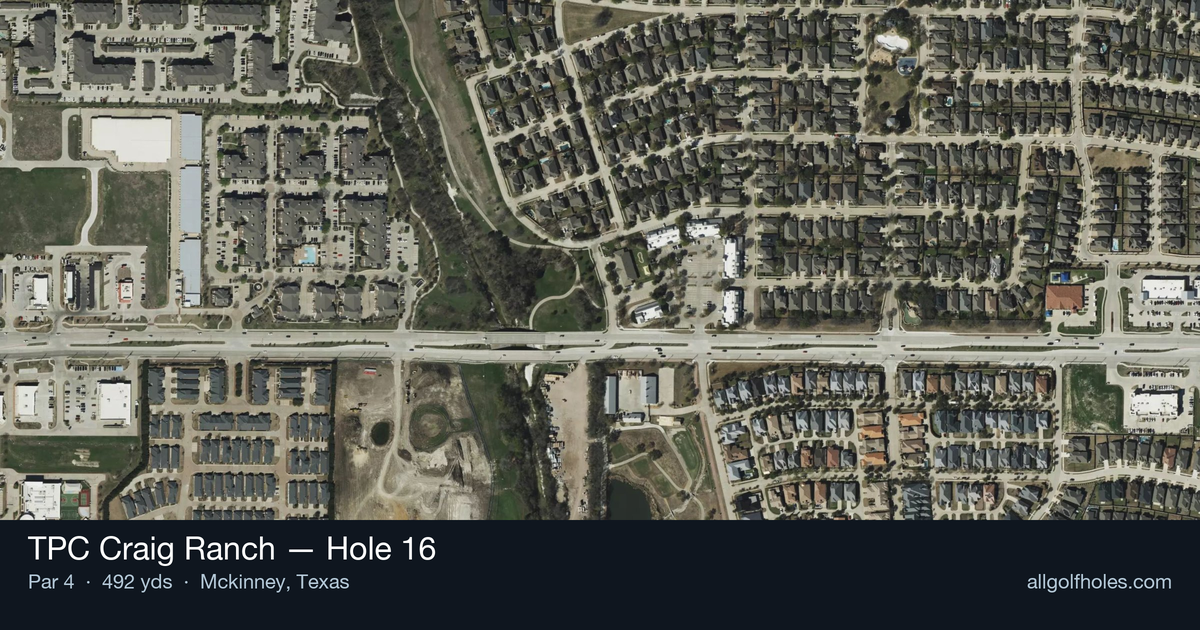
Aerial source not provided
Green size: 34 yds deep × 40 yds wide
Scorecard yardage is for Championship tees. The aerial shows its labeled reference position; distance rings measure to the green.
Championship tees · Par 4 · 492 yards
The plan for No. 16
TPC Craig Ranch hole 16 stands as a formidable test of precision and power, stretching 492 yards through Tom Weiskopf's thoughtful design on the Texas flatlands. This straight par 4 demands a commanding tee shot to establish proper position for the challenging approach to a compact green complex. Strategic fairway bunkers guard the ideal landing area, requiring golfers to thread the needle between sand hazards to gain the best angle of attack. The small green rewards accuracy over aggression, making club selection and approach shot execution critical for scoring opportunities. Despite the relatively flat terrain, Weiskopf's architectural expertise shines through in the hole's strategic elements, creating a memorable challenge that exemplifies why this McKinney layout has earned its reputation among discerning golfers.
Off the tee
Your tee shot strategy should prioritize finding the fairway over maximum distance. Driver is the obvious choice for most players given the hole's length, but accuracy is paramount. Focus on a smooth, controlled swing that finds the short grass and avoids the fairway bunkers that guard the landing area. The target line should favor the side of the fairway that provides the clearest approach angle to the green. Since avoiding fairway bunkers is crucial for attacking this green effectively, study the pin position and plan your drive accordingly. A well-placed tee shot in the fairway, even if it's not your longest drive of the day, sets up a much more manageable second shot than trying to recover from sand.
Approach & recovery
With the small green size, precision becomes critical on your approach shot. Depending on your tee shot placement, you'll likely face a mid-iron to long-iron for your second shot. The key is selecting enough club to carry any front-edge protection while avoiding the tendency to come up short on this lengthy hole. Since the green is small, focus on the center of the putting surface rather than attacking pins. The margin for error is limited, so a conservative approach targeting the heart of the green often yields better results than trying to get too aggressive with pin-seeking shots. Pay attention to wind conditions, as they can significantly affect club selection on this exposed hole.
On the green
The small green demands accurate putting and smart green reading. With limited real estate, most putts will be relatively straight, but don't underestimate the subtle breaks that can affect your roll. Focus on speed control, as running putts past the hole on a small green leaves challenging comeback attempts. When the pin is tucked near edges, lag putting to the center of the green and taking your two-putt par is often the smart play. The small target rewards patience and penalizes aggressive putting that runs too far past the hole. ## RISK VS REWARD The primary risk/reward decision comes with tee shot positioning versus distance. Aggressive drives that challenge fairway bunkers can leave shorter approaches, but the penalty for finding sand significantly complicates your scoring chances. The reward for finding the fairway cleanly is a clear shot at the small green with a mid-iron. On the approach, the risk lies in being too aggressive with pin positions on the small green. The reward for finding the putting surface, even away from the pin, is a legitimate birdie opportunity and almost certain par. ## DIFFERENT SKILL LEVELS **High-Handicap Players:** Focus entirely on finding the fairway with your tee shot, even if it means using a 3-wood or hybrid for better accuracy. From there, aim for the center of the green regardless of pin position. Two-putting for par on this challenging hole is an excellent result. **Low-Handicap Players:** You can be more aggressive off the tee with driver, but still respect the fairway bunkers. On approach shots, you have the skill to attack certain pin positions, but evaluate each situation carefully given the small green size. This hole offers a legitimate birdie opportunity with two quality shots. The 16th hole rewards patient, strategic golf over raw power, making it a true test of course management skills in Weiskopf's design.
Watch for
- Course conditioning and mapped hazards may affect line selection; confirm from the aerial.
Hole 16 Green Complex
Mapped green boundary
Green size: 6,486 sq ft
Course coverage
Tournament and creator videos about TPC Craig Ranch — shared course coverage, not hole-specific clips.
Tournament coverage
CJ CUP Byron Nelson highlights
THE CJ CUP Byron Nelson | Final Round Highlights
2025
Featured by these creators
Creator videos about this course
YouTube creators who filmed or featured TPC Craig Ranch. · Stats as of Oct 12, 2026 · 5d ago
A new-look TPC Craig Ranch, LIV’s cost cutting, & U.S. Open qualifying starts | The Shotgun Start
How did Hole 16 play?
How did this hole play today?
Frequently asked questions
Yardage reference: Championship tees · 492 yards.
What's the best strategy off the tee?
↓
For this 492-yard par 4, most players will hit driver to set up a comfortable approach.
How difficult is hole 16?
↓
This hole is one of the tougher holes on the course for most golfers. Key challenges include: long par 4, water in play, heavily bunkered.
How big is the green on hole 16?
↓
The green is fairly large with multiple pin positions. Lag putting becomes important on longer putts.
What's a good score on hole 16?
↓
This hole is one of the tougher holes where par feels like birdie. A challenging par 4. Accept that bogey happens and avoid big numbers.