Hole 14 at TPC Craig Ranch
- Par
- 4
- Yardage
- 330 yds
- Stroke index
- 18
- Hazards
- 8 bunkers · Water
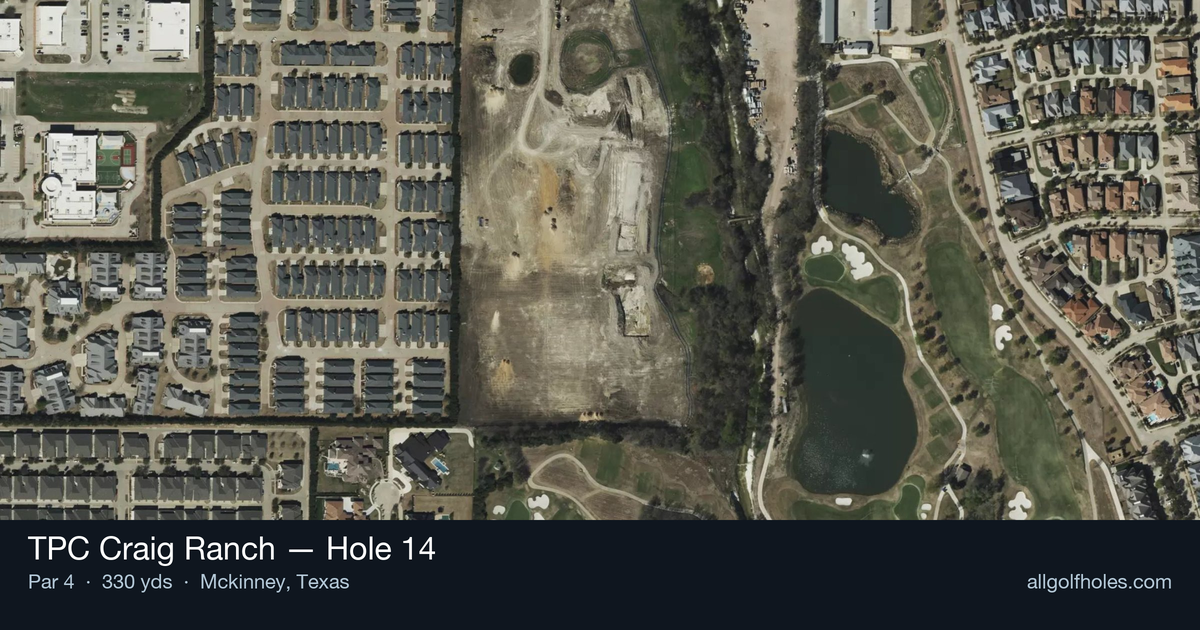
Aerial source not provided
Green size: 27 yds deep × 41 yds wide
Scorecard yardage is for Championship tees. The aerial shows its labeled reference position; distance rings measure to the green.
Championship tees · Par 4 · 330 yards
The plan for No. 14
TPC Craig Ranch hole 14 epitomizes Tom Weiskopf's genius for crafting tempting risk-reward opportunities. This drivable par 4 at 330 yards presents an immediate strategic dilemma, with the prevailing downwind conditions making the green tantalizingly reachable for aggressive players. The key lies in avoiding the strategically-placed fairway bunkers that guard the ideal driving line - clear these hazards and the small green becomes a legitimate target. Conservative players can lay up with a mid-iron, leaving a comfortable wedge approach shot to the compact putting surface. The hole's deceptively simple appearance masks the precision required to score well, as the small green demands accuracy whether attacking from the tee or approaching with a short iron. This signature hole perfectly captures the risk-reward philosophy that defines championship golf.
Off the tee
The tee shot presents two distinct strategies. Aggressive players with sufficient length can attempt to drive the green, particularly with the helping wind that typically favors this hole. However, the small target requires exceptional accuracy and carries significant risk if missed. The conservative approach involves laying up to an ideal wedge distance, avoiding the fairway bunkers that guard the landing zone around the 250-yard mark. A 3-wood or long iron aimed at the center of the fairway provides the safest route, leaving a comfortable short iron approach. The key is avoiding the fairway bunkers mentioned in course notes, as these complicate any subsequent attack on the green.
Approach & recovery
For players laying up, the approach shot becomes a prime scoring opportunity. With typical yardages in the 80-100 yard range, this represents one of the best birdie chances on the course. The small green demands precise distance control and proper spin to hold the putting surface. Aim for the center of the green unless the pin position clearly favors one side. The downwind conditions that help the tee shot can make the approach tricky, as balls may release more than expected upon landing. Club selection should account for this extra roll and the firm conditions typical of tournament-quality greens.
On the green
The small green at the 14th requires careful attention to speed control and break reading. With limited real estate, approach putts from off the green become particularly challenging, making accuracy on the approach shot even more critical. Focus on getting your first putt close rather than being overly aggressive, as three-putts can quickly turn a birdie opportunity into bogey. The green's size means that most putts will be relatively straight, but pay attention to any subtle slopes that could affect longer putts. ## RISK VS REWARD This hole perfectly embodies risk/reward strategy. Going for the green offers eagle potential but carries significant penalty risk if missed. The safer lay-up approach virtually guarantees a birdie look from close range. Consider your current round situation, confidence level, and pin position when making this decision. In medal play, the conservative approach often proves superior, while match play situations might call for more aggressive tactics. The downwind conditions increase the viability of going for it, but also amplify the consequences of a miss. ## DIFFERENT SKILL LEVELS **High Handicappers:** Always lay up with a comfortable club, focusing on finding the fairway and avoiding the bunkers. This strategy maximizes your chances of making par while keeping big numbers off the scorecard. A successful wedge approach can still yield birdie opportunities. **Low Handicappers:** Evaluate conditions and your current form before deciding whether to attack. If driving the ball well and feeling confident, the green is certainly reachable. However, don't let ego override smart course management – sometimes the lay-up is the correct play even for skilled players. **Tour Professionals:** As evidenced during PGA Tour events here, even professionals often choose the conservative approach, recognizing that a guaranteed birdie look from wedge range often outweighs the risk of missing the green entirely. The 14th hole rewards thoughtful strategy over pure aggression, making it a true test of golf course management skills regardless of your handicap level.
Watch for
- Course conditioning and mapped hazards may affect line selection; confirm from the aerial.
Hole 14 Green Complex
Mapped green boundary
Green size: 5,418 sq ft
Course coverage
Tournament and creator videos about TPC Craig Ranch — shared course coverage, not hole-specific clips.
Tournament coverage
CJ CUP Byron Nelson highlights
THE CJ CUP Byron Nelson | Final Round Highlights
2025
Featured by these creators
Creator videos about this course
YouTube creators who filmed or featured TPC Craig Ranch. · Stats as of Oct 12, 2026 · 5d ago
A new-look TPC Craig Ranch, LIV’s cost cutting, & U.S. Open qualifying starts | The Shotgun Start
How did Hole 14 play?
How did this hole play today?
Frequently asked questions
Yardage reference: Championship tees · 330 yards.
What's the best strategy off the tee?
↓
For this 330-yard par 4, most players will hit 3-wood or driver to set up a comfortable approach.
How difficult is hole 14?
↓
This hole is a moderate challenge for most golfers. Key challenges include: water in play, heavily bunkered.
How big is the green on hole 14?
↓
The green is medium-sized with moderate targets. The green is deeper than wide, so club selection is crucial. Pay attention to pin placement when selecting your approach club.
What's a good score on hole 14?
↓
This hole is a birdie opportunity if you find the fairway. This shorter par 4 rewards accuracy off the tee with a short iron approach.