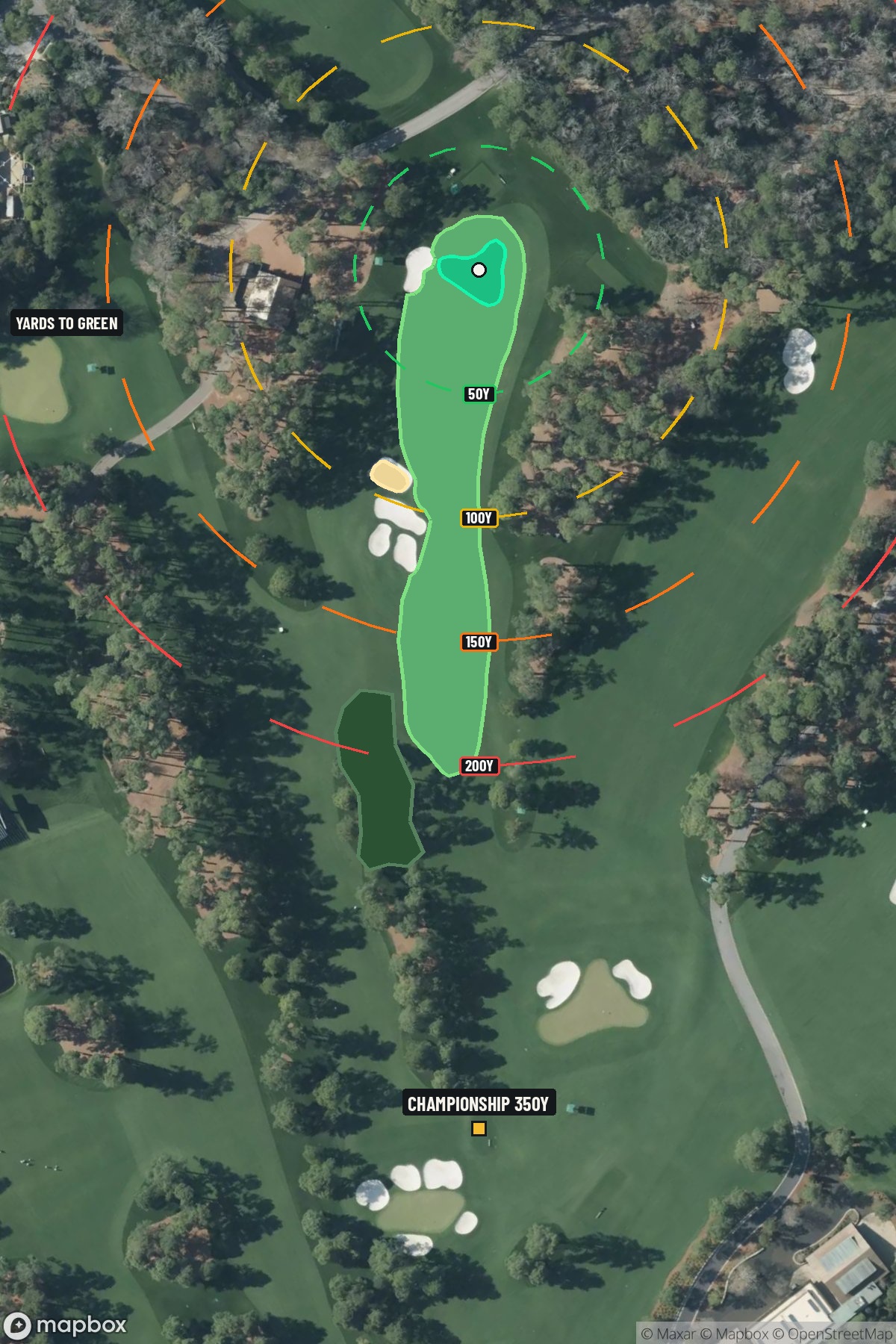
Hole 3 of 18 · Augusta, Georgia

Hole 3 at Augusta National Golf Club

Par
4
Yards
350
Bunkers
5
Hole 3 aerial at Augusta National Golf Club
Map distances from Championship tee · 350 yds

The map's printed distances are measured from the Championship tee to the green; they do not move when you change tees.

Green size: 28 yds deep × 28 yds wide

Mapbox Satellite composite · capture date not provided. Green at the top.

Where this map comes from

Satellite photo
Date not published
Mapbox satellite
Green contours
2018–2019 survey
USGS lidar survey
Report a map problem
100%
Hole 3 aerial at Augusta National Golf Club

The plan for No. 3

The play: Known as "Flowering Peach," Augusta National Golf Club hole 3 presents a deceptively challenging par 4 at 350 yards that demands precision over power. This seemingly short hole features a narrowing fairway that tightens significantly in the landing area, forcing players to carefully consider their tee shot strategy. Many professionals opt for 3-wood or long iron to ensure finding the fairway, as accuracy trumps distance on this Masters venue. The elevated small green creates a premium on approach shot control, with the back-right pin position particularly treacherous due to severe slopes that can send errant shots tumbling away from the hole. What appears straightforward from the tee becomes a true test of course management and short-iron precision, epitomizing Augusta National's ability to challenge even the world's best players on shorter holes.

Shot by shot

  1. Off the tee

    The tee shot strategy revolves around finding the optimal angle for your approach while avoiding the trouble that lurks with overly aggressive play. Professional insights suggest aiming at the trees on the right side and playing a controlled fade, which provides the best angle into the green. When playing downwind, many experienced players opt for a 3-wood instead of driver due to the fairway's narrowing characteristics. The target line should favor accuracy over distance - positioning yourself in the prime landing zone around 250-280 yards from the tee provides the ideal approach angle. Avoid the temptation to bomb driver, as the narrowing fairway can quickly turn an aggressive tee shot into trouble.

  2. Approach & recovery

    From a well-positioned drive, this hole transforms into a genuine birdie opportunity with a short-iron in hand. The approach shot is all about precision to the small green, with particular attention to pin position. The back-right pin location is notoriously difficult, as shots pulled left will catch the slope and roll away, leaving a challenging uphill chip back to the hole. Club selection should be conservative - take enough club to ensure you reach the putting surface, as coming up short leaves difficult recovery shots. The green's small size means there's little margin for error, making target line selection crucial based on the day's pin position.

  3. On the green

    Augusta National's greens are famous for their subtle breaks and lightning-fast speeds, and the third green is no exception. The small putting surface features slopes that can dramatically affect ball roll, particularly around the edges. When the pin is tucked in challenging positions like back-right, focus on getting the ball below the hole to ensure an uphill putt. Reading the green correctly is essential - even seemingly straight putts can have subtle breaks that catch players off guard. The key is committing to your read and maintaining smooth tempo through impact. ## RISK VS REWARD The primary risk/reward decision comes with tee shot aggression. While the hole's short length tempts players to attack with driver, the narrowing fairway punishes overly aggressive play. The reward for finding the fairway is significant - a short-iron approach to a birdie opportunity. The conservative play is 3-wood or long iron off the tee, ensuring fairway position but potentially leaving a longer approach. The aggressive play is driver, seeking maximum distance but risking trouble if the shot isn't perfectly executed. ## DIFFERENT SKILL LEVELS **High-Handicap Players:** Focus entirely on course management. Use 3-wood or hybrid off the tee to ensure fairway position, then play conservatively to the center of the green regardless of pin position. Par is an excellent score here - don't let the short yardage fool you into overly aggressive play. **Low-Handicap Players:** Can be more aggressive with driver when conditions allow, but must still respect the narrowing fairway. These players can attack specific pin positions and should view this as a birdie opportunity when properly positioned. The key is avoiding the mental trap of assuming this "short" par 4 should be easy. **Course Management Tip:** Regardless of skill level, always factor wind direction into your club selection strategy. Downwind conditions particularly affect both tee shot distance control and approach shot precision, making conservative club choices even more important.

  4. Watch for

    • Course conditioning and mapped hazards may affect line selection; confirm from the aerial.

The green on No. 3

Mapped boundary
Wide × deepyards
28×28
Areasq ft
3,472

Gear for Hole 3

We may earn a commission when you buy through these links.

Course coverage

Tournament and creator videos about Augusta National Golf Club — shared course coverage, not hole-specific clips.

Featured by these creators

Creator videos about this course

YouTube creators who filmed or featured Augusta National Golf Club. · Stats as of Nov 16, 2026 · 3d ago

Explore golf creators →

How to Play Augusta National at Home! ⛳️ #golf #golfsimulator #augustanational

Strapped: Augusta National

No Laying Up31K views

Jim "Bones" Mackay Goes In-Depth on Augusta National | Lunch With The Boys

Template Holes at Augusta National? | Designing Golf

The Original Augusta National (feat. Brian Schneider) | Designing Golf

Bernhard Langer on Augusta National, the “Big Five,” & His Life in Golf | The Fried Egg Golf Podcast

Will Zalatoris Talks Injury Comeback, Augusta National, & Much More | The Fried Egg Golf Podcast

I Play Golf at the FAKE Augusta National! (Wow!)

Rick Shiels Golf642K views

Playing Augusta National & Three Courses Brian Schneider Thinks About | The Fried Egg Golf Podcast

Golfer feedback

How did Hole 3 play?

⚡ Quick Golfer Pulse

How did this hole play today?

1-tap anonymous vote

Frequently asked questions

Yardage reference: Championship tees · 350 yards.

Why is hole 3 called 'Flowering Peach'?

↓

Hole 3 at Augusta National is called "Flowering Peach" as part of Augusta's tradition of naming each hole after the flowering trees and plants that bloom on the course during Masters week in April. The name reflects the beautiful peach trees that frame this short par-4, contributing to Augusta's reputation as one of the most botanically stunning golf courses in the world.

What's the best strategy off the tee?

↓

For this 350-yard par 4, most players will hit 3-wood or driver to set up a comfortable approach.

How difficult is hole 3?

↓

This hole is a moderate challenge for most golfers. Key challenges include: heavily bunkered, small green.

How big is the green on hole 3?

↓

The green is small and requires precision. Expect challenging pin positions with limited room for error.

What's a good score on hole 3?

↓

This hole is a medium-length test where par is a solid result. A straightforward par 4 where course management pays off.