Hole 6 at TPC Sawgrass (Dye Valley)
- Par
- 4
- Yardage
- 445 yds
- Stroke index
- 1
- Hazards
- 3 bunkers · Water
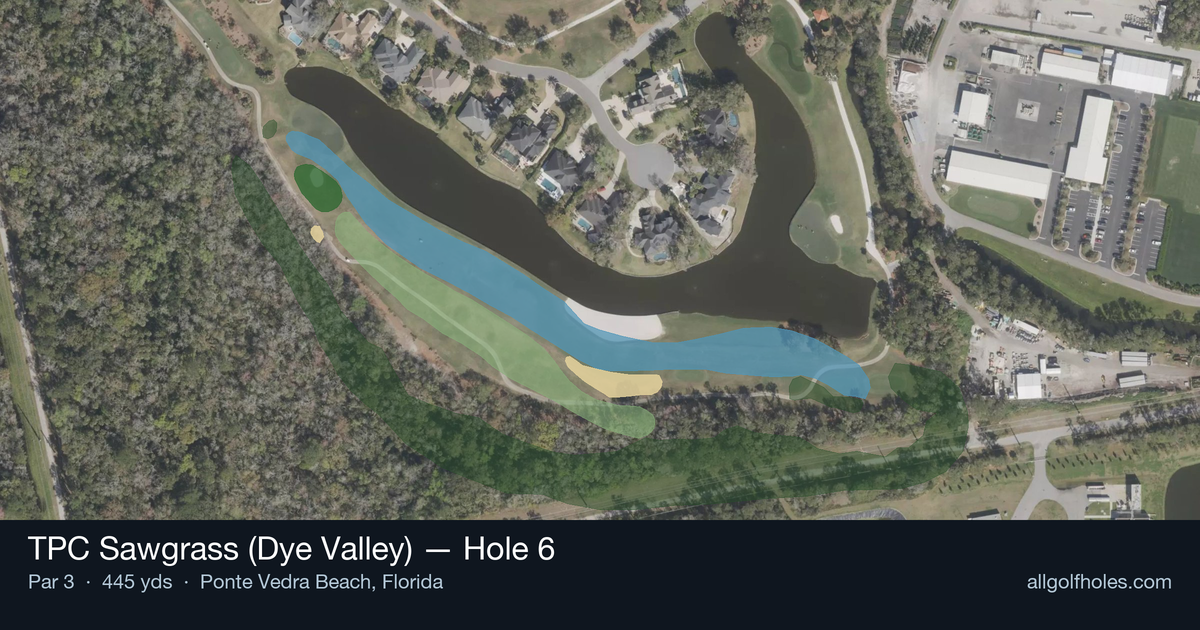
Aerial source not provided
Green size: 39 yds deep × 28 yds wide
Scorecard yardage is for Championship tees. The aerial shows its labeled reference position; distance rings measure to the green.
Championship tees · Par 4 · 445 yards
The plan for No. 6
TPC at Sawgrass hole 6 presents an unusual and demanding challenge as one of golf's longest par 3s at 445 yards. This monster one-shotter requires nothing short of a driver or fairway wood for most players, transforming the traditional par 3 strategy into something resembling a short par 4. The small green becomes an incredibly difficult target from such distance, demanding both power and precision that few golfers can consistently deliver. With the hole's #1 handicap rating, even tour professionals struggle to find the putting surface in regulation. The absence of major hazards might seem forgiving, but the sheer length and diminutive target create their own intimidation factor, making this hole a true test of ball-striking ability and course management at the Players Championship venue.
Off the tee
The tee shot is essentially an approach shot to a small target from an extreme distance. Most amateur golfers will need driver or 3-wood to reach this green, while stronger players might get there with a long iron or hybrid. The key is committing fully to your club selection and swing - any tentative move will leave you short. Aim for the center of the green regardless of pin position, as the small target makes pin-hunting extremely risky. Take one extra club and make a smooth, controlled swing rather than forcing a shot you're not comfortable with.
Approach & recovery
Since this is a par 3, your tee shot IS your approach shot. The small green demands pinpoint accuracy, so focus on solid contact and proper trajectory rather than trying to overpower the hole. Wind conditions play a crucial role here - factor in any crosswinds or headwinds when making your club selection. If you're between clubs, always take the longer option and make a controlled swing. The green's small size means you need to land the ball softly, so ensure you're taking enough club to clear any trouble and still land with a descending blow.
On the green
The small green at this hole makes two-putting a victory in itself. Focus on getting your first putt close rather than being aggressive toward the hole. The green's size means most putts will be relatively straight, but pace becomes critical on the smaller surface. Leave yourself below the hole whenever possible, as uphill putts are always easier to judge. If you do find the green in regulation, take your par and move on - this hole yields very few birdies even among professionals. ## RISK VS REWARD This hole offers little in terms of traditional risk/reward options due to its demanding length and small target. The primary decision is club selection - playing it safe with a shorter club almost guarantees you won't reach the green, while being aggressive with your longest club gives you the best chance at par. The reward for finding this green in regulation is significant, as it's one of the toughest pars on the course. Missing the green makes par very difficult, so the risk of being aggressive is substantial. ## DIFFERENT SKILL LEVELS **High-Handicap Players:** Accept that this hole will likely play as a par 4 for you. Focus on getting as close to the green as possible with your tee shot, then pitch on and try to two-putt for bogey. Don't be discouraged if you make double bogey - this hole challenges even tour professionals. Use your longest club confidently and aim for the center of the green. **Low-Handicap Players:** This hole demands your best long iron or fairway wood execution. Study the wind conditions carefully and commit to your club selection. Aim for the center of the green regardless of pin position - the small target makes precision more important than pin-hunting. A par here is a significant accomplishment and often gains strokes on the field. Practice your long iron accuracy extensively if you plan to play this course, as this hole will test that skill more than almost any other par 3 in golf.
Watch for
- Course conditioning and mapped hazards may affect line selection; confirm from the aerial.
Hole 6 Green Complex
Mapped green boundary
Green size: 5,155 sq ft
Course coverage
Tournament and creator videos about TPC Sawgrass (Dye Valley) — shared course coverage, not hole-specific clips.
Tournament coverage
The Players Championship highlights
THE PLAYERS Championship | Final Round Highlights
2025
Featured by these creators
Creator videos about this course
YouTube creators who filmed or featured TPC Sawgrass (Dye Valley). · Stats as of Oct 12, 2026 · 6d ago
Can We Make Major Cut @ TPC Sawgrass? (Players Edition)
Charlie Woods Mic'd Up 9-Hole Practice Round at TPC Sawgrass
Grant Horvat Vs Garrett Clark @ TPC Sawgrass
The Major Cut @ TPC Sawgrass (Players Edition)
All Pro Tournament @ TPC Sawgrass
The Bob Does Sports Major At TPC Sawgrass
How did Hole 6 play?
How did this hole play today?
Frequently asked questions
Yardage reference: Championship tees · 445 yards.
What hazards should I watch out for on hole 6?
↓
Key hazards include: water at 257.7 yards. Plan your shots to avoid these trouble spots.
How big is the green on hole 6?
↓
The green is medium-sized with moderate targets. Pay attention to pin placement when selecting your approach club.