Hole 18 at TPC Sawgrass (Dye Valley)
- Par
- 4
- Yardage
- 400 yds
- Stroke index
- 1
- Hazards
- 3 bunkers · Water
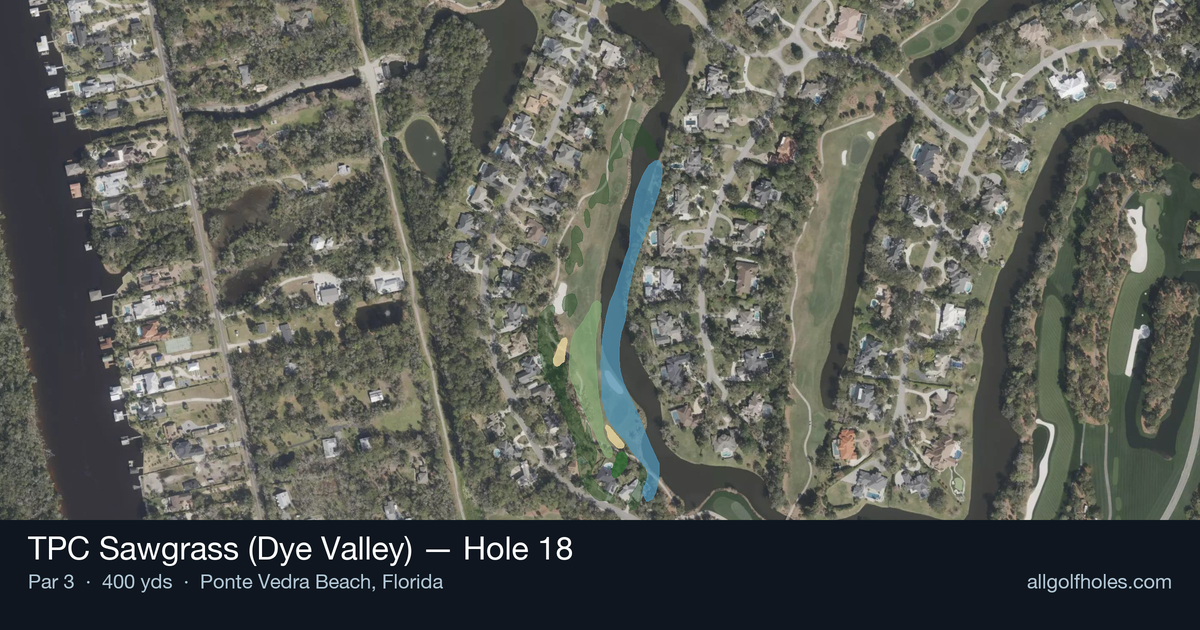
Aerial source not provided
Green size: 35 yds deep × 20 yds wide
Scorecard yardage is for Championship tees. The aerial shows its labeled reference position; distance rings measure to the green.
Championship tees · Par 4 · 400 yards
The plan for No. 18
The finishing hole at TPC at Sawgrass presents an unusual and demanding challenge as a 400-yard par 3, making it one of the longest par 3s in professional golf. This monster one-shotter requires golfers to navigate the entire length with precision, as the small green demands pinpoint accuracy from what amounts to a driver or fairway wood for most players. The straight layout offers no reprieve, forcing players to commit fully to their club selection and target line. With its designation as the number one handicap hole, this par 3 tests every aspect of a golfer's long iron game under the pressure of closing out their round at one of golf's most prestigious venues, where careers have been made and broken.
Off the tee
The tee shot is essentially an approach shot from an extreme distance, requiring your longest accurate club. Most golfers will need a fairway wood, hybrid, or long iron depending on conditions and personal distance capabilities. The target line should favor the center of the green, as the small putting surface provides minimal margin for error on either side. Focus on smooth tempo and solid contact rather than trying to muscle the shot. In crosswinds, aim for the fat part of the green and let the wind work the ball toward the pin. Many professionals play conservatively here, aiming for the center regardless of pin position, understanding that two-putting from anywhere on the green represents a successful outcome.
Approach & recovery
Since this is a par 3, the tee shot serves as your approach. The key is accepting that this hole rewards precision over aggression. With the green's small size, landing the ball on the putting surface should be the primary objective. Short shots that stay below the hole are preferable to long shots that run off the back. Consider the wind direction carefully - the coastal location means conditions can change throughout the round. A shot that seems perfect in calm conditions might come up drastically short in a headwind or sail long with assistance from behind.
On the green
The small green means that most putts will be relatively makeable if you've successfully found the putting surface. Focus on lag putting to ensure you don't three-putt what should be a satisfying par. Speed control is crucial, as running putts off this small green would be particularly deflating on the finishing hole. Pin positions in the corners or edges of the green should generally be ignored in favor of the safer center target, especially in tournament situations where protecting your score is paramount. ## RISK VS REWARD The primary risk/reward decision involves club selection and target selection. The reward for aggressive pin-hunting is minimal compared to the severe penalty for missing the green entirely. The conservative play - aiming for the center of the green regardless of pin position - typically offers the best risk/reward ratio. Some players might consider laying up short of the green if conditions are particularly difficult, accepting a pitch-and-putt scenario rather than risking a big number on the final hole. ## DIFFERENT SKILL LEVELS **High-Handicap Players:** Focus entirely on making solid contact with whatever club gets you closest to 400 yards. Don't worry about pin position - aim for the biggest part of the green. Consider laying up if you're not confident in your long club accuracy, as a bogey beats a double or triple bogey on the final hole. **Low-Handicap Players:** While you have the skill to be more precise, resist the temptation to get too aggressive with pin positions. The hole's reputation as a card-wrecker comes from good players trying to be too perfect. Play for the center of the green and trust your putting to convert birdie opportunities when they arise. This finishing hole exemplifies championship golf design - it's fair but demanding, rewarding good swings while severely punishing poor execution. The key to success is respecting the hole's difficulty and playing within your abilities when the pressure is at its highest.
Watch for
- Course conditioning and mapped hazards may affect line selection; confirm from the aerial.
Hole 18 Green Complex
Mapped green boundary
Green size: 3,258 sq ft
Course coverage
Tournament and creator videos about TPC Sawgrass (Dye Valley) — shared course coverage, not hole-specific clips.
Tournament coverage
The Players Championship highlights
THE PLAYERS Championship | Final Round Highlights
2025
Featured by these creators
Creator videos about this course
YouTube creators who filmed or featured TPC Sawgrass (Dye Valley). · Stats as of Oct 12, 2026 · 6d ago
Can We Make Major Cut @ TPC Sawgrass? (Players Edition)
Charlie Woods Mic'd Up 9-Hole Practice Round at TPC Sawgrass
Grant Horvat Vs Garrett Clark @ TPC Sawgrass
The Major Cut @ TPC Sawgrass (Players Edition)
All Pro Tournament @ TPC Sawgrass
The Bob Does Sports Major At TPC Sawgrass
How did Hole 18 play?
How did this hole play today?
Frequently asked questions
Yardage reference: Championship tees · 400 yards.
What hazards should I watch out for on hole 18?
↓
Key hazards include: water at 245.7 yards. Plan your shots to avoid these trouble spots.
How big is the green on hole 18?
↓
The green is small and requires precision. The green is deeper than wide, so club selection is crucial. Expect challenging pin positions with limited room for error.