Hole 3 at TPC Sawgrass (Dye Valley)
- Par
- 4
- Yardage
- 352 yds
- Stroke index
- 1
- Hazards
- 8 bunkers · Water
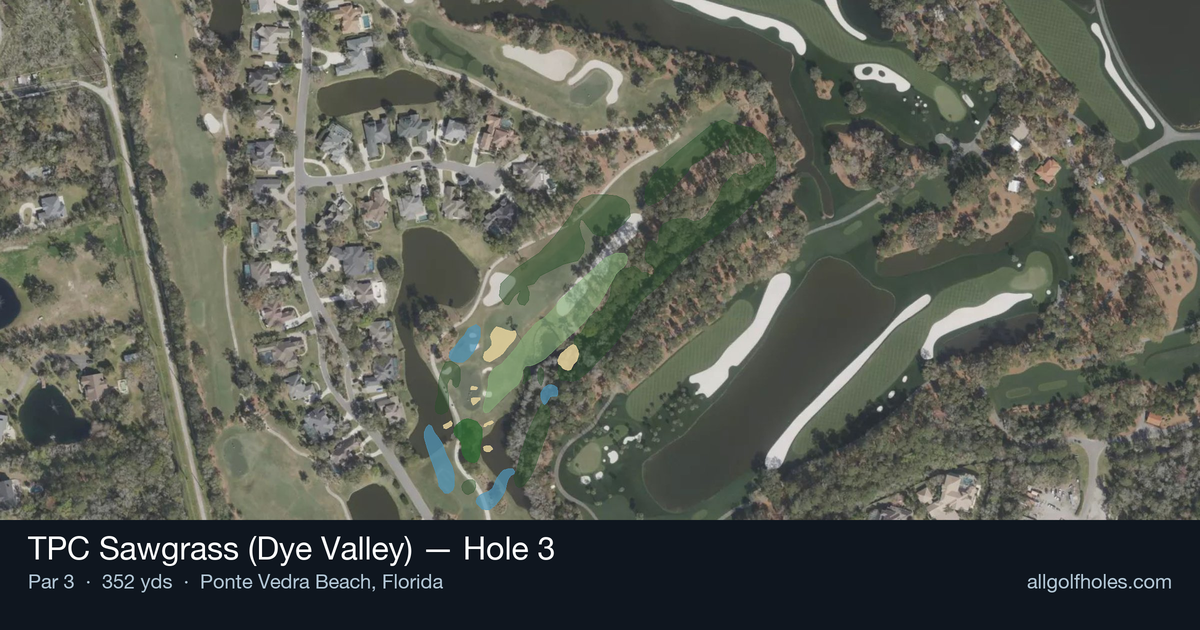
Aerial source not provided
Green size: 32 yds deep × 37 yds wide
Scorecard yardage is for Championship tees. The aerial shows its labeled reference position; distance rings measure to the green.
Championship tees · Par 4 · 352 yards
The plan for No. 3
The longest par 3 at TPC at Sawgrass, hole 3 stretches an imposing 352 yards and earns its #1 handicap rating through sheer length and precision demands. This beast of a one-shotter requires golfers to unleash their longest iron or fairway wood while maintaining pinpoint accuracy to find the small, well-guarded green complex. The expansive tee shot plays longer than the yardage suggests, especially when Florida's coastal winds swirl through the Stadium Course layout. With minimal room for error around the putting surface, even Tour professionals treat this hole with respect during THE PLAYERS Championship. Success here demands both power and placement, making it one of the most challenging opening holes in professional golf.
Off the tee
Club selection is paramount on this extended par 3. Most golfers will need a driver or 3-wood to reach the green, making accuracy challenging with longer clubs. Focus on smooth tempo rather than maximum power - a controlled swing with a fairway wood often proves more effective than an aggressive driver. Target the center of the green regardless of pin position, as the small putting surface leaves little margin for error. In windy conditions, take extra club and swing easier to maintain control. Consider the firmness of the green when selecting your club - a soft green allows for more aggressive play, while firm conditions may require landing short and running the ball on.
Approach & recovery
Since this is a par 3, your tee shot IS your approach. The small green demands pinpoint accuracy, making it crucial to commit fully to your club selection and target line. Avoid the temptation to aim directly at tucked pins - the center of the green provides the best angle for any subsequent recovery shots. Pay close attention to wind conditions, as the long carry amplifies any breeze effects. A slight headwind can turn a well-struck shot into a front-edge landing, while a tailwind might carry your ball through the green. Factor in elevation changes and green firmness when making your final club decision.
On the green
The small green size means you're likely facing lengthy putts even from the center. Focus on lag putting to ensure two-putts, as three-putting from long range can quickly turn a good tee shot into a disappointing score. Study the green's subtle breaks during your approach - with limited green space, even small slopes become significant. Most pins will create challenging angles, so prioritize getting your first putt close rather than being aggressive toward the hole. ## RISK VS REWARD The primary risk/reward decision centers on club selection and aggression level. Playing aggressively toward pins offers birdie opportunities but significantly increases the chance of missing the green entirely. The conservative play - aiming for the green's center regardless of pin position - maximizes par chances while minimizing disaster. Consider your overall round situation: if you need birdies, you might justify more aggressive pin-seeking, but in most cases, the small margin for error makes center-green the smart target. ## DIFFERENT SKILL LEVELS **High-Handicap Players:** Focus entirely on finding the green with whatever club gives you the best chance of solid contact. Don't worry about pin positions - the center of the green is always your target. Consider playing to the front edge if you're unsure about carrying the full distance, as a long putt beats a missed green. **Low-Handicap Players:** You have the skill to work the ball and attack certain pin positions, but respect this hole's difficulty. Even tour professionals treat this as a center-green target most of the time. Your superior distance control allows for more precise club selection, but maintain conservative targets unless the situation demands aggression. The length and small target make this hole a true test of golf strategy and execution for players of all abilities.
Watch for
- Course conditioning and mapped hazards may affect line selection; confirm from the aerial.
Hole 3 Green Complex
Mapped green boundary
Green size: 5,246 sq ft
Course coverage
Tournament and creator videos about TPC Sawgrass (Dye Valley) — shared course coverage, not hole-specific clips.
Tournament coverage
The Players Championship highlights
THE PLAYERS Championship | Final Round Highlights
2025
Featured by these creators
Creator videos about this course
YouTube creators who filmed or featured TPC Sawgrass (Dye Valley). · Stats as of Oct 12, 2026 · 6d ago
Can We Make Major Cut @ TPC Sawgrass? (Players Edition)
Charlie Woods Mic'd Up 9-Hole Practice Round at TPC Sawgrass
Grant Horvat Vs Garrett Clark @ TPC Sawgrass
The Major Cut @ TPC Sawgrass (Players Edition)
All Pro Tournament @ TPC Sawgrass
The Bob Does Sports Major At TPC Sawgrass
How did Hole 3 play?
How did this hole play today?
Frequently asked questions
Yardage reference: Championship tees · 352 yards.
What hazards should I watch out for on hole 3?
↓
Key hazards include: water at 269.8 yards. Plan your shots to avoid these trouble spots.
How big is the green on hole 3?
↓
The green is medium-sized with moderate targets. The green is deeper than wide, so club selection is crucial. Pay attention to pin placement when selecting your approach club.