Hole 17 at Wilshire Country Club
- Par
- 4
- Yardage
- 365 yds
- Stroke index
- 10
- Hazards
- 11 bunkers
Aerial source not provided
Green size: 26 yds deep × 32 yds wide
Scorecard yardage is for Pro tees. The aerial shows its labeled reference position; distance rings measure to the green.
Pro tees · Par 4 · 365 yards
The plan for No. 17
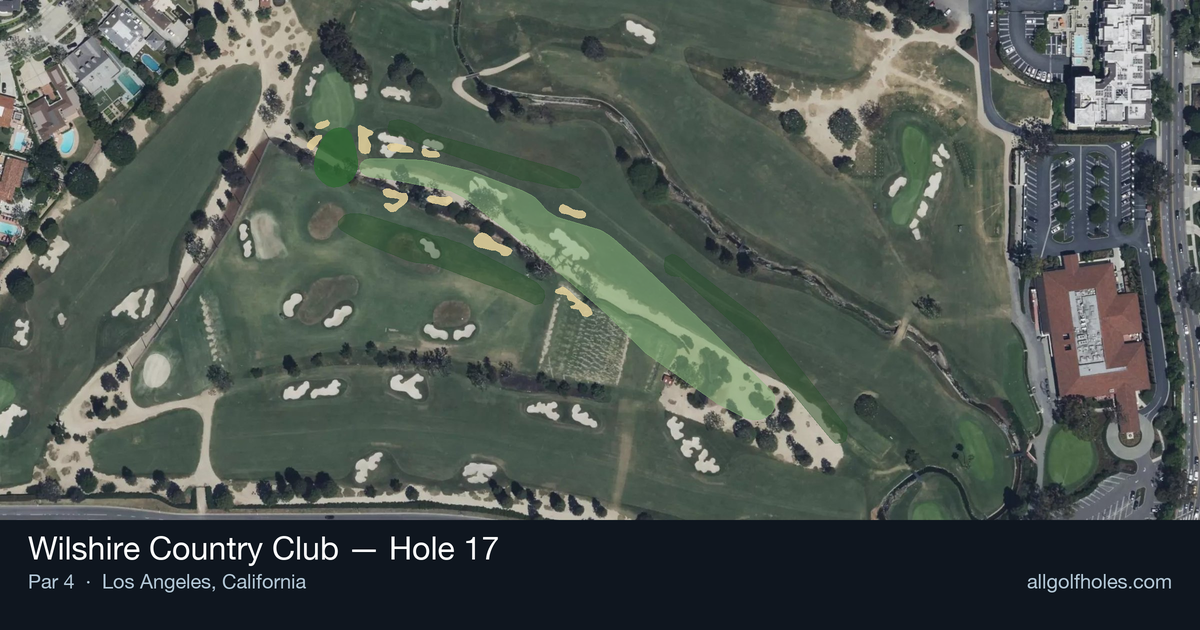
The 17th hole at Wilshire Country Club presents a deceptively strategic par 4 that demands both precision and course management from the elevated tee. At 365 yards, this straight-away hole appears straightforward, but the small green complex serves as the ultimate test of approach shot accuracy. The generous fairway invites an aggressive tee shot, yet players must carefully consider their angle into the compact putting surface. Without significant hazards to navigate, success hinges entirely on executing two quality shots under pressure. The intimate green rewards precise iron play while punishing anything less than committed swings. This classic design exemplifies how strategic architecture can create memorable challenges through simplicity rather than complexity.
Off the tee
The key decision off the tee revolves around positioning rather than power. Most players should focus on placing their drive in the optimal approach zone, typically leaving themselves with a comfortable mid-iron to short-iron into the green. Driver isn't automatically the right play - consider hitting 3-wood or hybrid to ensure you're in the perfect position for your approach shot. Target the center-right portion of the fairway to open up the best angle to the small green. Without significant hazards to navigate, your primary concern is distance control and avoiding any rough that might complicate your approach shot. The straight layout rewards accuracy over aggression.
Approach & recovery
The small green is this hole's primary defense and demands your full attention. Club selection becomes critical - it's better to be slightly long than short, as small greens typically offer more forgiveness beyond the pin than in front of it. Take one extra club and make a smooth swing rather than forcing a shorter iron. Focus on the center of the green regardless of pin position. With limited real estate to work with, going flag-hunting can lead to missed greens and difficult up-and-downs. A 20-foot putt from the center beats a challenging chip shot from the fringe every time.
On the green
Small greens typically feature subtle breaks that can be deceiving. Spend extra time reading your putts, as the reduced surface area means every slope is magnified. Pay particular attention to the overall tilt of the green and how putts will break near the edges. When facing longer putts on a small green, prioritize distance control over line. Getting your speed right prevents those frustrating three-putts that can derail a good round. Short putts require extra focus - the pressure of "should-make" putts on small greens can cause rushed strokes. ## RISK VS REWARD The main risk/reward decision occurs on the tee shot. Aggressive players might consider driver to leave themselves with just a wedge or short iron, but this strategy only pays off if you can consistently find the fairway and handle precise short iron shots under pressure. The conservative approach - positioning your drive for a comfortable mid-iron approach - typically yields better scoring over time. The small green rewards consistent, centered approaches over spectacular but risky short iron shots. ## DIFFERENT SKILL LEVELS **Higher Handicap Players:** Focus entirely on hitting the fairway with your most reliable club, even if it's a 5-iron or hybrid. Leave yourself with whatever approach distance feels most comfortable - there's no shame in hitting two 7-irons if that's your wheelhouse. Aim for the center of the green and take your two-putt par. **Lower Handicap Players:** You have more flexibility in tee shot selection and can consider the pin position when planning your approach. However, don't let the hole's apparent simplicity lead to careless execution. This is a hole where good players should consistently make par and occasionally steal a birdie through precise approach play. The absence of major hazards makes this hole very playable for all skill levels, but the small green ensures that only well-executed shots will be rewarded with easy scoring opportunities.
Watch for
- Course conditioning and mapped hazards may affect line selection; confirm from the aerial.
Hole 17 Green Complex
Mapped green boundary
Green size: 4,520 sq ft
How did Hole 17 play?
How did this hole play today?
Frequently asked questions
Yardage reference: Pro tees · 365 yards.
What's the best strategy off the tee?
↓
For this 365-yard par 4, most players will hit 3-wood or driver to set up a comfortable approach.
How difficult is hole 17?
↓
This hole is a good scoring opportunity for most golfers.
How big is the green on hole 17?
↓
The green is medium-sized with moderate targets. The green is deeper than wide, so club selection is crucial. Pay attention to pin placement when selecting your approach club.
What's a good score on hole 17?
↓
This hole is a medium-length test where par is a solid result. A straightforward par 4 where course management pays off.