Hole 5 at The Omni Homestead Resort Spa Old Course
- Par
- 3
- Yardage
- 163 yds
- Hazards
- 2 bunkers
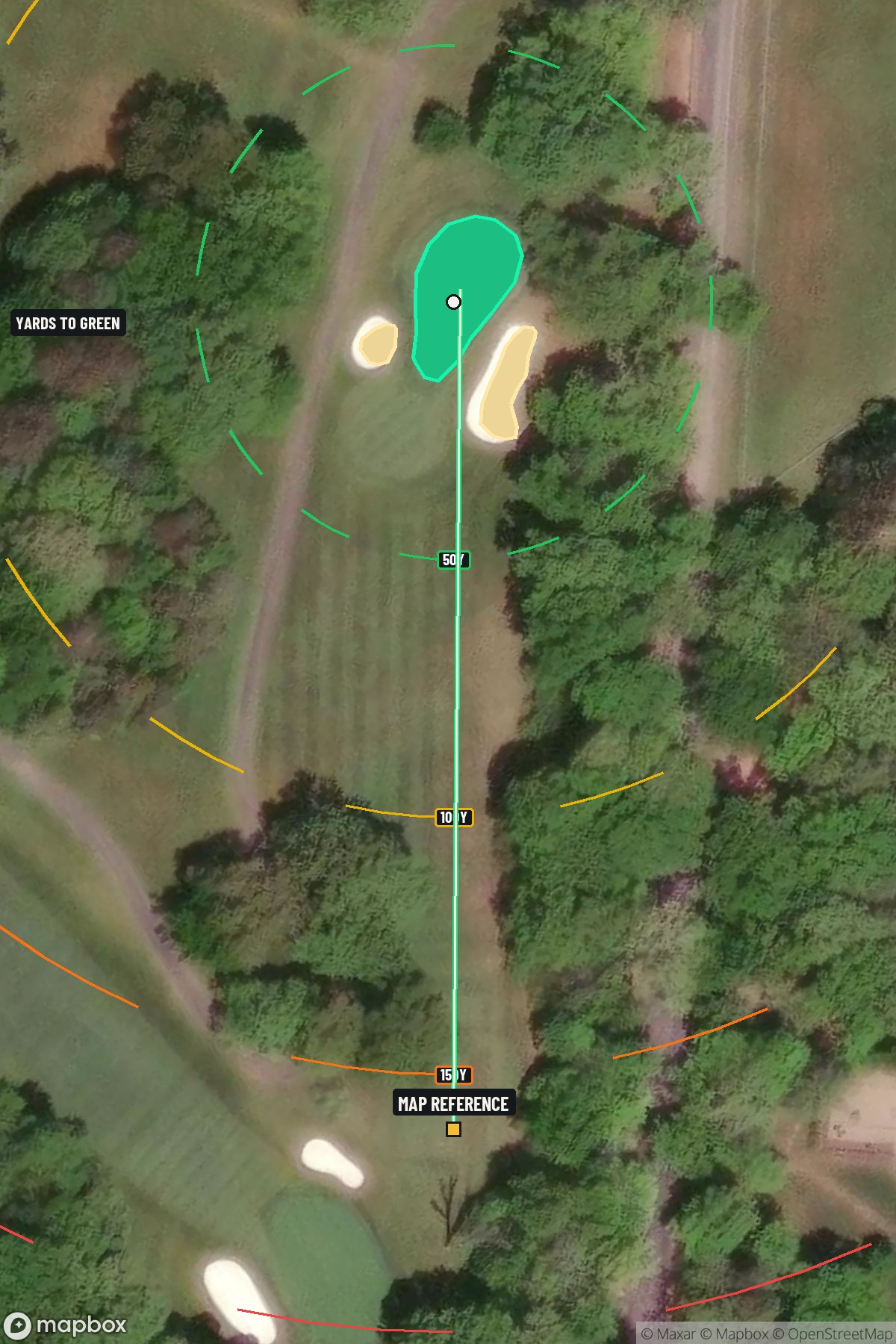
Mapbox Satellite composite · capture date not provided
Green size: 33 yds deep × 21 yds wide
Scorecard yardage is for Blue tees. The aerial shows its labeled reference position; distance rings measure to the green.
Blue tees · Par 3 · 163 yards
The plan for No. 5
Downhill par 3 at 163 yards protected by a huge deep bunker right and a small bunker left. The green is narrow in front and widens in back, sloping away at the rear. Elevation drop usually means one less club than the card suggests.
Off the tee
Account for the downhill and consider taking one less club. Aim center-left of the green to stay away from the deep right bunker. The narrow front entrance rewards a committed middle line over pin-hunting.
Approach & recovery
Tee shot is the approach. Prefer landing in the wider back portion of the green rather than challenging a front pin between the bunkers. Misses right into the deep bunker are costly.
On the green
Narrow in front, wider in back, sloping away at the rear. Long putts from the back can run off the front; leave yourself below any back pin and be careful with speed.
Watch for
- Mapped bunkers (2) are in play around the landing areas and green.
- Huge deep bunker right of the green; small bunker left.
- Green narrows in front and slopes away at the rear.
Hole 5 Green Complex & Slope
USGS 3DEP terrain analysis
Green size: 3,517 sq ft
How did Hole 5 play?
How did this hole play today?
Sources & further reading
- Omni Homestead / Homestead Members
Hole #5 description
Downhill par 3 protected by a huge deep bunker right and small bunker left. Green is narrow in front and widens in back, sloping away at the rear. Consider one less club because of the elevation drop.
- GolfPass
Old Course playing notes
At ~6,099 yards the Old Course does not feel short because sloping fairways and crooked lies make solid contact hard; opening 5-3-5-5-3 stretch is called among the most gettable starts in golf, with all early par 5s under 475 yards.
- NCGolf / Len Ziehm
presidential history paragraph
Author cites William McKinley as first sitting President to play golf here (dated 1901 in this piece) and notes William Howard Taft as an avid Old Course player during his presidency.
- Greens Visited
surviving feel paragraph
Clearest places to study pad-style / false-front green presentation per tour language: holes 3, 6, 8, 12, and 16 — without asserting any contour is still exact 1913 Ross.
- NCGolf / Len Ziehm
Donald Ross / course character paragraph
Despite later Flynn and Rees Jones updates, tips still only ~6,099 yards with well-contoured fairways leaving sidehill/uphill/downhill lies to relatively small greens.
- MyGolfSpy
The Old Course section
Do not let the ~6,099-yard card fool you: mountain elevation changes, blind shots, and treacherous greens test patience and speed control even though off-the-tee lines are relatively straightforward Ross golf.
- Greens Visited
Donald Ross at Homestead / Documented uncertainties
Documents chronology uncertainty: some resort materials say Ross expanded nine→18 in 1913; others say 18 by 1901 with Ross redesign in 1913. Also attributes 1920s Flynn updates and a 1994 Rees Jones renovation that altered clubhouse-side corridors (No. 1 as par 5, par-3 18th, range addition).
- GolfPass
Opening first-tee vignette
First tee of the Old Course is described as the longest-running still-used first tee in America, dating to 1892, with presidential play including Clinton, Ford, and both Bushes cited by the author.
- Golf Daily
Intro golf history paragraph
Golf at Homestead began 1892 (six holes), expanded to 18 by 1901, redesigned by Donald Ross in 1913; round begins on the oldest teebox in the nation (resort claim).
- NCGolf / Len Ziehm
history / Mark Fry interview paragraphs
Head pro Mark Fry clarified to the author that only six holes existed in 1892 (players looped for 18); the course did not have 18 different holes until 1901 — keeping Chicago Golf Club’s 'first 18-hole course' claim intact.
- Historic Hotels of America
Opening golf overview paragraphs
Historic Hotels chronology: Old Course opened 1892 as six holes, expanded to nine by 1898, and Donald Ross expanded it to 18 holes in 1913. Cascades (Flynn) is the companion course opened 1924 — do not conflate the two.
- Omni Hotels & Resorts
Rankings sentence (search-index excerpt)
National ranking claim on official page: often listed among best Southern / playable courses, including Golf Digest Best You Can Play by state and America’s 100 Greatest Public Courses (2023–2024 cited).
- Omni Hotels & Resorts
Hero / course intro copy (search-index excerpt)
Official page: Old Course completed 1892 and boasts the nation’s oldest first tee still in continuous use; significant updates by William S. Flynn and Rees Jones.
- Omni Hotels & Resorts
Course stats / intro copy (search-index excerpt)
Official page: unique ~6,099-yard layout of six par 3s, six par 4s, and six par 5s (18 holes / par 72).
- Omni Homestead / Homestead Members
Hole yardage headers across tour
Official tour card framing: unusual 6–6–6 balance of par 3s, 4s, and 5s (par 72), with Blue tips around 6,099 yards on the published tour yardages.
- MyGolfSpy
The Old Course section
Old Course is positioned as more welcoming to all skill levels than Cascades; prefer Old Course for a more casual round at the resort.
- GolfLink
Old Course history paragraphs in review
Review restates: oldest first tee in continuous use; McKinley first sitting president to play golf here; nine holes by 1896, 18 by 1901; Ross redesign (dated 1916 here) adding contoured fairways and saucer greens; 6–6–6 par mix.
- GolfLink
Golfin' G. maintenance paragraph
Reviewer credits maintenance: thick green fairways and putting surfaces that roll quick and true (Aug 2022 visit conditions).
- MyGolfSpy
The Old Course section
Reviewer highlights the fun of a par-72 with six par 5s as a defining Old Course character trait.
- Golf Daily
Ross’s Old Course has enduring bonafides section
Ross signatures cited: contoured/off-camber fairways that create uneven lies, tree-lined corridors testing accuracy, and smaller saucer-shaped greens. Slope-capable rangefinder recommended for elevation changes; greens roll quick and true.
- GolfPass
Old Course routing paragraph
Routing called a 'royal mutt' with work attributed across Donald Ross, William Flynn, Robert Trent Jones Sr., and Rees Jones as the resort evolved.
- Greens Visited
Unique Design Characteristics / routing signatures
Routing signatures: 6–6–6 par balance; back-to-back par 5s at 3–4 and 12–13; distinctive elevated par-3 finish at 18 dropping toward the hotel.
- Historic Hotels of America
Snead paragraph in golf overview
Sam Snead’s early ties: as a boy he caddied at the Old Course before later becoming Cascades golf professional — useful for resort context, not Old Course strategy.
- Greens Visited
Unique Design Characteristics section
Summarizing the resort hole tour: false fronts recur at Nos. 3, 6, and 8; elevated green at 16 with deep bunkers and L→R / back→front fall; blind/semi-blind drives at 4 and 10; flanking bunkers at 11; large deep bunker right-front at 17.
- GolfLink
Golfin' G. review body
Tree-lined fairways test accuracy; fairway contouring creates many uneven lies; substantial elevation change — slope rangefinder recommended. First three holes play uphill.
- NCGolf / Len Ziehm
quirky course paragraph
Unusual features called out: back-to-back par 5s on both nines and a par-3 finishing hole; author notes a #1 handicap on the first hole as quirky.
- Historic Hotels of America
Presidential play section
William McKinley is cited as the first U.S. President to play golf while in office, teeing off at the Old Tee on the Old Course in 1899.
- Historic Hotels of America
Presidential / first ladies section
Woodrow Wilson and Edith Wilson are described as honeymooning at the resort in 1915 and playing the Old Course each morning.
- Golf Daily
Old Course short-by-today’s-standards paragraph
Yardage understates difficulty: substantial Allegheny elevation changes make several holes play uphill or longer than the scorecard suggests.