Hole 16 at Bandon Dunes Resort (Pacific Dunes Course)
- Par
- 4
- Yardage
- 338 yds
- Stroke index
- 12
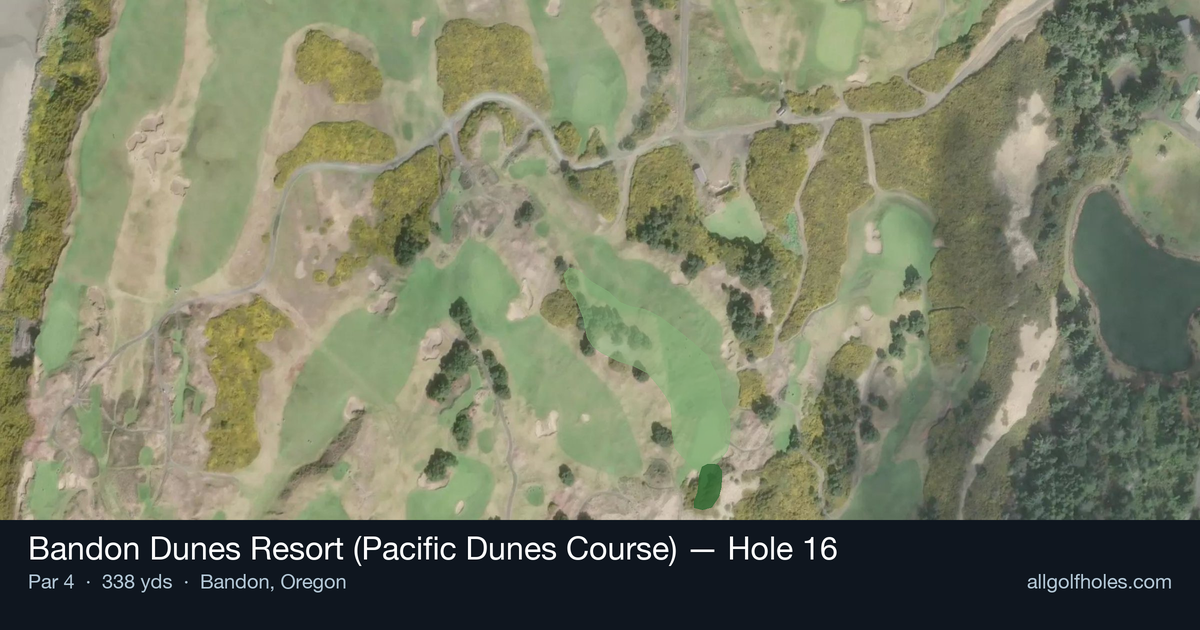
Aerial source not provided
Green size: 34 yds deep × 40 yds wide
Scorecard yardage is for Championship tees. The aerial shows its labeled reference position; distance rings measure to the green.
Hole 16 gameplan by handicap
Choose your playing level to compare the available shot plans.
Mid handicap (6–15)
conservative plan
Tee shot (3-wood)
Play safely to the left side of fairway
Target: fairway
Approach (SW)
Aim for center of green from 73.5 yards
Target: center of green
aggressive plan
Tee shot (Driver)
Challenge the dogleg by aiming right
Target: fairway
Approach (LW)
Attack pin from 43.5 yards
Target: pin
High handicap (16+)
conservative plan
Tee shot (3-wood)
Play safely to the left side of fairway
Target: fairway
Approach (SW)
Aim for center of green from 63.7 yards
Target: center of green
aggressive plan
Tee shot (Driver)
Challenge the dogleg by aiming right
Target: fairway
Approach (LW)
Attack pin from 37.7 yards
Target: pin
Low handicap
conservative plan
Tee shot (3-wood)
Play safely to the left side of fairway
Target: fairway
Approach (Driver)
Aim for center of green from 83.3 yards
Target: center of green
aggressive plan
Tee shot (Driver)
Challenge the dogleg by aiming right
Target: fairway
Approach (LW)
Attack pin from 49.3 yards
Target: pin
Tour player
conservative plan
Tee shot (3-wood)
Play safely to the left side of fairway
Target: fairway
Approach (Driver)
Aim for center of green from 98 yards
Target: center of green
aggressive plan
Tee shot (Driver)
Challenge the dogleg by aiming right
Target: fairway
Approach (LW)
Attack pin from 58 yards
Target: pin
Hole 16 Green Complex
Mapped green boundary
Green size: 6,101 sq ft
📚Playing strategyDetailed Hole 16 Guide
Read full guide ↓Collapse ↑
Detailed Hole 16 Guide
Overview
Hole BriefingAt just 338 yards, this short par 4 at Pacific Dunes presents a classic risk/reward scenario where aggressive players can attack the pin while conservative golfers must resist the temptation to overpower the hole. The key to success lies in understanding that shorter doesn't always mean easier, especially with the Pacific winds and small green demanding precision over power.
OVERVIEW
Hole OverviewThis hole epitomizes strategic golf course design, offering multiple ways to play based on your skill level and confidence. The relatively short yardage invites aggressive play, but the small green size punishes wayward shots severely. Wind conditions off the Pacific Ocean add another layer of complexity, making club selection and target line crucial decisions. Success here comes from playing within your abilities while recognizing scoring opportunities when conditions favor bold play.
TEE SHOT
Off the TeeThe tee shot strategy varies dramatically based on your approach to risk/reward golf. Conservative players should focus on finding the fairway with a controlled iron or hybrid, leaving a comfortable wedge distance to the small green. This approach prioritizes accuracy over distance and sets up a straightforward approach shot.
More aggressive players can consider driver, potentially leaving just a short wedge or even reaching the green in favorable wind conditions. However, this strategy requires precise execution - any mishit becomes magnified on a short hole where recovery options are limited. The target line should favor the center of the fairway, allowing for natural shot dispersion while maintaining optimal approach angles.
Pay careful attention to wind direction and strength, as Pacific coastal conditions can dramatically affect ball flight. A helping wind might make driver too much club, while a strong headwind could require more aggressive tactics to reach proper approach distances.
APPROACH
Approach ZoneThe small green demands pinpoint accuracy on approach shots, making this where the hole's true challenge reveals itself. From ideal fairway position, you'll likely have a short iron or wedge in hand, but the margin for error is minimal.
Focus on the center of the green regardless of pin position - the small target makes going flag-hunting extremely risky. A controlled, committed swing with proper distance control takes precedence over trying to get cute with spin or trajectory. The green's size means any shot that catches the putting surface gives you a reasonable birdie opportunity.
Consider the wind's effect on your shorter irons, as coastal breezes can push even well-struck wedges off target. Take one more club and swing easier rather than forcing a shot in challenging conditions.
ON THE GREEN
Putting SurfaceWhile specific green contours aren't detailed, small greens typically feature subtle but significant breaks that become more pronounced in coastal wind conditions. The key is reading putts carefully and committing to your line - tentative putting on small greens often results in leaving putts short and in the "amateur zone."
Focus on lag putting to the center of the green on longer putts, as three-putting from a small green is particularly frustrating on a scoring hole. The premium here is on solid contact and distance control rather than trying to hole everything.
RISK VS REWARD
Risk & Decision MatrixThis hole presents one of golf's classic risk/reward scenarios. The reward for aggressive play is substantial - birdie opportunities abound for those who execute properly. However, the risk of missing the small green and facing difficult recovery shots can quickly turn a scoring opportunity into a bogey or worse.
The decision often comes down to course management philosophy and current round momentum. If you're playing well and need to make moves, the aggressive line makes sense. If you're protecting a good score or struggling with accuracy, the conservative approach preserves scoring potential while minimizing disaster.
DIFFERENT SKILL LEVELS
Skill-Level AdviceHigh-handicap players should treat this as a strategic par 4, not a potential eagle hole. Use a club you're confident with off the tee - likely a 7-iron or hybrid - to ensure fairway contact. From there, focus entirely on hitting the green with whatever club provides the most confidence, even if it means putting from 40 feet.
Low-handicap players can be more aggressive with their tee shot selection, potentially using driver in favorable conditions. However, even skilled players should respect the small green size and prioritize center-green approaches over flag-hunting. The scoring opportunity comes from solid execution rather than heroic shots.
Mid-handicap players face the most interesting strategic decisions here. Consider your current ball-striking form and confidence level when choosing between conservative and aggressive lines. When in doubt, favor the conservative approach - pars are excellent scores on challenging short holes.
The key for all skill levels is recognizing that this hole rewards smart, committed golf over flashy or overly aggressive play. Let the short yardage work in your favor through proper course management rather than trying to overpower the design.
More playing tips
Architecture & history
At 338 yards, Bandon Dunes Resort (Pacific Dunes Course) hole 16 presents a deceptively strategic par 4 that epitomizes links golf at its finest. This straight-away hole challenges golfers to find the optimal balance between distance and accuracy on the tee shot, as the coastal winds can dramatically influence ball flight. The fairway offers a generous landing area, but precise positioning becomes crucial for the approach to the small, subtly contoured green. Without significant hazards to intimidate, this hole relies on nuanced shot-making and course management, demanding golfers read the ever-changing Oregon coast conditions. The green's compact size rewards accurate iron play, making this a true test of precision over power.
Course coverage
Tournament and creator videos about Bandon Dunes Resort (Pacific Dunes Course) — shared course coverage, not hole-specific clips.
Featured by these creators
Creator videos about this course
YouTube creators who filmed or featured Bandon Dunes Resort (Pacific Dunes Course). · Stats as of Oct 12, 2026 · 6d ago
Our Stroke Play Competition At Bandon Dunes Got Off To A Hot Start! (Bandon Belt Episode 1)
Maintaining Bandon Dunes: Oregon's Links Golf Mecca | All Grass Is Local | Pres. by Toro
The Evolution of Maintaining Bandon Dunes Resort | All Grass Is Local
PGA Professional Championship 2026 at Bandon Dunes.
PGA Professional Championship 2026 at Bandon Dunes
PGA Professional Championship 2026 at Bandon Dunes.
How did Hole 16 play?
How did this hole play today?
Frequently asked questions
Yardage reference: Championship tees · 338 yards.
What's the best strategy off the tee?
↓
For this 338-yard par 4, most players will hit 3-wood or driver to set up a comfortable approach.
How difficult is hole 16?
↓
This hole is a good scoring opportunity for most golfers.
How big is the green on hole 16?
↓
The green is fairly large with multiple pin positions. The green is deeper than wide, so club selection is crucial. Lag putting becomes important on longer putts.
What's a good score on hole 16?
↓
This hole is a birdie opportunity if you find the fairway. This shorter par 4 rewards accuracy off the tee with a short iron approach.