Hole 18 at Bandon Dunes Resort (Bandon Trails Course)
- Par
- 4
- Yardage
- 399 yds
- Stroke index
- 6
- Hazards
- 9 bunkers
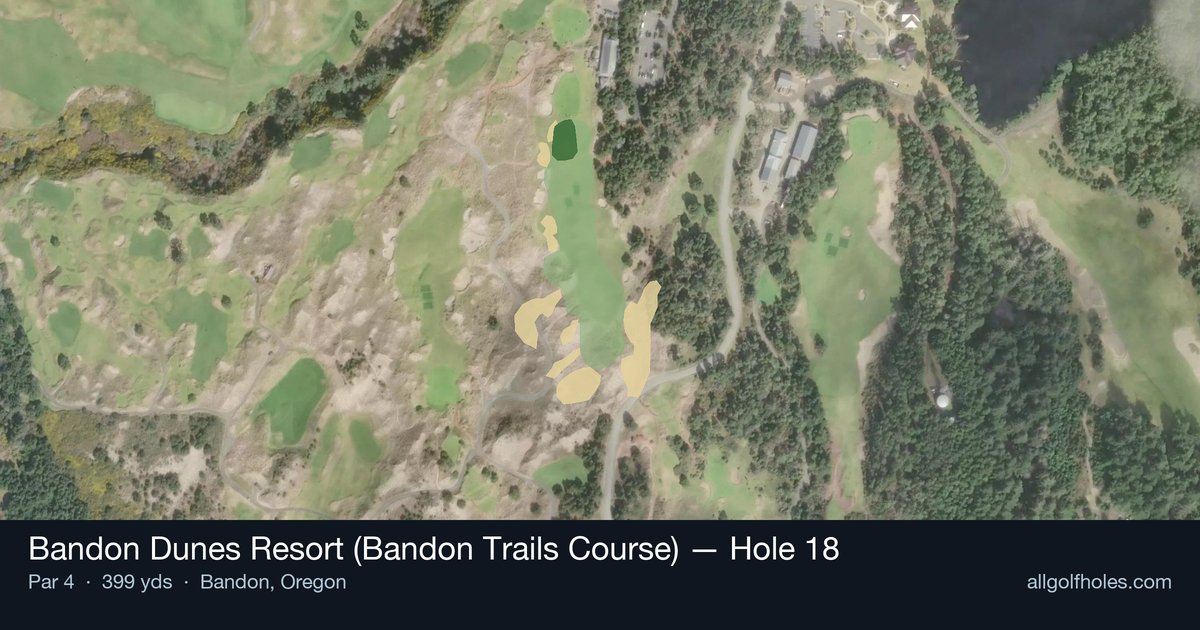
Aerial source not provided
Green size: 40 yds deep × 30 yds wide
Scorecard yardage is for Championship tees. The aerial shows its labeled reference position; distance rings measure to the green.
Championship tees · Par 4 · 399 yards
The plan for No. 18
The finishing hole at Bandon Dunes Resort's Bandon Trails Course presents a deceptively challenging finale to one of Oregon's most celebrated inland layouts. This straight par 4 stretches 399 yards through rolling terrain dotted with native grasses and coastal vegetation that defines the resort's rugged aesthetic. The tee shot demands precision over power, as the fairway narrows toward the landing zone, requiring golfers to find the optimal angle for their approach. The small green sits as an inviting target, but its compact size demands accuracy with mid-irons. Without major hazards to intimidate, this hole rewards strategic thinking and solid execution, making it a fitting conclusion to Bill Coore and Ben Crenshaw's masterful design that seamlessly blends links-style golf with Oregon's natural beauty.
Off the tee
Focus on finding the fairway center rather than maximizing distance on this closing hole. The straight layout provides a clear target line, but wind conditions will heavily influence your club selection and aim point. Consider hitting a fairway wood or long iron if driver accuracy has been inconsistent during your round - the relatively short length means you can still reach the green comfortably with a mid-iron approach. Pay special attention to crosswinds that can push shots toward the rough, and adjust your target line accordingly.
Approach & recovery
The small green demands pinpoint accuracy on your approach shot, making this where the hole's true challenge lies. With the green size being the primary defense, focus on hitting to the center of the green rather than attacking pins, especially in windy conditions. A controlled mid-iron to short-iron approach typically works best, prioritizing a smooth tempo and solid contact over aggressive distance control. The wind can easily turn a well-struck shot into trouble, so take extra club when facing into the breeze and trust your swing.
On the green
The small putting surface means that even slight misreads can result in longer comeback putts than expected. Focus on speed control, as the compact green doesn't offer much room for error on longer putts. Pay attention to the coastal wind's effect on longer putts, particularly those that break with or against the prevailing breeze. Conservative lag putting to ensure two-putts will often be the smart play, especially on a finishing hole where avoiding big numbers is crucial. ## RISK VS REWARD This hole's risk/reward equation centers on tee shot club selection and approach shot aggression. The reward for finding the fairway with driver is a shorter approach, but the risk of missing increases with the longer club. The small green creates a similar dynamic - attacking pins offers birdie opportunities but significantly increases the risk of missing the putting surface entirely. The smart play typically favors conservative targets and letting your short game capitalize on good positioning. ## DIFFERENT SKILL LEVELS **High-Handicap Players:** Prioritize accuracy over distance throughout the hole. Use your most reliable tee shot club, even if it's a hybrid or long iron, ensuring you stay in play. Aim for the center of the green regardless of pin position, and focus on two-putting for a solid par finish. The small green makes scrambling difficult, so staying on the putting surface is crucial. **Low-Handicap Players:** You can be more aggressive with driver off the tee if your accuracy is sharp, setting up shorter approach shots for birdie opportunities. However, respect the small green by taking enough club and committing to your target. Consider pin positions more carefully, but still err toward the fat part of the green in challenging wind conditions. This hole rewards disciplined execution over heroic shots.
Watch for
- Fairway bunker crossing the landing zone
Hole 18 Green Complex
Mapped green boundary
Green size: 7,333 sq ft
Course coverage
Tournament and creator videos about Bandon Dunes Resort (Bandon Trails Course) — shared course coverage, not hole-specific clips.
Featured by these creators
Creator videos about this course
YouTube creators who filmed or featured Bandon Dunes Resort (Bandon Trails Course). · Stats as of Oct 12, 2026 · 6d ago
Our Stroke Play Competition At Bandon Dunes Got Off To A Hot Start! (Bandon Belt Episode 1)
Maintaining Bandon Dunes: Oregon's Links Golf Mecca | All Grass Is Local | Pres. by Toro
The Evolution of Maintaining Bandon Dunes Resort | All Grass Is Local
PGA Professional Championship 2026 at Bandon Dunes.
PGA Professional Championship 2026 at Bandon Dunes
PGA Professional Championship 2026 at Bandon Dunes.
How did Hole 18 play?
How did this hole play today?
Frequently asked questions
Yardage reference: Championship tees · 399 yards.
What's the best strategy off the tee?
↓
For this 399-yard par 4, most players will hit driver to set up a comfortable approach.
How difficult is hole 18?
↓
This hole is a good scoring opportunity for most golfers. Key challenges include: large green requiring good lag putting.
How big is the green on hole 18?
↓
The green is fairly large with multiple pin positions. The green is deeper than wide, so club selection is crucial. Lag putting becomes important on longer putts.
What's a good score on hole 18?
↓
This hole is a medium-length test where par is a solid result. A straightforward par 4 where course management pays off.