Hole 10 at Arcadia Bluffs Golf Club
- Par
- 4
- Yardage
- 481 yds
- Stroke index
- 2
- Hazards
- 1 bunker
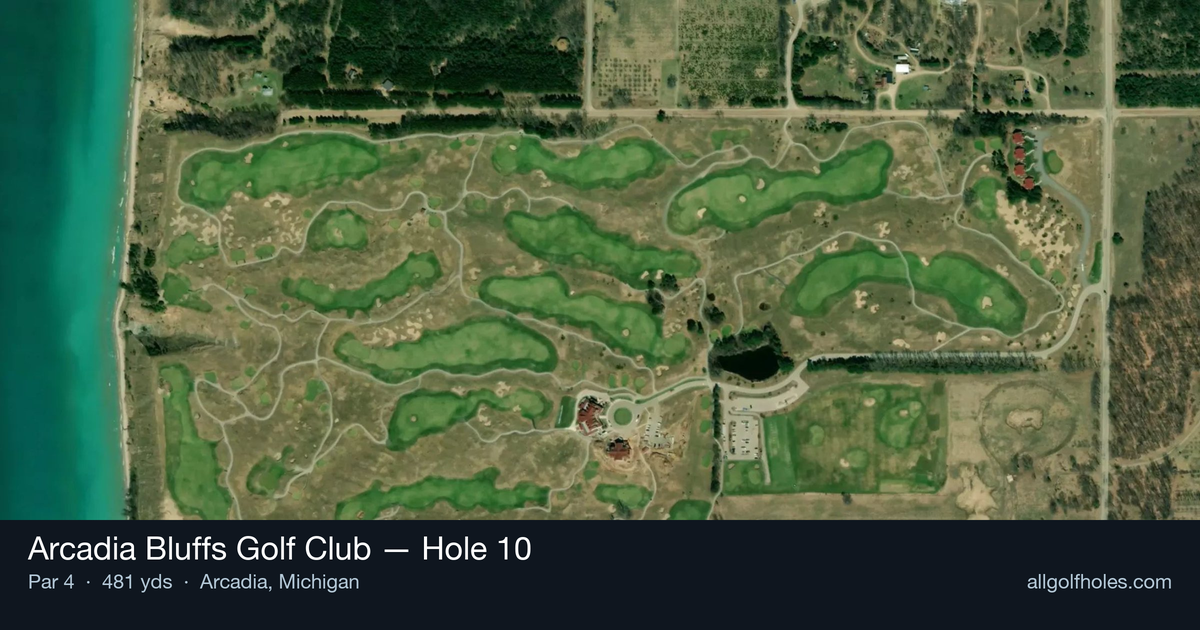
Aerial source not provided
Green size: 46 yds deep × 38 yds wide
Scorecard yardage is for Championship tees. The aerial shows its labeled reference position; distance rings measure to the green.
Championship tees · Par 4 · 481 yards
The plan for No. 10
The 10th hole at Arcadia Bluffs Golf Club marks the beginning of the course's legendary outer loop, where Michigan's lakeside winds become a defining factor in every shot. This demanding 481-yard par 4 presents a deceptively straightforward challenge that rewards precision over power. The generous fairway invites an aggressive tee shot, but the real test lies in the approach to a compact green complex that demands surgical accuracy. As part of the outer loop's six-hole stretch, this hole showcases the Rick Smith and Warren Henderson design philosophy that has earned Arcadia Bluffs comparisons to Whistling Straits. The small target green leaves little margin for error, making club selection and wind assessment critical for scoring opportunities on this handicap-2 test.
Off the tee
Your tee shot strategy should prioritize finding the fairway over maximum distance. With 481 yards to work with, most players can afford to take a controlled swing with driver or even consider a 3-wood if wind conditions are challenging. The target line should favor the center-left portion of the fairway, giving you the best angle into the small green complex. Pay special attention to wind direction and strength, as this outer loop section is particularly exposed. A headwind may require moving up a club or two, while a tailwind demands extra focus on accuracy since the ball will carry further than expected. Avoid the temptation to overswing - smooth tempo and solid contact will serve you better than trying to bomb it down the fairway.
Approach & recovery
The approach shot to this small green demands precision and smart club selection. From a good drive position, you'll likely face a mid-iron to long-iron approach depending on conditions and pin position. The small green size leaves little margin for error, making distance control absolutely critical. Study the pin position carefully before selecting your club. With limited green real estate, aim for the center of the green rather than attacking difficult pin positions. The wind factor becomes even more crucial on the approach - take extra time to assess conditions and don't be afraid to take one more club if there's any doubt about distance.
On the green
The small green at the 10th requires careful speed control and precise line reading. While specific break patterns will vary with pin position, focus on getting your first putt close rather than being overly aggressive. The putting surface, typical of links-style courses, can be firm and fast, especially in windy conditions. Pay attention to grain direction if present, and remember that putts may be affected by the wind on this exposed section of the course. Conservative putting strategy - aiming for the fat part of the hole and ensuring good speed control - will help you avoid three-putts on this challenging green. ## RISK VS REWARD This hole offers limited risk/reward opportunities, instead demanding solid, strategic golf. The primary risk comes from trying to overpower the hole rather than playing within your capabilities. The reward for good course management is avoiding bogey or worse on one of the course's most difficult holes. The biggest risk/reward decision comes with club selection off the tee in windy conditions. Playing conservatively with a fairway wood might leave a longer approach, but finding the fairway is paramount given the small target on the approach. ## DIFFERENT SKILL LEVELS **High-Handicap Players:** Focus entirely on keeping the ball in play. Consider hitting 3-wood or hybrid off the tee to ensure you find the fairway. For the approach, aim for the center of the green regardless of pin position. Two putts for bogey represents a solid score on this difficult hole. **Low-Handicap Players:** While you can be more aggressive with driver off the tee, still prioritize accuracy. You have the skill to attack certain pin positions, but be selective - only go at pins in the middle portions of the green. Use your course management skills to play for the best miss, and don't be afraid to take your medicine if you're between clubs. The 10th hole at Arcadia Bluffs rewards patience, precision, and smart decision-making. Embrace the links-style challenge, respect the wind conditions, and focus on solid fundamentals to navigate this demanding opener to the outer loop successfully.
Watch for
- Course conditioning and mapped hazards may affect line selection; confirm from the aerial.
Hole 10 Green Complex
Mapped green boundary
Green size: 9,648 sq ft
Course coverage
Tournament and creator videos about Arcadia Bluffs Golf Club — shared course coverage, not hole-specific clips.
Featured by these creators
Creator videos about this course
YouTube creators who filmed or featured Arcadia Bluffs Golf Club. · Stats as of Oct 12, 2026 · 5d ago
Course Record - Arcadia Bluffs
How did Hole 10 play?
How did this hole play today?
Frequently asked questions
Yardage reference: Championship tees · 481 yards.
What's the best strategy off the tee?
↓
For this 481-yard par 4, most players will hit driver to set up a comfortable approach.
How difficult is hole 10?
↓
This hole is a moderate challenge for most golfers. Key challenges include: long par 4, large green requiring good lag putting.
What hazards should I watch out for on hole 10?
↓
Key hazards include: 1 greenside bunker. Plan your shots to avoid these trouble spots.
How big is the green on hole 10?
↓
The green is large and can play quite long. Three-putt territory if you don't manage your approach distance well.
What's a good score on hole 10?
↓
This hole is one of the tougher holes where par feels like birdie. A challenging par 4. Accept that bogey happens and avoid big numbers.