Hole 7 at Valhalla Golf Club
- Par
- 5
- Yardage
- 600 yds
- Hazards
- 7 bunkers · Water
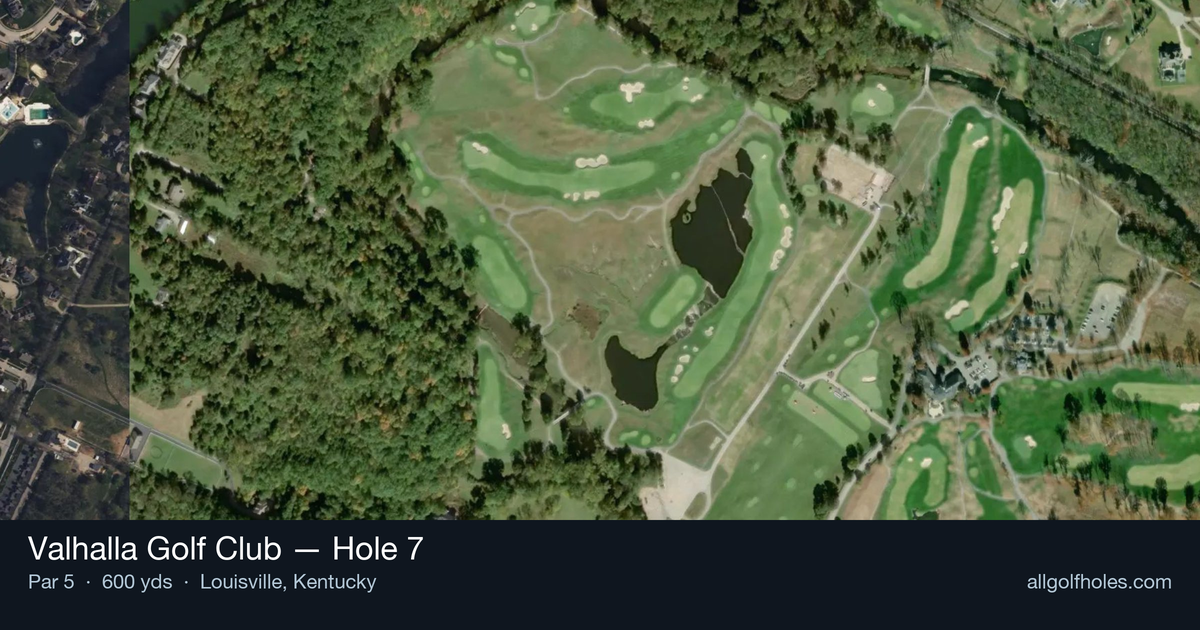
Aerial source not provided
Green size: 29 yds deep × 29 yds wide
Scorecard yardage is for Championship tees. The aerial shows its labeled reference position; distance rings measure to the green.
Championship tees · Par 5 · 600 yards
The plan for No. 7
Valhalla Golf Club hole 7 stands as the course's longest and most demanding par 5 at 600 yards, earning its designation as the number one handicap hole. This straight, uncompromising test of length and precision requires three expertly executed shots to reach the small green complex. The tee shot demands both power and accuracy down a generous fairway that gradually narrows toward the landing area. The second shot presents a critical decision point, as players must navigate the substantial distance remaining while positioning for an optimal approach angle. The compact green rewards precise iron play and punishes anything less than committed swings. At this PGA Championship venue, where every hole carries its own moniker, the seventh represents pure golf strategy at its finest—a hole where patience and course management triumph over aggressive play.
Off the tee
Your tee shot strategy should focus on finding the fairway with your longest comfortable club. The generous landing area allows you to swing freely with driver, but course management suggests considering your second shot positioning. Aim for the center-left portion of the fairway to set up the ideal angle for your layup. The lack of hazards means you can be aggressive off the tee, but remember that accuracy becomes increasingly important as you get closer to that small green.
Approach & recovery
This hole typically requires a strategic layup for most golfers, given the 600-yard length. Position your second shot to leave a comfortable wedge distance to the pin - ideally between 100-120 yards out. The small green size makes distance control paramount on your third shot. Choose a club that allows you to swing smoothly rather than forcing a longer iron. Target the center of the green unless the pin position clearly favors one side, as the compact putting surface leaves little room for error.
On the green
The small green at the 7th demands respect with your putter. Focus on lag putting to ensure you don't leave yourself with lengthy comeback putts. Without specific knowledge of the green's contours, play conservatively by aiming for the center of the cup on most putts. The compact size means even slight misreads can leave you well outside the comfort zone for your next putt. ## RISK VS REWARD The primary risk/reward decision comes with your second shot. Longer hitters may be tempted to go for the green in two, but the small target makes this a low-percentage play. The reward of a potential eagle must be weighed against the difficulty of hitting such a small green from long range. Most players will find better scoring opportunities by laying up to their favorite wedge distance and attacking the pin with a controlled approach. ## DIFFERENT SKILL LEVELS **High Handicappers:** Focus on keeping the ball in play and advancing it steadily down the fairway. Use three comfortable shots rather than trying to reach in two. Your third shot should prioritize finding the green over attacking pins. **Low Handicappers:** Consider going for the green in two only if conditions are perfect and you're confident with long irons or fairway woods. Otherwise, use precision wedge play to create birdie opportunities. Your superior short game skills make the layup strategy particularly effective. **Scratch Players:** This hole offers one of your best birdie chances at Valhalla. Whether going for it in two or laying up depends on pin position and conditions, but your ability to control wedge distances should make this a consistent scoring hole when played strategically. The 7th hole embodies classic risk/reward golf strategy - the absence of hazards invites aggressive play, but the small green demands precision. Smart golfers will recognize this as a prime scoring opportunity when approached with patience and proper club selection.
Watch for
- Sand 1 (crossing) influences line and recovery options.
- Sand 2 (crossing) influences line and recovery options.
- Sand 3 (crossing) influences line and recovery options.
- Sand 4 (crossing) influences line and recovery options.
- Sand 5 (crossing) influences line and recovery options.
- Sand 6 (crossing) influences line and recovery options.
- Sand 7 (greenside) influences line and recovery options.
- Water 1 (crossing) influences line and recovery options.
- Water 2 (tee) influences line and recovery options.
Hole 7 Green Complex
Mapped green boundary
Green size: 4,623 sq ft
Course coverage
Tournament and creator videos about Valhalla Golf Club — shared course coverage, not hole-specific clips.
Featured by these creators
Creator videos about this course
YouTube creators who filmed or featured Valhalla Golf Club. · Stats as of Oct 12, 2026 · 6d ago
Can We Make Cut @ Valhalla?! (2024 PGA Championship)
Ride along while I analyze the front nine of Valhalla for the 2024 PGA Championship
How did Hole 7 play?
How did this hole play today?
Frequently asked questions
Yardage reference: Championship tees · 600 yards.
Can this par 5 be reached in two?
↓
At 600 yards, A true three-shot hole for most players. Position your layup to leave a comfortable wedge distance.
How difficult is hole 7?
↓
This hole is one of the tougher holes on the course for most golfers. Key challenges include: long par 5, water in play, heavily bunkered.
How big is the green on hole 7?
↓
The green is medium-sized with moderate targets. Pay attention to pin placement when selecting your approach club.
Which side of the fairway is safer on hole 7?
↓
Aim for the left side of the fairway when possible. Missing right (water) brings more trouble into play.
What's a good score on hole 7?
↓
This hole is a true three-shot hole where birdie requires execution. This longer par 5 demands patience. Two good shots set up the scoring opportunity.