Hole 15 at Streamsong Resort (Black Course)
- Par
- 3
- Yardage
- 133 yds
- Stroke index
- 17
- Hazards
- 5 bunkers
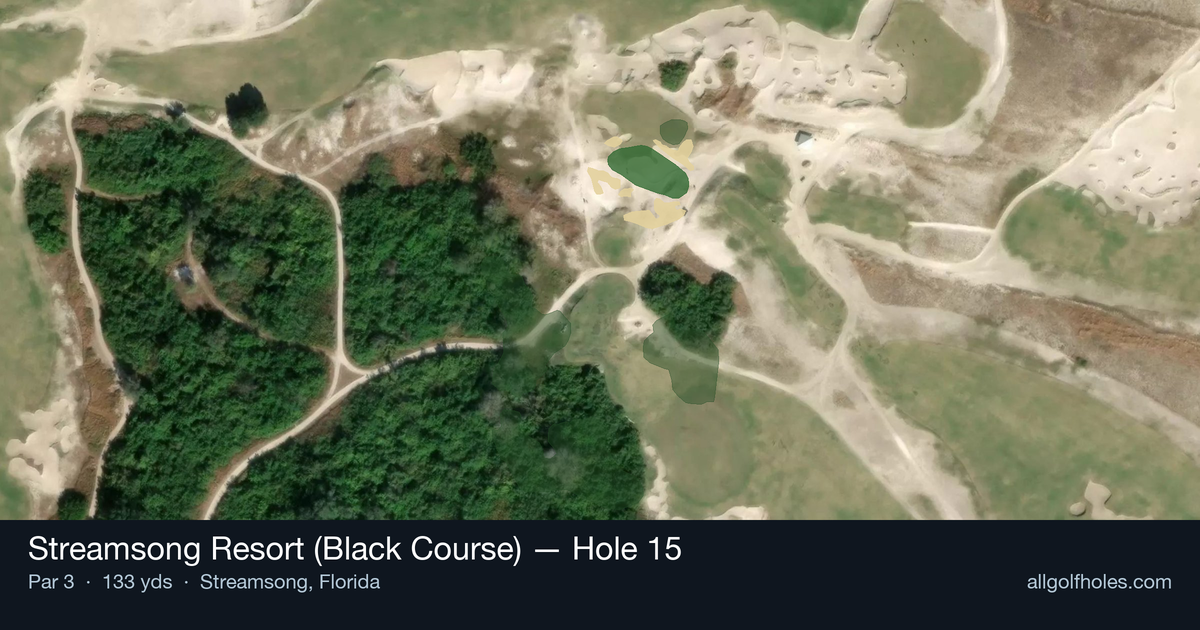
Aerial source not provided
Green size: 28 yds deep × 46 yds wide
Scorecard yardage is for Championship tees. The aerial shows its labeled reference position; distance rings measure to the green.
Championship tees · Par 3 · 133 yards
The plan for No. 15
The shortest hole at Streamsong Resort (Black Course) hole 15 proves that great things come in small packages. This 133-yard par 3 may lack the dramatic elevation changes found elsewhere on Tom Doak's masterpiece, but its deceptive simplicity demands precision over power. The straight shot to a small green complex requires golfers to dial in their distance control, as the compact putting surface offers little margin for error. Without significant hazards to intimidate, players often underestimate this seemingly straightforward tee shot, only to discover that finding the correct portion of the green is crucial for scoring opportunities. It's a classic example of Streamsong's subtle strategic design philosophy.
Off the tee
With no fairway to navigate, your tee shot IS your approach shot on this par 3. Club selection becomes paramount - most players will be looking at anything from a pitching wedge to a 9-iron depending on wind conditions and pin position. The key is committing fully to your yardage and club choice rather than trying to finesse a shot between clubs. Focus on a smooth, controlled swing rather than trying to muscle a shorter club or ease up on a longer one. The target line should be dictated by pin position, but with a small green, you'll want to favor the center of the green on most occasions. Wind assessment is crucial at this distance - even a moderate breeze can turn a perfect 9-iron into a short or long miss.
Approach & recovery
Since this is a par 3, your approach strategy is built into your tee shot selection. The small green demands precision, so course management becomes about picking the safest target rather than going directly at every pin position. When the pin is tucked near an edge, consider aiming for the fat part of the green and taking your two-putt par. Pay special attention to the green's surroundings - while there are no major hazards, missing this small target could leave you with challenging recovery shots from rough or collection areas. The margin for error is minimal, making this a hole where conservative play often yields better results than aggressive pin-hunting.
On the green
The small green size means you're likely facing relatively short putts, but don't underestimate the importance of reading the subtle breaks correctly. Short putts can be deceptively tricky, especially under pressure late in the round. Take time to read the putt from multiple angles, as these seemingly simple putts often have more break than initially apparent. Speed control becomes crucial on a smaller surface - you want to be aggressive enough to hold your line but not so firm that a miss runs well past the hole. The key is finding that perfect pace that gives your putt the best chance to find the center of the cup.
Watch for
- Greenside bunker (greenside)
Hole 15 Green Complex
Mapped green boundary
Green size: 5,506 sq ft
How did Hole 15 play?
How did this hole play today?
Frequently asked questions
Yardage reference: Championship tees · 133 yards.
What club should I use on this par 3?
↓
At 133 yards, most golfers will need a short iron (9-iron to PW) to reach this green. Adjust for elevation, wind, and pin position.
How difficult is hole 15?
↓
This hole is a good scoring opportunity for most golfers. Key challenges include: heavily bunkered.
What hazards should I watch out for on hole 15?
↓
Key hazards include: 5 greenside bunkers. Plan your shots to avoid these trouble spots.
How big is the green on hole 15?
↓
The green is medium-sized with moderate targets. The green is wider than it is deep, rewarding shots that find the correct tier. Pay attention to pin placement when selecting your approach club.
What's a good score on hole 15?
↓
This hole is a legitimate birdie opportunity for accurate iron players. Most golfers should target par, with birdie chances if you hit the green in regulation.