Hole 15 at Wilshire Country Club
- Par
- 4
- Yardage
- 329 yds
- Stroke index
- 1
- Hazards
- 8 bunkers
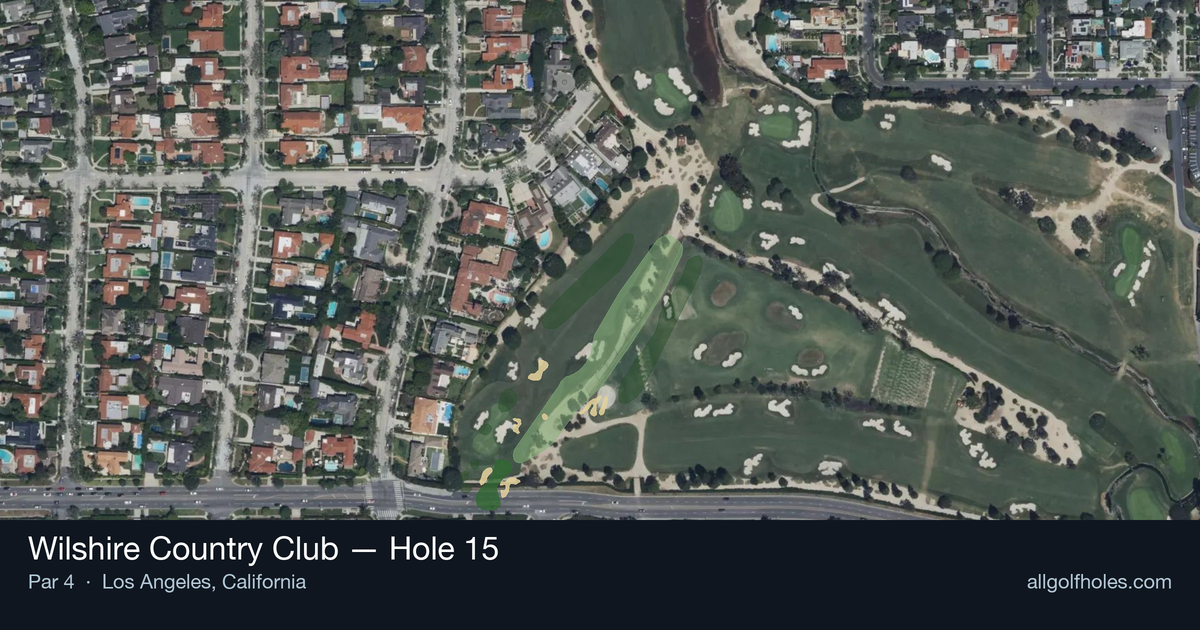
Aerial source not provided
Green size: 44 yds deep × 24 yds wide
Scorecard yardage is for Pro tees. The aerial shows its labeled reference position; distance rings measure to the green.
Pro tees · Par 4 · 329 yards
The plan for No. 15
Don't let the modest 329 yards fool you—Wilshire Country Club hole 15 stands as the course's number one handicap for good reason. This deceptively challenging par 4 demands precision over power, with its straight layout offering no room for error despite the absence of traditional hazards. The small green complex serves as the hole's primary defense, requiring a perfectly placed approach shot to hold the putting surface. Strategic positioning off the tee becomes critical, as the ideal angle into the green rewards thoughtful course management over aggressive play. What appears straightforward from the tee reveals its true character through subtle contours and demanding accuracy requirements that separate skilled players from the field.
Off the tee
**Target Line & Strategy:** Favor the center of the fairway to maximize your options for the approach shot. The straight layout allows for aggressive positioning, but resist the urge to overpower this hole. A controlled drive that finds the fairway is infinitely more valuable than extra distance in the rough. **Club Selection:** Consider hitting less than driver if accuracy is a concern. A 3-wood or long iron that ensures fairway contact will leave a comfortable wedge or short iron approach - exactly what you want facing a small green. The relatively short length means even conservative tee shots leave manageable approach distances. **Key Considerations:** With no hazards off the tee, the primary risk is missing the fairway and facing a more difficult approach from rough or uneven lies.
Approach & recovery
**Preferred Angles:** From the fairway center, you'll have the best angle to attack any pin position on the small green. Focus on the middle of the green regardless of pin placement - the small target makes aggressive pin-hunting extremely risky. **Club Selection:** Expect to hit anywhere from a wedge to a mid-iron depending on your tee shot distance and pin position. Take one extra club and swing smoothly rather than forcing a shot with insufficient club. **Strategy:** The small green size makes this approach shot the hole's defining moment. Prioritize accuracy over distance control - being 20 feet away on the green is far better than being 10 feet away in a greenside bunker or rough.
On the green
**Putting Strategy:** Small greens typically feature subtle but tricky slopes. Take time to read the green carefully, as short putts can be deceptive on smaller surfaces. The compact size means most putts will be relatively short, making lag putting less critical than accurate reads. **Pin Position Considerations:** When the pin is tucked near edges, resist the temptation to get too aggressive. The small green provides little margin for error, making center-green approaches the smart play regardless of pin placement. ## RISK VS REWARD **Conservative Approach:** Play for the center of the green on every approach shot. This strategy virtually guarantees a regulation par opportunity and eliminates the risk of short-siding yourself. **Aggressive Option:** Only attack tight pin positions when you're hitting your approach from an ideal fairway lie and feel completely confident in your distance control. The small green severely punishes missed aggressive shots. ## DIFFERENT SKILL LEVELS **High Handicap Players:** Focus entirely on hitting the fairway off the tee, even if it means hitting hybrid or long iron. From there, aim for the center of the green with whatever club gives you the most confidence. Two-putt pars are excellent scores on this hole. **Low Handicap Players:** You can be more aggressive off the tee with driver, but the approach shot demands the same conservative strategy as higher handicappers. The small green is the great equalizer - even scratch players should prioritize the middle of the green over pin-hunting. **Course Management Tip:** Remember that this is the #1 handicap hole for a reason. Respect its difficulty by playing within your abilities and avoiding the temptation to attack aggressively simply because of the short yardage.
Watch for
- Course conditioning and mapped hazards may affect line selection; confirm from the aerial.
Hole 15 Green Complex
Mapped green boundary
Green size: 4,130 sq ft
How did Hole 15 play?
How did this hole play today?
Frequently asked questions
Yardage reference: Pro tees · 329 yards.
What's the best strategy off the tee?
↓
For this 329-yard par 4, most players will hit 3-wood or driver to set up a comfortable approach.
How difficult is hole 15?
↓
This hole is a good scoring opportunity for most golfers. Key challenges include: small green.
How big is the green on hole 15?
↓
The green is small and requires precision. The green is deeper than wide, so club selection is crucial. Expect challenging pin positions with limited room for error.
What's a good score on hole 15?
↓
This hole is a birdie opportunity if you find the fairway. This shorter par 4 rewards accuracy off the tee with a short iron approach.