Hole 17 at Aviara Golf Club at Four Seasons Resort
- Par
- 5
- Yardage
- 585 yds
- Stroke index
- 4
- Hazards
- 1 bunker
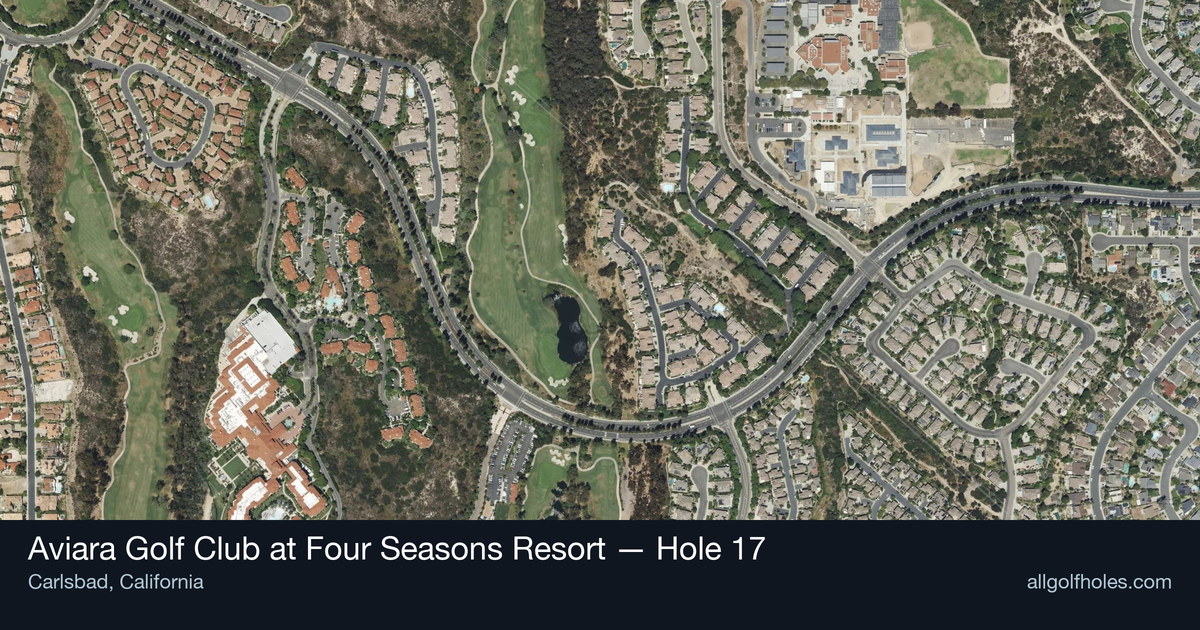
Aerial source not provided
Green size: 35 yds deep × 25 yds wide
Scorecard yardage is for Championship tees. The aerial shows its labeled reference position; distance rings measure to the green.
Championship tees · Par 5 · 585 yards
The plan for No. 17
The 17th at Aviara Golf Club at Four Seasons Resort presents a strategic par 5 that demands both power and precision across its 585 yards. This straight-away hole unfolds beautifully through the rolling terrain of Carlsbad's coastal landscape, offering golfers multiple route options to reach the small, well-protected green. With minimal hazards flanking the fairway, the primary challenge lies in managing distance control and positioning for the crucial approach shot. The compact green complex requires surgical accuracy, particularly on approach shots, as its tight dimensions leave little margin for error. Despite being the fourth-most difficult hole on the course, aggressive players can still attack this reachable par 5 with proper course management and execution.
Off the tee
The opening shot should prioritize finding the fairway center with your most reliable long club. Driver is typically the right choice for most players to maximize distance, but accuracy remains paramount. Aim for the heart of the fairway rather than trying to cut corners or gain extra yards through risky lines. The straight layout means there's no strategic advantage to favoring either side, so play to your natural shot shape and commit to a smooth, controlled swing. A well-struck fairway wood can be equally effective if driver consistency is a concern.
Approach & recovery
Your second shot strategy depends heavily on your tee shot result and remaining distance. Longer hitters may have an opportunity to reach the small green in two with a mid-to-long iron, but the green's compact size demands precision. For most players, the smart play is positioning the ball in the optimal wedge range - typically 80-120 yards from the pin. This layup shot should favor the center of the fairway to provide the best angle into the green. Avoid the temptation to get too aggressive with distance; leaving yourself a full wedge shot is often preferable to a difficult half-shot.
On the green
The small green demands accuracy on approach shots and careful speed control when putting. Without specific hazard information, focus on hitting the center of the green and taking what the putt gives you. Small greens typically feature subtle breaks that can be more challenging to read than dramatic slopes. Pay attention to the overall terrain and any grain in the grass. Conservative putting strategy often pays dividends - getting your first putt close to the hole is more valuable than aggressive lines that risk leaving difficult comeback putts. ## RISK VS REWARD The primary risk/reward decision comes on the second shot for longer players who can potentially reach in two. Going for the green offers birdie or eagle possibilities but risks missing the small target and facing a difficult up-and-down. The percentage play for most golfers is the three-shot strategy, which provides multiple birdie opportunities while virtually eliminating big numbers. The absence of water or bunkers means missed shots typically result in recovery opportunities rather than penalty strokes. ## DIFFERENT SKILL LEVELS **Higher Handicap Players:** Focus on three solid shots rather than trying to overpower the hole. Use your most reliable clubs off the tee and for the layup, even if it means playing more conservatively. The small green rewards accuracy over distance, so prioritize hitting the putting surface over getting close to specific pin positions. A bogey here isn't devastating given the hole's difficulty rating. **Lower Handicap Players:** This hole offers genuine birdie opportunities with proper execution. Consider going for the green in two only when you have a comfortable lie and favorable conditions. The small green means even good approaches might not finish close to the pin, so be prepared for longer birdie putts. Focus on avoiding the three-putt that can quickly turn a scoring opportunity into a disappointing par or worse. The key to conquering this lengthy par 5 lies in patient, strategic play that builds scoring opportunities through consistent execution rather than high-risk heroics.
Watch for
- Course conditioning and mapped hazards may affect line selection; confirm from the aerial.
Hole 17 Green Complex
Mapped green boundary
Green size: 4,362 sq ft
How did Hole 17 play?
How did this hole play today?
Frequently asked questions
Yardage reference: Championship tees · 585 yards.
Can this par 5 be reached in two?
↓
At 585 yards, A true three-shot hole for most players. Position your layup to leave a comfortable wedge distance.
How difficult is hole 17?
↓
This hole is a moderate challenge for most golfers. Key challenges include: long par 5, small green.
How big is the green on hole 17?
↓
The green is small and requires precision. The green is deeper than wide, so club selection is crucial. Expect challenging pin positions with limited room for error.
What's a good score on hole 17?
↓
This hole is a true three-shot hole where birdie requires execution. This longer par 5 demands patience. Two good shots set up the scoring opportunity.