Hole 13 of 18 · Fort Mcdowell, Arizona
Hole 13 at We-Ko-Pa Golf Club (Cholla)
- Par
- 4
- Yards
- 420
- Handicap
- 12
- Bunkers
- 5
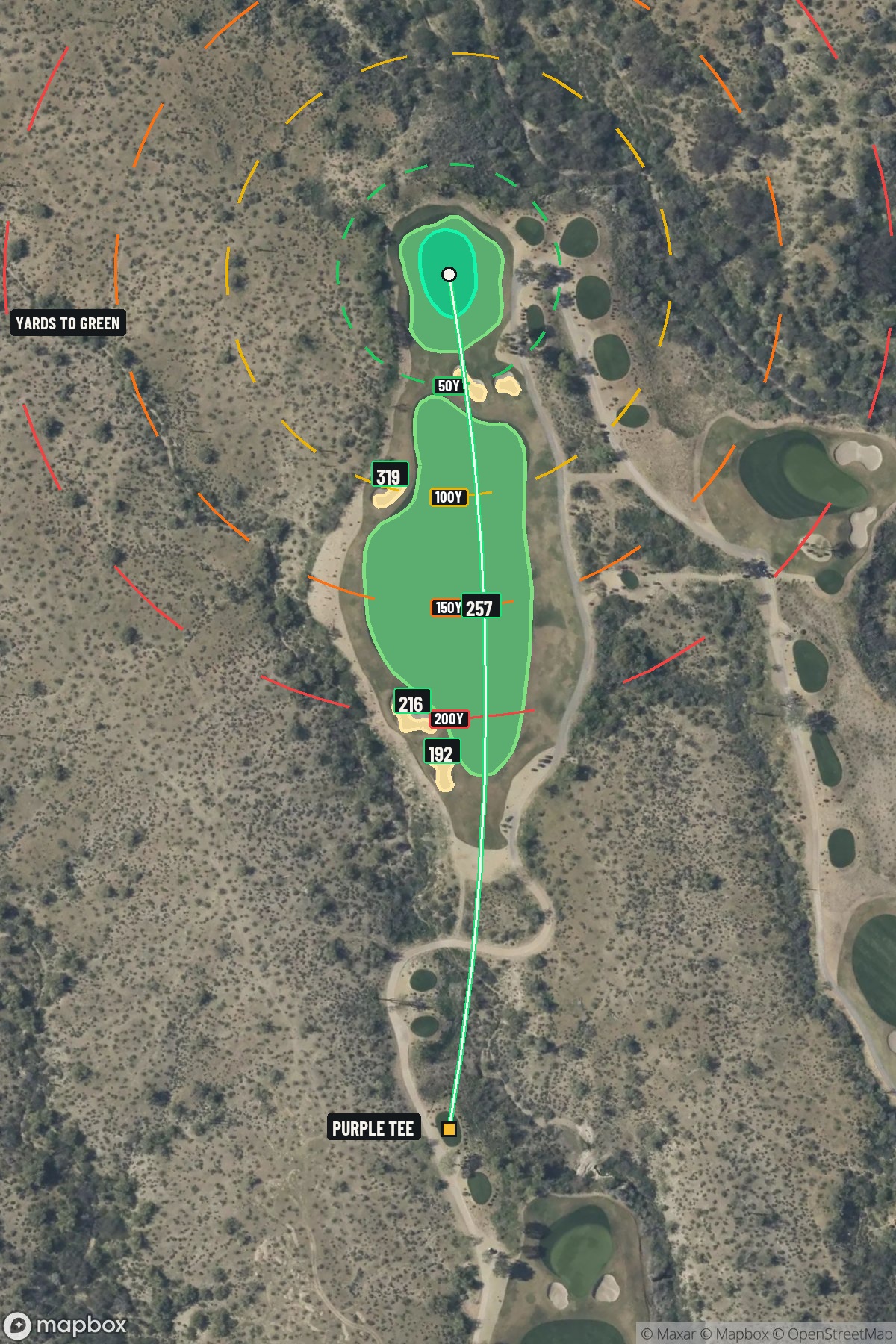
Map distances from Purple tee · 395 yds
The map's printed distances are measured from the Purple tee to the green; they do not move when you change tees. Your Gold yardage is in the tiles above.
Green size: 41 yds deep × 27 yds wide
Mapbox Satellite composite · capture date not provided. Green at the top.
Where this map comes from
- Satellite photo
- Date not published
- Mapbox satellite
- Green contours
- 2020–2021 survey
- USGS lidar survey
The plan for No. 13
These notes were written before the current map. Where their distances differ, trust the map.
The play: The 13th hole at We-Ko-Pa's Cholla Course offers one of the better scoring opportunities on the back nine, playing as a straight par 4 without significant hazards to penalize wayward shots. However, the small green demands precise approach shots, and the desert environment means any ball that strays too far offline will find the native vegetation. This is a hole where solid fundamentals and conservative strategy typically yield the best results.
Shot by shot
The green on No. 13
Mapped boundary- Wide × deepyards
- 27×41
- Areasq ft
- 6,206
Gear for Hole 13
5bunkers
Bring a sand wedge you trust
 Titleist Vokey SM10 Tour Chrome$180 MSRPCheck priceCompare all picks →
We may earn a commission when you buy through these links.
How did Hole 13 play?
How did this hole play today?
Frequently asked questions
Yardage reference: Gold tees · 420 yards.
What's the best strategy off the tee?
↓
For this 420-yard par 4, most players will hit driver to set up a comfortable approach.
How difficult is hole 13?
↓
This hole is a moderate challenge for most golfers. Key challenges include: heavily bunkered.
How big is the green on hole 13?
↓
The green is fairly large with multiple pin positions. Lag putting becomes important on longer putts.
Research notes
- A big fairway with a section jutting left; the small tree in it rarely matters. The green sits in a bowl, and the back slope can act as a backstop. (Hole 13 (Composite 347))[1]
- Blind drive to a very wide fairway. A lone mesquite on the right and two bunkers ahead are the aiming points. The bunkers that look greenside are about 20 yards short, with a hill beyond the green. (Paragraph 11)[2]
- The aggressive line is left, just left of the tree, to a plateau by the bunker for the best angle. There is lots of room right, but the green is hidden from there, so check the pin on the cart GPS. (09:30–11:00)[3]
- Cholla reopened on 28 Oct 2016 after a $1.8M renovation. All 18 greens changed from Tifdwarf to faster MiniVerde ultradwarf Bermuda, and every bunker got new sand and drainage. About six acres of turf were replaced with native desert. (Paragraphs 1 and 5)[4]
- GM Matt Barr calls Cholla a traditional desert course played 'pod to pod', with a few more forced carries and slightly bigger greens than Saguaro. — Matt Barr (Barr quote, design-philosophy section)[5]
- Local 'Desert Rule': for a ball in the desert, the player may, under a one-stroke penalty, drop within two club lengths of where the ball last crossed the turf line. (Page 1, local rules)[6]
- Miller chose land dominated by natural desert washes from the McDowell Mountains. He routed most holes up or down those washes and moved more than 500,000 cubic yards of material. (Cholla section)[7]
Miller says desert courses should keep a recovery shot, because a ball in brittle bush is often unplayable. That is why Cholla has 'saving bunkers' and room to play.
— Scott Miller (Course description, Miller quote)[8]- Scott Miller (2001) built Cholla around clear landing areas and well-defined, visible trouble, with a risk/reward line off every tee. The club calls it more 'traditional desert golf' than Saguaro, with some forced carries, especially on par-5 second shots. (Course description paragraphs 2 and final)[8]
- The club's 08/24 Cholla card lists par 72 with five sets: Cholla 7,225 (73.4/138), Purple 6,740 (70.7/133), Composite 6,436 (69.4/126), White 6,114 (67.5/119; ladies 73.6/130) and Green 5,289 (64.2/112; ladies 69.3/124). Yardages are measured to the centre of the green. (Page 1 ratings table; page 2 totals)[6]
- The front nine opens with a run of narrow, severe desert holes. The back nine is less taxing, with wider fairways and corridors; only the long par-3 11th and the par-4 16th stand out as clearly difficult. (Paragraphs 2 and 7)[2]
Sources
- We-Ko-Pa Golf Club (Cholla) — Tiger Golf Travelerhttps://tigergolftraveler.com/2018/10/08/we-ko-pa-golf-club-cholla/
- We-Ko-Pa – Cholla — The Ardent Golferhttps://ardentgolfer.wordpress.com/we-ko-pa-cholla/
- Back 9 at We-Ko-Pa Cholla Course — Two Under Pa (YouTube)https://www.youtube.com/watch?v=ojvMp7ta6LQ
- Cholla Course at We-Ko-Pa Golf Club Reopens After Renovation — We-Ko-Pa Golf Clubhttps://wekopa.com/cholla-course-at-we-ko-pa-golf-club-reopens-after-renovation/
- We-Ko-Pa's Cholla and Saguaro courses are cause for pause — Sports Illustratedhttps://www.si.com/golf/travel/feature-2020-03-16-we-ko-pa-duo-is-cause-for-pause
- We-Ko-Pa Golf Club — Cholla scorecard (printed 08/24) — We-Ko-Pa Golf Clubhttps://wekopa.com/wp-content/uploads/2024/07/WKPC-SC-2024-Cholla.pdf
- Cholla Vs. Saguaro — We-Ko-Pa Golf Club — We-Ko-Pa Golf Clubhttps://wekopa.com/cholla-vs-saguaro/
- Cholla Course — We-Ko-Pa Golf Club — We-Ko-Pa Golf Clubhttps://wekopa.com/cholla-course/