Hole 14 of 18 · Fort Mcdowell, Arizona
Hole 14 at We-Ko-Pa Golf Club (Cholla)
- Par
- 3
- Yards
- 177
- Handicap
- 18
- Bunkers
- 2
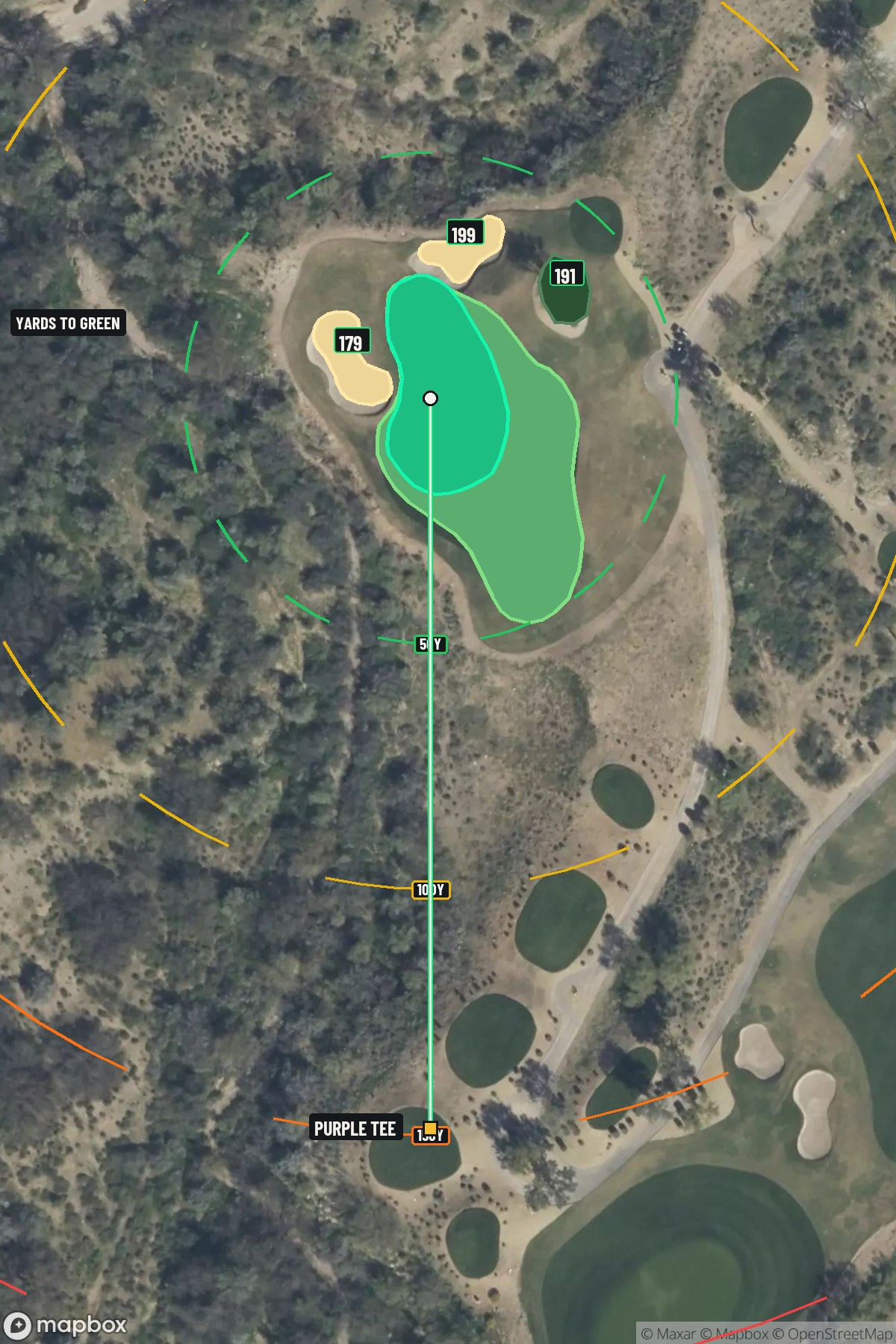
Map distances from Purple tee · 159 yds
The map's printed distances are measured from the Purple tee to the green; they do not move when you change tees. Your Gold yardage is in the tiles above.
Green size: 45 yds deep × 25 yds wide
Mapbox Satellite composite · capture date not provided. Green at the top.
Where this map comes from
- Satellite photo
- Date not published
- Mapbox satellite
- Green contours
- 2020–2021 survey
- USGS lidar survey
The plan for No. 14
These notes were written before the current map. Where their distances differ, trust the map.
The play: The 14th hole represents a classic desert par 3 where course management and smart club selection trump aggressive play. With the smallest handicap rating on the course, this hole rewards precision over power. The key strategic considerations center around committing to enough club to clear any desert trouble short of the green while avoiding the temptation to attack difficult pin positions on the compact putting surface.
Shot by shot
The green on No. 14
Mapped boundary- Wide × deepyards
- 25×45
- Areasq ft
- 6,250
Gear for Hole 14
177yd par 3
Know the exact number
 Bushnell Pro X3+$549 MSRPCheck priceCompare all picks →
We may earn a commission when you buy through these links.
How did Hole 14 play?
How did this hole play today?
Frequently asked questions
Yardage reference: Gold tees · 177 yards.
What club should I use on this par 3?
↓
At 177 yards, most golfers will need a mid-iron (7-iron to 8-iron) to reach this green. Adjust for elevation, wind, and pin position.
How difficult is hole 14?
↓
This hole is a good scoring opportunity for most golfers.
What hazards should I watch out for on hole 14?
↓
Key hazards include: 2 greenside bunkers. Plan your shots to avoid these trouble spots.
How big is the green on hole 14?
↓
The green is fairly large with multiple pin positions. The green is wider than it is deep, rewarding shots that find the correct tier. Lag putting becomes important on longer putts.
What's a good score on hole 14?
↓
This hole is a solid par with birdie chances for precise approach shots. Making par is a good result here. Focus on hitting the green and avoiding three-putts.
Research notes
- Almost a dogleg-left par 3, playing downhill to a green backed by two bunkers. (Hole 14 (Composite 159))[1]
- Downhill par 3: take at least one club less for the slope with no wind. (13:00–13:30)[2]
- Short downhill par 3 with a hint of a Redan bump front-right. It mostly affects front hole locations. (Paragraph 12)[3]
- Cholla reopened on 28 Oct 2016 after a $1.8M renovation. All 18 greens changed from Tifdwarf to faster MiniVerde ultradwarf Bermuda, and every bunker got new sand and drainage. About six acres of turf were replaced with native desert. (Paragraphs 1 and 5)[4]
- GM Matt Barr calls Cholla a traditional desert course played 'pod to pod', with a few more forced carries and slightly bigger greens than Saguaro. — Matt Barr (Barr quote, design-philosophy section)[5]
- Local 'Desert Rule': for a ball in the desert, the player may, under a one-stroke penalty, drop within two club lengths of where the ball last crossed the turf line. (Page 1, local rules)[6]
- Miller chose land dominated by natural desert washes from the McDowell Mountains. He routed most holes up or down those washes and moved more than 500,000 cubic yards of material. (Cholla section)[7]
Miller says desert courses should keep a recovery shot, because a ball in brittle bush is often unplayable. That is why Cholla has 'saving bunkers' and room to play.
— Scott Miller (Course description, Miller quote)[8]- Scott Miller (2001) built Cholla around clear landing areas and well-defined, visible trouble, with a risk/reward line off every tee. The club calls it more 'traditional desert golf' than Saguaro, with some forced carries, especially on par-5 second shots. (Course description paragraphs 2 and final)[8]
- The club's 08/24 Cholla card lists par 72 with five sets: Cholla 7,225 (73.4/138), Purple 6,740 (70.7/133), Composite 6,436 (69.4/126), White 6,114 (67.5/119; ladies 73.6/130) and Green 5,289 (64.2/112; ladies 69.3/124). Yardages are measured to the centre of the green. (Page 1 ratings table; page 2 totals)[6]
- The front nine opens with a run of narrow, severe desert holes. The back nine is less taxing, with wider fairways and corridors; only the long par-3 11th and the par-4 16th stand out as clearly difficult. (Paragraphs 2 and 7)[3]
Sources
- We-Ko-Pa Golf Club (Cholla) — Tiger Golf Travelerhttps://tigergolftraveler.com/2018/10/08/we-ko-pa-golf-club-cholla/
- Back 9 at We-Ko-Pa Cholla Course — Two Under Pa (YouTube)https://www.youtube.com/watch?v=ojvMp7ta6LQ
- We-Ko-Pa – Cholla — The Ardent Golferhttps://ardentgolfer.wordpress.com/we-ko-pa-cholla/
- Cholla Course at We-Ko-Pa Golf Club Reopens After Renovation — We-Ko-Pa Golf Clubhttps://wekopa.com/cholla-course-at-we-ko-pa-golf-club-reopens-after-renovation/
- We-Ko-Pa's Cholla and Saguaro courses are cause for pause — Sports Illustratedhttps://www.si.com/golf/travel/feature-2020-03-16-we-ko-pa-duo-is-cause-for-pause
- We-Ko-Pa Golf Club — Cholla scorecard (printed 08/24) — We-Ko-Pa Golf Clubhttps://wekopa.com/wp-content/uploads/2024/07/WKPC-SC-2024-Cholla.pdf
- Cholla Vs. Saguaro — We-Ko-Pa Golf Club — We-Ko-Pa Golf Clubhttps://wekopa.com/cholla-vs-saguaro/
- Cholla Course — We-Ko-Pa Golf Club — We-Ko-Pa Golf Clubhttps://wekopa.com/cholla-course/