Hole 16 at Colonial Country Club
- Par
- 3
- Yardage
- 188 yds
- Stroke index
- 18
- Hazards
- 4 bunkers · Water
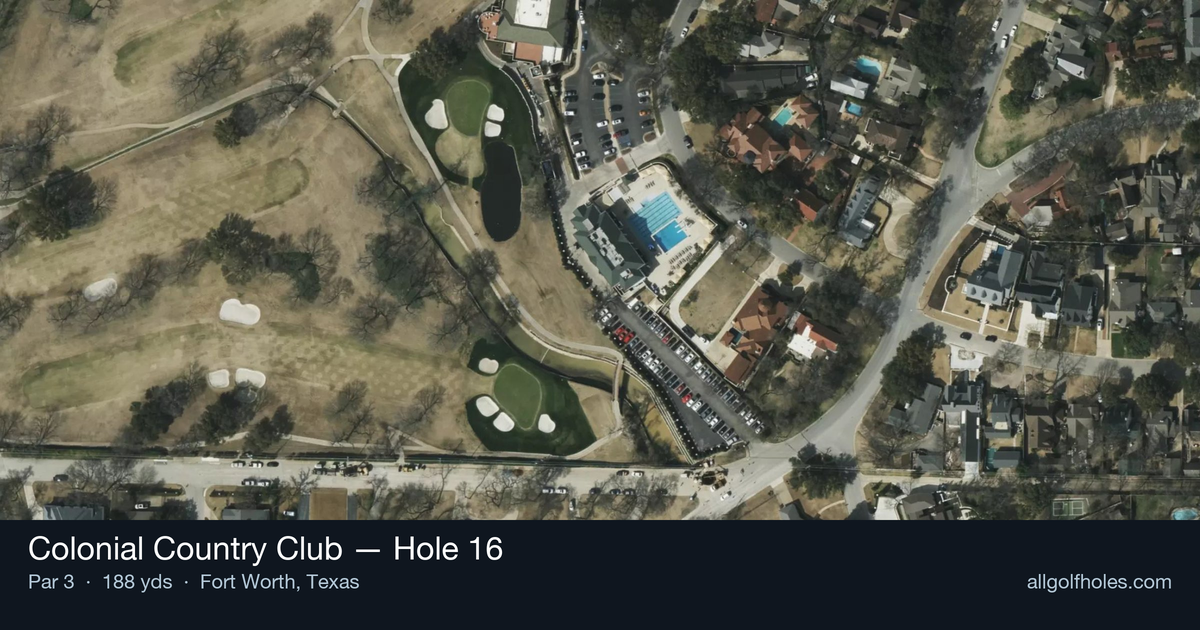
Aerial source not provided
Green size: 27 yds deep × 22 yds wide
Scorecard yardage is for Championship tees. The aerial shows its labeled reference position; distance rings measure to the green.
Championship tees · Par 3 · 188 yards
The plan for No. 16
The 16th at Colonial Country Club offers a deceptively challenging par 3 that demands precision over power. At 188 yards, this straight shot to a small green requires careful club selection and unwavering accuracy. The hole's minimalist design—free of major hazards—places the entire premium on execution, making it a true test of iron play under pressure. What makes Colonial Country Club hole 16 particularly treacherous is its position late in the round, where fatigue and mounting pressure can turn this seemingly straightforward tee shot into a card-wrecker. The compact green complex leaves little margin for error, rewarding only the most precise approach shots. It's the kind of hole that separates contenders from pretenders at this storied Fort Worth venue.
Off the tee
Club selection is absolutely critical on this hole - the small green leaves little margin for error in distance control. Most players will be looking at a mid-iron to long-iron depending on conditions, with wind being a major factor in the decision. The key is committing fully to your yardage and club choice rather than trying to manufacture a shot between clubs. Aim for the center of the green regardless of pin position, as the small target makes going for tucked pins a high-risk proposition. Take one extra club if you're between selections - being long is typically more manageable than coming up short on a hole of this length. ## APPROACH Since this is a par-3, your tee shot IS your approach shot, making execution even more crucial. Focus on a smooth, balanced swing rather than trying to muscle the shot. The small green demands precision, so maintain your tempo and trust your yardage. Pay close attention to wind conditions, as they can significantly affect club selection on this length of shot. If the pin is tucked in a corner, resist the temptation to fire directly at it - the center of the green is always your friend on a target this small. ## ON THE GREEN The small green means you won't face extremely long putts if you find the putting surface, but it also means the slopes and breaks will be more pronounced relative to the green's size. Focus on lag putting to ensure you don't leave yourself with difficult second putts. Speed control becomes even more important on a smaller surface where running putts off the green is a real concern. Study the green's contours carefully during your approach - with limited real estate, every subtle break matters more. ## RISK VS REWARD The primary risk/reward decision comes in pin hunting versus playing to the center of the green. With such a small target, the reward for going directly at tucked pins rarely justifies the risk of missing the green entirely. The smart play is almost always the center of the green, accepting a potential 20-30 foot putt rather than risking a difficult up-and-down. This conservative approach aligns with Colonial's reputation as a course that rewards patience and punishes aggression. ## DIFFERENT SKILL LEVELS **High-Handicap Players:** Take the guesswork out by always aiming for the center of the green, regardless of pin position. Focus on making solid contact with a club you're confident in, even if it means being slightly long or short. A bogey from just off the green is far better than a double or triple from a poor miss. **Low-Handicap Players:** While you have the skills to attack pins, the small green still demands respect. Consider pin hunting only when the flag is in the middle third of the green. Use your superior distance control to be more aggressive with club selection, but maintain the discipline to aim center when pins are tucked tight. The 16th hole at Colonial serves as a reminder that even seemingly straightforward holes can test every aspect of your game when precision is required.
Approach & recovery
Since this is a par-3, your tee shot IS your approach shot, making execution even more crucial. Focus on a smooth, balanced swing rather than trying to muscle the shot. The small green demands precision, so maintain your tempo and trust your yardage. Pay close attention to wind conditions, as they can significantly affect club selection on this length of shot. If the pin is tucked in a corner, resist the temptation to fire directly at it - the center of the green is always your friend on a target this small. ## ON THE GREEN The small green means you won't face extremely long putts if you find the putting surface, but it also means the slopes and breaks will be more pronounced relative to the green's size. Focus on lag putting to ensure you don't leave yourself with difficult second putts. Speed control becomes even more important on a smaller surface where running putts off the green is a real concern. Study the green's contours carefully during your approach - with limited real estate, every subtle break matters more. ## RISK VS REWARD The primary risk/reward decision comes in pin hunting versus playing to the center of the green. With such a small target, the reward for going directly at tucked pins rarely justifies the risk of missing the green entirely. The smart play is almost always the center of the green, accepting a potential 20-30 foot putt rather than risking a difficult up-and-down. This conservative approach aligns with Colonial's reputation as a course that rewards patience and punishes aggression. ## DIFFERENT SKILL LEVELS **High-Handicap Players:** Take the guesswork out by always aiming for the center of the green, regardless of pin position. Focus on making solid contact with a club you're confident in, even if it means being slightly long or short. A bogey from just off the green is far better than a double or triple from a poor miss. **Low-Handicap Players:** While you have the skills to attack pins, the small green still demands respect. Consider pin hunting only when the flag is in the middle third of the green. Use your superior distance control to be more aggressive with club selection, but maintain the discipline to aim center when pins are tucked tight. The 16th hole at Colonial serves as a reminder that even seemingly straightforward holes can test every aspect of your game when precision is required.
On the green
The small green means you won't face extremely long putts if you find the putting surface, but it also means the slopes and breaks will be more pronounced relative to the green's size. Focus on lag putting to ensure you don't leave yourself with difficult second putts. Speed control becomes even more important on a smaller surface where running putts off the green is a real concern. Study the green's contours carefully during your approach - with limited real estate, every subtle break matters more. ## RISK VS REWARD The primary risk/reward decision comes in pin hunting versus playing to the center of the green. With such a small target, the reward for going directly at tucked pins rarely justifies the risk of missing the green entirely. The smart play is almost always the center of the green, accepting a potential 20-30 foot putt rather than risking a difficult up-and-down. This conservative approach aligns with Colonial's reputation as a course that rewards patience and punishes aggression. ## DIFFERENT SKILL LEVELS **High-Handicap Players:** Take the guesswork out by always aiming for the center of the green, regardless of pin position. Focus on making solid contact with a club you're confident in, even if it means being slightly long or short. A bogey from just off the green is far better than a double or triple from a poor miss. **Low-Handicap Players:** While you have the skills to attack pins, the small green still demands respect. Consider pin hunting only when the flag is in the middle third of the green. Use your superior distance control to be more aggressive with club selection, but maintain the discipline to aim center when pins are tucked tight. The 16th hole at Colonial serves as a reminder that even seemingly straightforward holes can test every aspect of your game when precision is required.
Watch for
- Mapped water (4) influences the playing line on this hole.
- Mapped bunkers (4) are in play around the landing areas and green.
Hole 16 Green Complex
Mapped green boundary
Green size: 3,011 sq ft
Course coverage
Tournament and creator videos about Colonial Country Club — shared course coverage, not hole-specific clips.
Tournament coverage
Charles Schwab Challenge highlights
Charles Schwab Challenge | Final Round Highlights
2025
Featured by these creators
Creator videos about this course
YouTube creators who filmed or featured Colonial Country Club. · Stats as of Oct 12, 2026 · 6d ago
Kiz breaks down his week at Colonial, his first PGA Tour event since November. @Chevrolet #Ad
Kevin Kisner breaks down his 2017 Colonial WIN over Jordan Spieth and Jon Rahm 🏆
The 2025 Year in Review, Part 8: Colonial, Memorial, Canada, & the U.S. Open | The Shotgun Start
Latest from LIV Korea, Rainy Thursday at Colonial, & Golf Advice | The Shotgun Start
Can Scottie win 10 majors, Sr. PGA hits Congressional, & the olds take Colonial | The Shotgun Start
How did Hole 16 play?
How did this hole play today?
Frequently asked questions
Yardage reference: Championship tees · 188 yards.
What club should I use on this par 3?
↓
At 188 yards, most golfers will need a long iron or hybrid (5-iron to 6-iron) to reach this green. Adjust for elevation, wind, and pin position.
How difficult is hole 16?
↓
This hole is one of the tougher holes on the course for most golfers. Key challenges include: water in play, heavily bunkered, small green.
How big is the green on hole 16?
↓
The green is small and requires precision. The green is deeper than wide, so club selection is crucial. Expect challenging pin positions with limited room for error.
Where is the best miss on hole 16?
↓
If you're going to miss the green, favor the left side. The right (water) brings more trouble into play and makes recovery difficult.