Hole 2 at Bandon Dunes Resort (Bandon Trails Course)
- Par
- 3
- Yardage
- 214 yds
- Stroke index
- 17
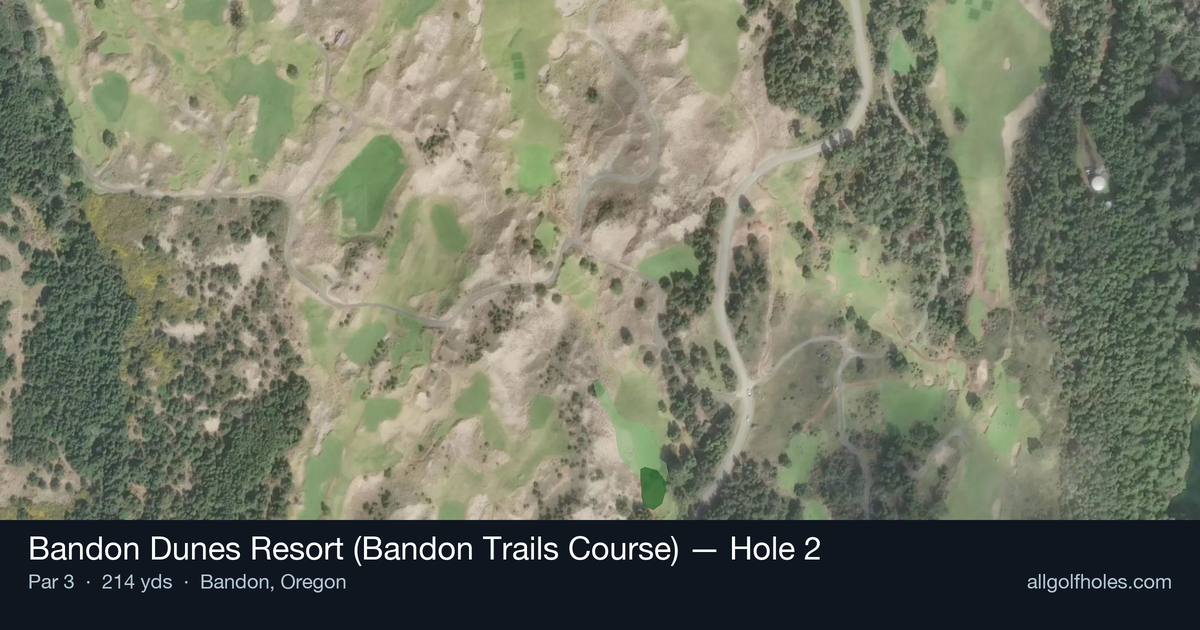
Aerial source not provided
Green size: 38 yds deep × 28 yds wide
Scorecard yardage is for Championship tees. The aerial shows its labeled reference position; distance rings measure to the green.
Championship tees · Par 3 · 214 yards
The plan for No. 2
Bandon Trails' second hole presents a deceptively challenging par 3 that embodies the course's rugged coastal character. From the elevated tee, golfers face a 214-yard carry to a small, well-protected green that demands precision over power. The absence of major hazards might suggest an easier approach, but the green's compact size and subtle undulations create their own strategic puzzle. Wind conditions, typical of Oregon's dramatic coastline, can dramatically alter club selection and shot trajectory. The hole rewards accurate iron play and punishes overconfidence, as missing the putting surface leaves difficult recovery shots. This straightforward yet demanding par 3 perfectly captures Bandon Trails' philosophy of strategic golf in a spectacular natural setting.
Off the tee
Club selection is everything on this hole. Most golfers will need anywhere from a 5-iron to a hybrid depending on wind conditions and pin position. Take one extra club and swing smoothly rather than forcing a shot with insufficient club. Aim for the center of the green regardless of pin position - the small green size makes going flag-hunting a risky proposition. Pay close attention to wind direction and strength, as the exposed nature of most links-style holes at Bandon can dramatically affect ball flight over this distance.
Approach & recovery
Since this is a par-3, your tee shot IS your approach. Focus on trajectory control - you'll likely need a higher ball flight to hold the small green surface. Consider the firmness of the green when selecting your club, as harder conditions may require landing the ball short and allowing it to release. If the pin is tucked to one side, still play to the center unless you're feeling particularly confident with your iron play.
On the green
Small greens typically feature subtle but significant slopes that can be deceiving from the tee. Take time to read the green carefully, as three-putts from long range can quickly turn a good tee shot into a disappointing bogey. The key is getting your first putt close enough for a comfortable par save. Don't be overly aggressive with birdie attempts unless you have a short putt. ## RISK VS REWARD The primary risk/reward decision comes in club selection and target choice. The conservative play is taking plenty of club and aiming dead center, virtually guaranteeing you'll be putting for par. The aggressive play involves going after tucked pins, but with a small green, the margin for error is minimal. Given the hole's length, making par should be considered a victory. ## DIFFERENT SKILL LEVELS **Higher Handicap Players:** Focus entirely on finding the green with your tee shot. Use whatever club gives you confidence to make solid contact - even if that means a hybrid or fairway wood. Don't worry about pin position; just get the ball somewhere on the putting surface and two-putt for par. **Lower Handicap Players:** You have the luxury of being more precise with your target selection. Still prioritize the center of the green, but you can be slightly more aggressive with pin positions. Consider how the wind and green conditions affect your club selection, and don't be afraid to take one more club than you think you need to ensure you clear any front trouble and hold the green. The beauty of this hole lies in its simplicity - execute one good swing and you're likely walking away with par or better. Let the lack of major hazards work in your favor by committing fully to your club selection and swing.
Watch for
- While no bunkers are identified around this green, the lack of a fairway landing zone means any mishit will likely find natural hazards or rough - commit fully to reaching the putting surface
Hole 2 Green Complex
Mapped green boundary
Green size: 5,707 sq ft
Course coverage
Tournament and creator videos about Bandon Dunes Resort (Bandon Trails Course) — shared course coverage, not hole-specific clips.
Featured by these creators
Creator videos about this course
YouTube creators who filmed or featured Bandon Dunes Resort (Bandon Trails Course). · Stats as of Oct 12, 2026 · 5d ago
Our Stroke Play Competition At Bandon Dunes Got Off To A Hot Start! (Bandon Belt Episode 1)
Maintaining Bandon Dunes: Oregon's Links Golf Mecca | All Grass Is Local | Pres. by Toro
The Evolution of Maintaining Bandon Dunes Resort | All Grass Is Local
PGA Professional Championship 2026 at Bandon Dunes.
PGA Professional Championship 2026 at Bandon Dunes
PGA Professional Championship 2026 at Bandon Dunes.
How did Hole 2 play?
How did this hole play today?
Frequently asked questions
Yardage reference: Championship tees · 214 yards.
What club should I use on this par 3?
↓
At 214 yards, most golfers will need a fairway wood or hybrid to reach this green. Adjust for elevation, wind, and pin position.
How difficult is hole 2?
↓
This hole is a moderate challenge for most golfers. Key challenges include: long par 3.
How big is the green on hole 2?
↓
The green is medium-sized with moderate targets. The green is deeper than wide, so club selection is crucial. Pay attention to pin placement when selecting your approach club.
What's a good score on hole 2?
↓
This hole is a challenging par where bogey is acceptable. This longer par 3 will test your long iron or hybrid game. Par is a good score.