Hole 4 at Muirfield Village Golf Club
- Par
- 3
- Yardage
- 210 yds
- Stroke index
- 17
- Hazards
- 4 bunkers
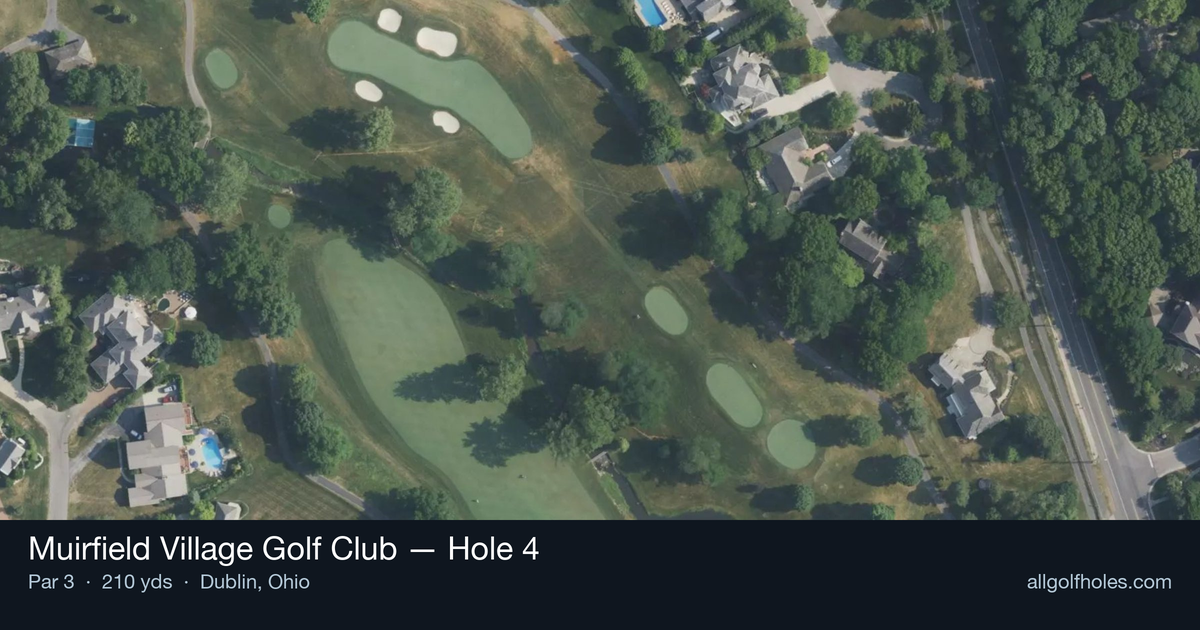
Aerial source not provided
Green size: 48 yds deep × 28 yds wide
Scorecard yardage is for Championship tees. The aerial shows its labeled reference position; distance rings measure to the green.
Championship tees · Par 3 · 210 yards
The plan for No. 4
The fourth hole at Muirfield Village Golf Club exemplifies Jack Nicklaus's strategic design philosophy with a deceptively challenging par 3 that plays 210 yards to a small, well-protected green. This signature hole at "Jack's Place" demands precision over power, as the compact putting surface leaves little margin for error on approach shots. The absence of major hazards might fool players into complacency, but the green's subtle contours and strategic bunkering require careful club selection and precise execution. What makes this hole memorable is its ability to test even the most skilled golfers' accuracy while rewarding those who commit fully to their tee shot with proper distance control and green-reading skills.
Off the tee
Your tee shot is everything on this hole - there's no recovery shot to bail you out. Club selection becomes critical, typically requiring a long iron to hybrid depending on wind conditions and pin position. Focus on smooth tempo rather than forcing extra distance, as the small green punishes any shot that's slightly off-line. Aim for the center of the green regardless of pin position, as the compact target makes aggressive pin-hunting a high-risk proposition. Take one extra club if there's any doubt, as being short of this green often leaves a more difficult recovery than being slightly long.
Approach & recovery
Since this is a par 3, your approach shot is your tee shot. The key consideration is understanding that the small green size amplifies any directional mistakes. Wind assessment becomes crucial at this distance - even a slight breeze can significantly affect ball flight over 200+ yards. Consider the pin position only after ensuring you have enough club to reach the back edge of the green. The straight hole layout means you won't have to worry about doglegs affecting your angle, allowing you to focus entirely on distance control and accuracy.
On the green
The small green size means putting strategy revolves around lag putting and avoiding three-putts rather than aggressive birdie attempts. Speed control becomes paramount on a compact surface where running putts past the hole can leave challenging comeback attempts. Read the green carefully from multiple angles during your approach, as you'll have limited time once on the putting surface. Focus on getting your first putt within a three-foot radius of the hole rather than trying to hole everything. ## RISK VS REWARD This hole offers a clear risk/reward scenario: aggressive pin-hunting versus conservative center-green strategy. The reward for attacking pins is a potential birdie opportunity, but the risk is missing the small green entirely and facing a difficult up-and-down. The conservative play to the center of the green virtually guarantees a par opportunity while minimizing the chance of a damaging bogey or worse. Given the hole's handicap ranking of 17, most players should opt for the conservative approach and take their par gladly. ## DIFFERENT SKILL LEVELS **High-handicap players** should focus entirely on finding the green with their most reliable long iron or hybrid. Ignore pin positions completely and aim for the largest portion of the green. Take an extra club to ensure you don't come up short, and practice your pre-shot routine to maintain confidence over this intimidating shot. **Low-handicap players** can be more aggressive with pin positions, especially when the pin is in the center portion of the green. However, even skilled players should resist the urge to attack extreme pin positions on such a small target. Focus on committed swings with proper club selection, and remember that a stress-free par on a long par 3 is always a good score. The beauty of Jack Nicklaus's design philosophy shines through on this hole - it appears simple but demands execution under pressure, making it a true test of both physical skill and mental course management.
Hole 4 Green Complex
Mapped green boundary
Green size: 5,396 sq ft
Course and tournament history
Historical context for the course and venue. Each entry identifies the event or course it describes.
2013 · Jack Nicklaus
(2013) Muirfield Village was the brainchild of Jack Nicklaus, earning its nickname of "Jack's Place"
Source →2024 · Scottie Scheffler
The creek appears docile, with its mown banks and sleep-calming trickle, but as it winds down the left flank of the par-4 18th fairway at Muirfield Village Golf Club, particularly on a certain springtime Sunday afternoon, it has as much menace as a raging sea
Source →
Course coverage
Tournament and creator videos about Muirfield Village Golf Club — shared course coverage, not hole-specific clips.
Tournament coverage
The Memorial Tournament highlights
the Memorial Tournament | Final Round Highlights
2025
How did Hole 4 play?
How did this hole play today?
Frequently asked questions
Yardage reference: Championship tees · 210 yards.
What club should I use on this par 3?
↓
At 210 yards, most golfers will need a fairway wood or hybrid to reach this green. Adjust for elevation, wind, and pin position.
How difficult is hole 4?
↓
This hole is a moderate challenge for most golfers. Key challenges include: long par 3, heavily bunkered.
What hazards should I watch out for on hole 4?
↓
Key hazards include: 4 greenside bunkers. Plan your shots to avoid these trouble spots.
How big is the green on hole 4?
↓
The green is medium-sized with moderate targets. The green is wider than it is deep, rewarding shots that find the correct tier. Pay attention to pin placement when selecting your approach club.
What's a good score on hole 4?
↓
This hole is a challenging par where bogey is acceptable. This longer par 3 will test your long iron or hybrid game. Par is a good score.