Hole 16 at Muirfield Village Golf Club
- Par
- 3
- Yardage
- 200 yds
- Stroke index
- 18
- Hazards
- 3 bunkers · Water
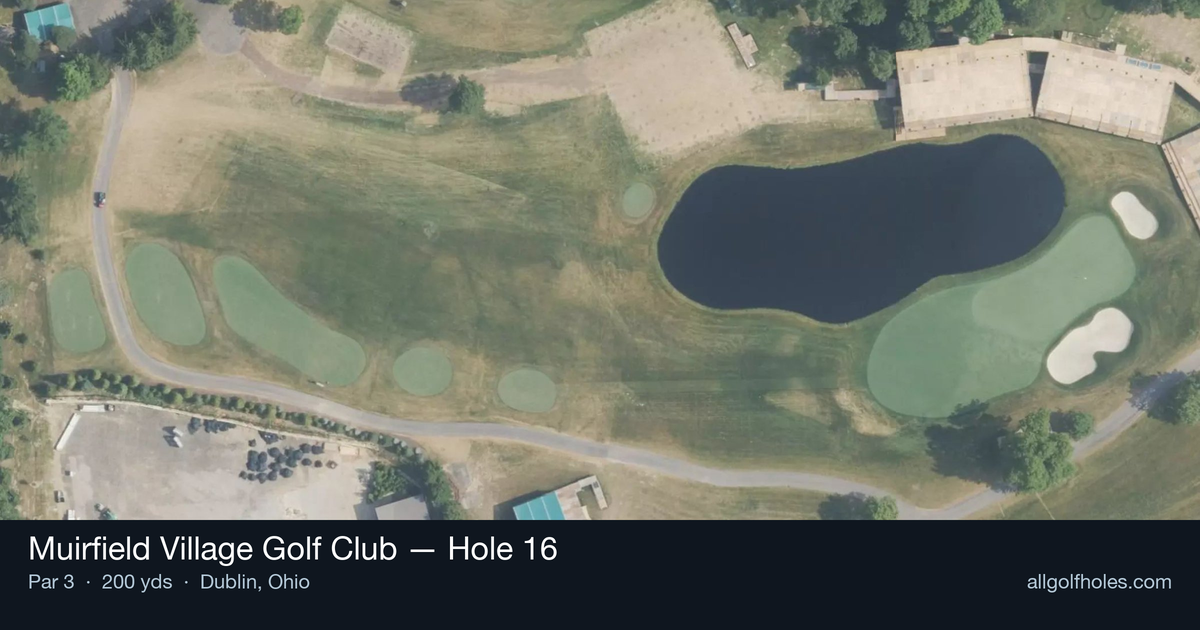
Aerial source not provided
Green size: 34 yds deep × 29 yds wide
Scorecard yardage is for Championship tees. The aerial shows its labeled reference position; distance rings measure to the green.
Championship tees · Par 3 · 200 yards
The plan for No. 16
The redesigned 16th hole at Muirfield Village Golf Club represents Jack Nicklaus's vision of a "more player-friendly" par 3, though the Golden Bear's definition of friendly remains characteristically demanding. This 200-yard test requires precise club selection and unwavering commitment, as the compact green complex offers little margin for error. The hole's deceptive simplicity masks its strategic complexity - while appearing straightforward from the tee, the small target demands surgical precision with mid-to-long irons. Recent tweaks since the 2020 renovation have refined the challenge further, creating a hole where Memorial Tournament professionals and weekend warriors alike must respect every yard. The absence of major hazards shifts focus entirely to execution, making this Muirfield Village Golf Club hole 16 a pure test of ball-striking ability in the closing stretch.
Off the tee
Club selection is paramount on this hole, with most players requiring anything from a mid-iron to hybrid depending on conditions and pin placement. The straight layout means there's no room for a miss-and-recover mentality - your tee shot must find the putting surface or face a challenging up-and-down. Focus on smooth tempo rather than forcing extra distance. The small green size means precision trumps power every time. Commit fully to your club choice and swing within yourself to maintain accuracy. Wind conditions at Muirfield Village can significantly impact club selection, so factor in any breeze before making your final decision.
Approach & recovery
Since this is a par-3, your tee shot IS your approach shot, making target selection critical. Study the pin position carefully - when the flag is tucked in a corner or positioned on the smaller portion of the green, consider aiming for the center of the putting surface rather than chasing the pin. The green's small size means there's little margin for error in any direction. Favor the fat part of the green when in doubt, as even a 30-foot putt is preferable to a difficult chip shot from the surrounding areas.
On the green
The small green creates challenging putting scenarios even from seemingly good positions. Expect subtle breaks and quick speeds typical of Nicklaus designs. Three-putts can happen quickly if you're overly aggressive with your first putt. Pay attention to grain direction and any slopes, as the compact putting surface can create deceptive reads. When facing longer putts, prioritize lag putting to ensure you don't leave yourself a knee-knocker coming back. ## RISK VS REWARD The primary risk/reward decision centers on pin hunting versus playing to the center of the green. When the pin is accessible and you're confident in your distance control, attacking can yield birdie opportunities. However, the penalty for missing is severe enough that conservative play often proves wise. Consider the context of your round - if you need birdies, this hole offers a legitimate scoring opportunity. If you're protecting a good score, the center of the green strategy minimizes disaster. ## DIFFERENT SKILL LEVELS **High-Handicap Players:** Focus entirely on finding the putting surface with your most reliable mid-to-long iron. Ignore pin positions and aim for the center of the green every time. A bogey here isn't devastating given the handicap rating, but double-bogey or worse can be round-killers. **Low-Handicap Players:** You can be more aggressive with pin hunting, especially when the flag is in the larger portion of the green. Use your distance control skills to attack accessible pins while still respecting the small target. Consider how this hole fits into your overall round strategy - sometimes par is a great score even for skilled players. The 16th at Muirfield Village rewards patience and precision while punishing indecision and poor execution. Trust your yardage, commit to your club selection, and remember that even after multiple renovations, Jack Nicklaus designed this hole to test your mental game as much as your physical skills.
Hole 16 Green Complex
Mapped green boundary
Green size: 3,939 sq ft
Course and tournament history
Historical context for the course and venue. Each entry identifies the event or course it describes.
1974 · Jack Nicklaus
Since its opening in 1974, Jack Nicklaus has remodeled every hole at Muirfield Village, some more than once, using play at the PGA Tour’s annual Memorial Tournament for some guidance. The renovation i
Source →Jack Nicklaus
Muirfield Village was the brainchild of Jack Nicklaus, earning its nickname of "Jack's Place"
Source →
Course coverage
Tournament and creator videos about Muirfield Village Golf Club — shared course coverage, not hole-specific clips.
Tournament coverage
The Memorial Tournament highlights
the Memorial Tournament | Final Round Highlights
2025
How did Hole 16 play?
How did this hole play today?
Frequently asked questions
Yardage reference: Championship tees · 200 yards.
What club should I use on this par 3?
↓
At 200 yards, most golfers will need a long iron or hybrid (5-iron to 6-iron) to reach this green. Adjust for elevation, wind, and pin position.
How difficult is hole 16?
↓
This hole is one of the tougher holes on the course for most golfers. Key challenges include: water in play, small green.
What hazards should I watch out for on hole 16?
↓
Key hazards include: 3 greenside bunkers; water at 155.8 yards. Plan your shots to avoid these trouble spots.
How big is the green on hole 16?
↓
The green is small and requires precision. The green is wider than it is deep, rewarding shots that find the correct tier. Expect challenging pin positions with limited room for error.