Hole 6 at Arcadia Bluffs Golf Club
- Par
- 3
- Yardage
- 195 yds
- Stroke index
- 9
- Hazards
- 2 bunkers
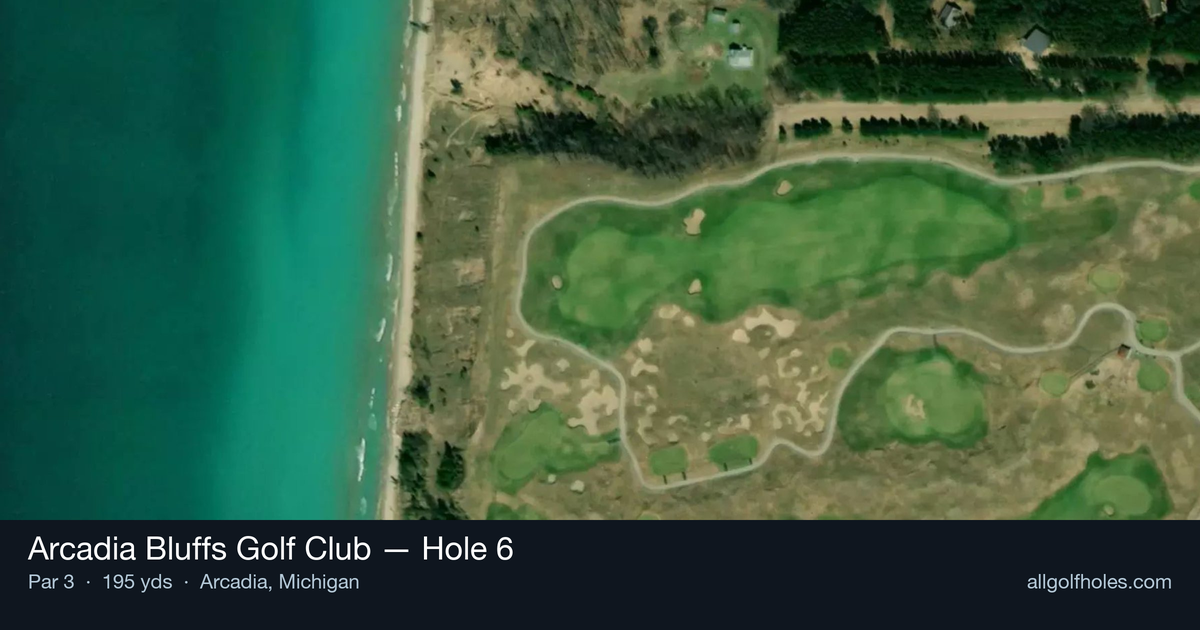
Aerial source not provided
Green size: 50 yds deep × 53 yds wide
Scorecard yardage is for Championship tees. The aerial shows its labeled reference position; distance rings measure to the green.
Championship tees · Par 3 · 195 yards
The plan for No. 6
Hole 6 at Arcadia Bluffs Golf Club presents one of Michigan's most dramatic par 3 experiences, where golfers fire their tee shot into a natural dune amphitheater. This 195-yard test demands precision as the small green sits nestled at the bottom of towering sand dunes that create an intimate, almost mystical playing environment. The elevated tee provides a commanding view of this unique green complex, but the intimidating dune walls surrounding the target require golfers to commit fully to their club selection and swing. With minimal hazards beyond the challenging terrain, success depends entirely on accurate distance control and the mental fortitude to execute under the watchful gaze of Arcadia's signature dunes. This hole epitomizes the genius of Rick Smith and Warren Henderson's design philosophy.
Off the tee
From the elevated tee, club selection becomes paramount on this downhill par 3. The elevation drop typically plays one to two clubs less than the actual yardage, so most players will find themselves between a mid-iron and long-iron depending on conditions and pin position. Aim for the center of the green regardless of pin placement, as the small target demands precision over aggression. The key is making a confident, committed swing – the dune amphitheater can create an intimidating visual that leads to deceleration through impact. Trust your yardage and swing with conviction.
Approach & recovery
Since this is a par 3, your tee shot is your approach. The straight layout means there's no preferred angle to attack, making accuracy the primary concern. The small green size means you must be precise with both distance and direction. Wind can be a significant factor on this exposed hole, so pay careful attention to conditions and adjust your club selection accordingly. The dunes provide some protection, but crosswinds can still affect ball flight significantly.
On the green
The small green at the 6th demands respect with your putting approach. While specific break patterns aren't detailed, the natural dune setting suggests subtle undulations that follow the land's natural contours. Focus on speed control, as the elevated approach often leaves uphill putts that can easily run past the hole on a small surface. Take time to read the green carefully from multiple angles, as the amphitheater setting can create optical illusions regarding slope and break. ## RISK VS REWARD This hole offers limited risk/reward opportunities given its straightforward par 3 design. The primary decision involves pin hunting versus playing safe to the green's center. With the small green size, aggressive pin seeking rarely pays off unless you're supremely confident in your iron play. The smart play is always the center of the green, accepting a longer putt in exchange for avoiding the surrounding trouble and ensuring you're putting rather than chipping. ## DIFFERENT SKILL LEVELS **High Handicappers:** Focus entirely on getting the ball on the green. Take one extra club to account for the elevation drop and any tendency to come up short under pressure. Aim for the absolute center of the green and don't let the dramatic setting intimidate you into a poor swing. A bogey here is perfectly acceptable. **Mid Handicappers:** Use the elevation change to your advantage by taking one less club than normal and making an aggressive swing. Still aim for the green's center, but you can be slightly more aggressive with pin positions in the middle third of the green. **Low Handicappers:** This is a scoring opportunity if you execute properly. You can attack more pin positions, but respect the small green size. The key is precise distance control – being pin-high is more important than being perfectly on line. Consider the amphitheater's wind patterns and how they might affect your ball flight. The 6th hole at Arcadia Bluffs exemplifies the course's genius use of natural dune features, creating a memorable and challenging one-shot hole that rewards precision and punishes indecision.
Watch for
- Course conditioning and mapped hazards may affect line selection; confirm from the aerial.
Hole 6 Green Complex
Mapped green boundary
Green size: 13,916 sq ft
Course coverage
Tournament and creator videos about Arcadia Bluffs Golf Club — shared course coverage, not hole-specific clips.
Featured by these creators
Creator videos about this course
YouTube creators who filmed or featured Arcadia Bluffs Golf Club. · Stats as of Oct 12, 2026 · 5d ago
Course Record - Arcadia Bluffs
How did Hole 6 play?
How did this hole play today?
Frequently asked questions
Yardage reference: Championship tees · 195 yards.
What club should I use on this par 3?
↓
At 195 yards, most golfers will need a long iron or hybrid (5-iron to 6-iron) to reach this green. Adjust for elevation, wind, and pin position.
How difficult is hole 6?
↓
This hole is a good scoring opportunity for most golfers. Key challenges include: large green requiring good lag putting.
How big is the green on hole 6?
↓
The green is large and can play quite long. Three-putt territory if you don't manage your approach distance well.