Hole 5 at Standard Country Club, The
- Par
- 4
- Yardage
- 403 yds
- Stroke index
- 5
- Hazards
- 4 bunkers
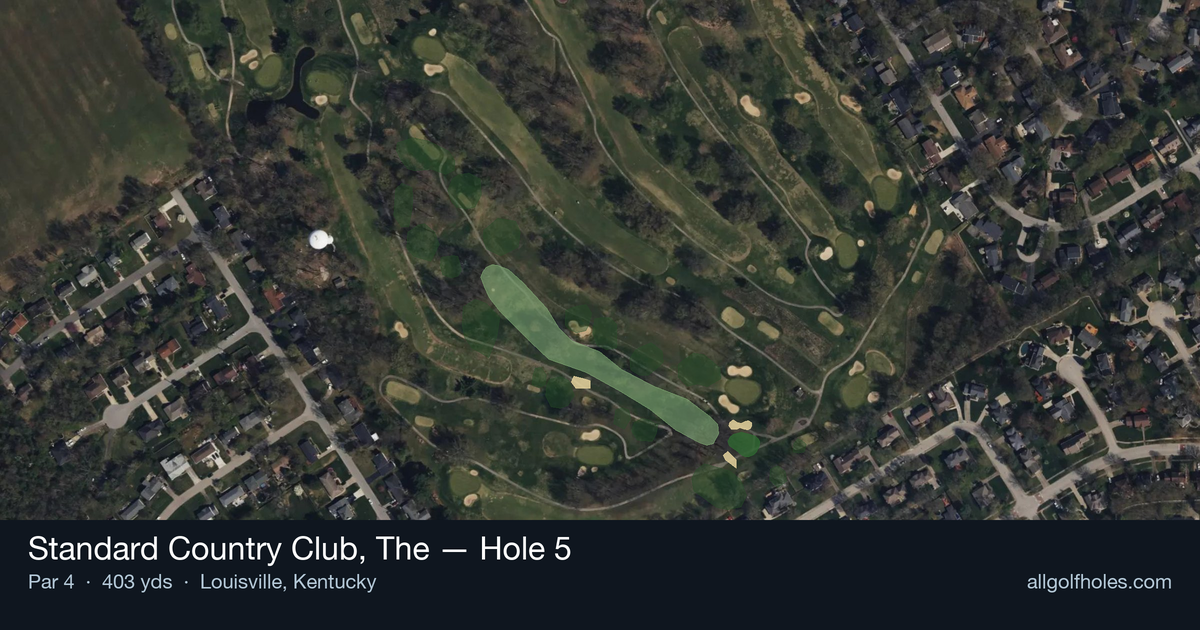
Aerial source not provided
Green size: 29 yds deep × 22 yds wide
Scorecard yardage is for Championship tees. The aerial shows its labeled reference position; distance rings measure to the green.
Championship tees · Par 4 · 403 yards
The plan for No. 5
The 5th hole at Standard Country Club, The presents a classic 403-yard par 4 that demands both precision and patience from golfers. This straight-away hole may appear deceptively simple from the tee, but its small green complex creates the primary challenge that earns its number 5 handicap ranking. The generous fairway allows players to focus on positioning for the crucial approach shot, where accuracy becomes paramount. With no significant hazards to navigate, success hinges entirely on executing a precise iron or wedge into the compact putting surface. The hole rewards strategic thinking over power, as finding the right angle and distance control proves essential for scoring opportunities. This demanding yet fair test exemplifies thoughtful golf course design.
Off the tee
The tee shot strategy centers on finding the optimal position in the fairway for your approach distance. Most players will benefit from a controlled driver or 3-wood, aiming for the center-left portion of the fairway to set up the best angle to the small green. The straight layout means there's no need to work the ball, but accuracy is paramount. Players who struggle with driver consistency should consider a fairway wood or long iron to ensure they stay in play, as hitting from the rough will make the already challenging approach shot even more difficult.
Approach & recovery
The approach shot is where this hole shows its teeth. With a small green as your target, precision trumps distance every time. Depending on your tee shot position, you'll likely face anything from a mid-iron to a long-iron for your second shot. The key is committing to a club that gets you to the center of the green rather than trying to get cute with pin positions. Take one extra club and swing smoothly - the small green leaves little margin for error, and being short or long can lead to difficult up-and-downs.
On the green
The small green demands respect with your putter in hand. Focus on lag putting to the center of the green when facing longer putts, as the limited surface area means aggressive putts that miss can easily roll off the putting surface. Pay attention to the overall slope and grain of the green, and don't be afraid to aim for the fat part of the hole on shorter putts. Two-putting should be your primary goal unless you have a very makeable birdie opportunity. ## RISK VS REWARD This hole offers limited risk/reward opportunities, which actually makes it more challenging mentally. The temptation might be to get aggressive with driver to shorten the approach, but the straight layout and small green reward conservative, accurate play. The real risk/reward decision comes on the approach shot - do you fire at a tucked pin or play to the center of the green? Given the small target, playing to the middle is almost always the percentage play. ## DIFFERENT SKILL LEVELS **Higher Handicap Players:** Focus on keeping the ball in play off the tee, even if it means hitting 3-wood or hybrid. On the approach, take plenty of club and aim for the center of the green regardless of pin position. Your primary goal is avoiding big numbers by staying out of trouble around the green. **Lower Handicap Players:** You can be more aggressive with driver off the tee, but still prioritize accuracy over distance. On approach shots, you have the skill to work the ball toward different pin positions, but respect the small green size. This is a hole where patience and precision can set up birdie opportunities, but forcing shots often leads to bogey or worse. The key to conquering this hole is embracing its straightforward nature while respecting the challenge of the small green. It's a perfect example of how golf course architecture can create difficulty through precision requirements rather than penal hazards.
Watch for
- Course conditioning and mapped hazards may affect line selection; confirm from the aerial.
Hole 5 Green Complex
Mapped green boundary
Green size: 3,853 sq ft
How did Hole 5 play?
How did this hole play today?
Frequently asked questions
Yardage reference: Championship tees · 403 yards.
What's the best strategy off the tee?
↓
For this 403-yard par 4, most players will hit driver to set up a comfortable approach.
How difficult is hole 5?
↓
This hole is a moderate challenge for most golfers. Key challenges include: small green.
How big is the green on hole 5?
↓
The green is small and requires precision. Expect challenging pin positions with limited room for error.