Hole 6 at TPC at Deere Run
- Par
- 4
- Yardage
- 367 yds
- Stroke index
- 13
- Hazards
- 3 bunkers
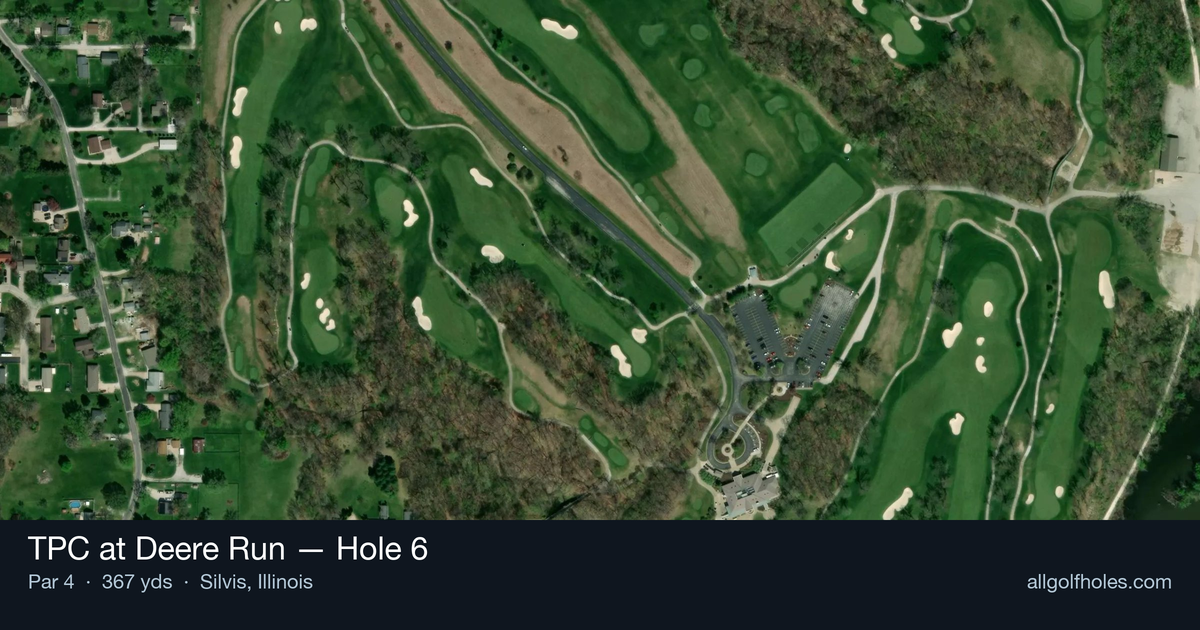
Aerial source not provided
Green size: 30 yds deep × 28 yds wide
Scorecard yardage is for Championship tees. The aerial shows its labeled reference position; distance rings measure to the green.
Championship tees · Par 4 · 367 yards
The plan for No. 6
The sixth hole at TPC at Deere Run, known as "William Butterworth," presents a deceptively straightforward par 4 at 367 yards that demands precision over power. This straight-away hole features a generous fairway that welcomes aggressive tee shots, but the real challenge lies in the approach to the small, well-protected green complex. D.A. Weibring's design philosophy shines through here, rewarding strategic thinking over brute force. The compact green requires careful club selection and precise distance control, as any approach shot that comes up short or long will leave a challenging recovery. Named after a prominent figure in Deere & Company history, this hole embodies the course's blend of playability and subtle challenge that has made it a favorite among John Deere Classic competitors for years.
Off the tee
The tee shot strategy centers on positioning rather than maximum distance. Most players should focus on hitting a controlled shot that leaves them with their preferred approach yardage. A driver isn't always necessary here – many golfers will benefit from hitting 3-wood or long iron to ensure they stay in the fairway and avoid any trouble that might lurk in the landing zone around 280-300 yards out. The straight layout allows you to aim down the center of the fairway with confidence. Focus on a smooth, controlled swing that prioritizes accuracy over distance. Leave yourself in the 100-150 yard range for the approach, which puts most mid-to-short irons in play for the second shot.
Approach & recovery
The approach shot is where this hole's true test reveals itself. The small green requires pinpoint accuracy, making club selection and commitment crucial. Depending on pin position, you'll likely be hitting anything from a wedge to a mid-iron. Pay careful attention to pin placement, as the compact green size means there's little margin for error. Aim for the center of the green when the pin is tucked, and only attack aggressive pin positions when you're confident in your distance control. The green's small size makes it essential to take enough club – being short or long can leave difficult recovery shots.
On the green
With a small putting surface, most approach shots that find the green will leave relatively short putts. However, the compact nature means that even slight misreads can be costly. Take time to read the green carefully, as subtle breaks can be deceptive on smaller surfaces. Focus on speed control, as the small green means putts that miss the hole don't have much room to roll out safely. Lag putting becomes less of a factor here, but precision putting is paramount. ## RISK VS REWARD This hole offers excellent risk/reward balance for different playing styles. Conservative players can lay up with an iron off the tee, ensuring a comfortable approach shot. More aggressive players might take driver to get closer to the green, but must execute perfectly to avoid trouble. The real reward comes from hitting quality approach shots. A well-struck iron to the small green can set up birdie opportunities, while missed approaches can lead to difficult up-and-downs. ## DIFFERENT SKILL LEVELS **High Handicappers:** Focus on keeping the ball in play off the tee with a club you can control confidently. Don't worry about getting close to the green – instead, leave yourself a full swing with a comfortable iron. Aim for the center of the green regardless of pin position. **Low Handicappers:** This hole offers a prime scoring opportunity. Consider the pin position when selecting your tee shot strategy – you might lay back to your favorite yardage or be more aggressive if the pin is accessible. Attack tucked pins only when you're confident in your approach shot execution. **Tour Players:** During John Deere Classic weeks, professionals often view this as a birdie hole where precision trumps power. The key is finding the optimal angle and distance for approach shots while avoiding any subtle trouble that might not be immediately visible from the tee. The strategic beauty of this D.A. Weibring design lies in its apparent simplicity masking the precision required for optimal scoring.
Watch for
- Course conditioning and mapped hazards may affect line selection; confirm from the aerial.
Hole 6 Green Complex
Mapped green boundary
Green size: 4,580 sq ft
How did Hole 6 play?
How did this hole play today?
Frequently asked questions
Yardage reference: Championship tees · 367 yards.
What's the best strategy off the tee?
↓
For this 367-yard par 4, most players will hit 3-wood or driver to set up a comfortable approach.
How difficult is hole 6?
↓
This hole is a good scoring opportunity for most golfers.
How big is the green on hole 6?
↓
The green is medium-sized with moderate targets. Pay attention to pin placement when selecting your approach club.
What's a good score on hole 6?
↓
This hole is a medium-length test where par is a solid result. A straightforward par 4 where course management pays off.