Hole 10 at TPC at Deere Run
- Par
- 5
- Yardage
- 583 yds
- Stroke index
- 8
- Hazards
- 4 bunkers · Water
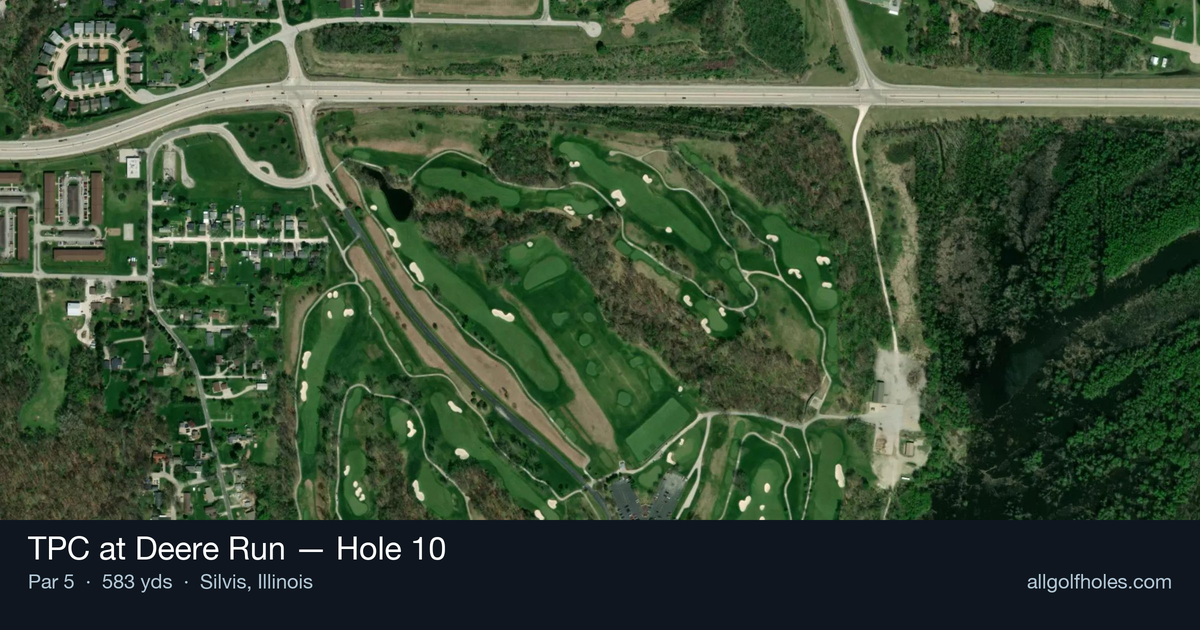
Aerial source not provided
Green size: 57 yds deep × 27 yds wide
Scorecard yardage is for Championship tees. The aerial shows its labeled reference position; distance rings measure to the green.
Championship tees · Par 5 · 583 yards
The plan for No. 10
The tenth hole at TPC at Deere Run, known as "Cor-Ten," presents a strategic par 5 that plays shorter than its 583 yards due to a dramatic downhill tee shot that drops some 50 feet to the fairway below. This elevation change creates an exhilarating opening shot and transforms what appears to be a lengthy three-shot hole into a legitimate birdie opportunity for longer hitters. The straight layout demands precision off the tee to find the generous landing area, while the approach to the small green requires careful club selection and accurate distance control. As golfers navigate this John Deere Classic venue, the hole's deceptive nature and scoring potential make it a pivotal point in any round, where aggressive play can be rewarded but wayward shots are quickly punished.
Off the tee
Your tee shot strategy should focus on finding the optimal position in the fairway rather than maximum distance. A well-struck driver or 3-wood down the center of the fairway sets up the ideal second shot angle. The straight layout allows you to aim directly at your target line without worrying about doglegs or forced carries. Consider the wind conditions and course firmness when selecting your club - sometimes a controlled 3-wood leaves you in better position than an aggressive driver that runs through the landing zone.
Approach & recovery
The second shot becomes crucial for setting up your scoring opportunity. Most players will be hitting a mid to long iron, laying up to their preferred wedge distance. Target the center of the fairway about 100-120 yards from the green to leave yourself a full swing with a scoring club. Avoid the temptation to go for the green in two unless you're confident in your long iron accuracy - the small green size makes this a low-percentage play for most golfers. Your third shot requires precision into the small green. A controlled wedge or short iron allows you to attack pins and create birdie opportunities. Focus on smooth tempo and solid contact rather than trying to spin the ball excessively.
On the green
The small green demands accurate approach shots and careful putting. With limited surface area, there's little room for error on your approach, making distance control critical. Once on the green, focus on lag putting to avoid three-putts, as the compact size can create tricky shorter putts if you're not careful with your first attempt. Read the grain and subtle breaks carefully, as even small greens can have significant undulations. ## RISK VS REWARD This hole offers a clear risk/reward decision on the second shot. Conservative players should lay up to their favorite wedge distance, virtually guaranteeing a good look at birdie. More aggressive players might attempt to reach the green in two, but the small target makes this a risky proposition. The reward of a potential eagle must be weighed against the danger of missing the green entirely and facing a difficult up-and-down. ## DIFFERENT SKILL LEVELS **High-handicap players** should treat this as a three-shot hole, focusing on keeping the ball in play and avoiding big numbers. Use fairway woods or hybrids off the tee for accuracy, lay up to a comfortable wedge distance, and aim for the center of the green regardless of pin position. **Low-handicap players** can be more aggressive with their club selection and target lines. Consider going for the green in two when conditions are favorable, but have the discipline to lay up when the percentages don't favor the aggressive play. These players can also attack specific pin positions based on their approach angle and confidence level. The 10th hole rewards patience and precision over power, making it an excellent scoring opportunity for golfers who execute a smart game plan and resist the urge to force difficult shots.
Watch for
- Course conditioning and mapped hazards may affect line selection; confirm from the aerial.
Hole 10 Green Complex
Mapped green boundary
Green size: 6,745 sq ft
How did Hole 10 play?
How did this hole play today?
Frequently asked questions
Yardage reference: Championship tees · 583 yards.
Can this par 5 be reached in two?
↓
At 583 yards, A true three-shot hole for most players. Position your layup to leave a comfortable wedge distance.
How difficult is hole 10?
↓
This hole is one of the tougher holes on the course for most golfers. Key challenges include: long par 5, water in play, heavily bunkered.
How big is the green on hole 10?
↓
The green is fairly large with multiple pin positions. The green is deeper than wide, so club selection is crucial. Lag putting becomes important on longer putts.
What's a good score on hole 10?
↓
This hole is a true three-shot hole where birdie requires execution. This longer par 5 demands patience. Two good shots set up the scoring opportunity.