Hole 10 at Olympia Fields Country Club (North Course)
- Par
- 4
- Yardage
- 429 yds
- Stroke index
- 8
- Hazards
- 9 bunkers · Water
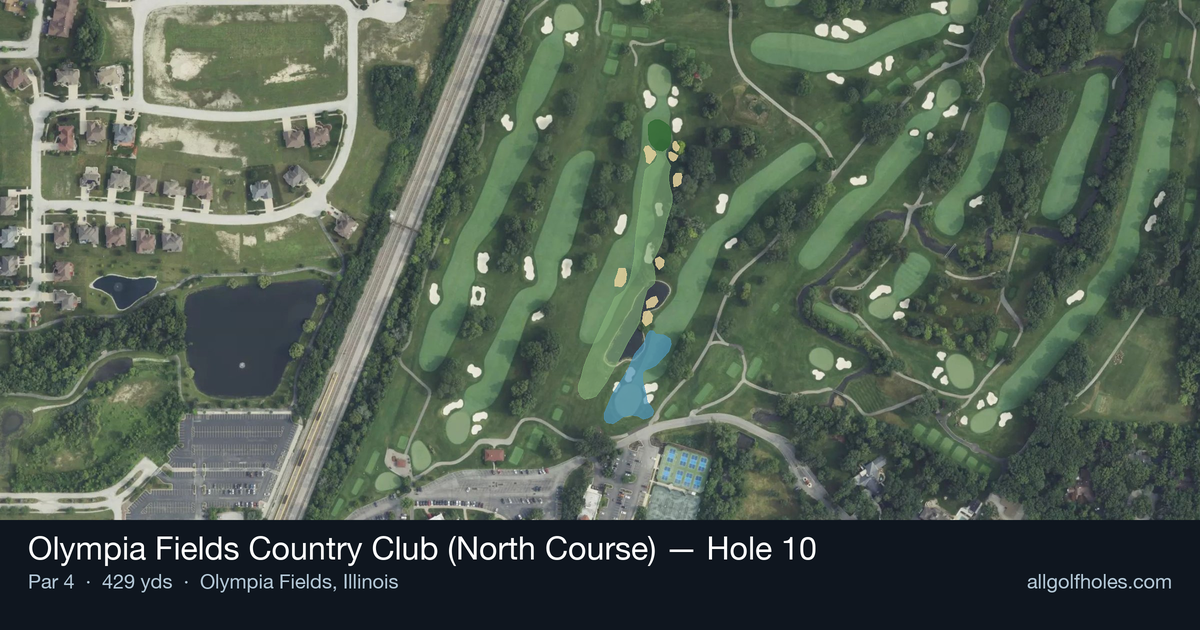
Aerial source not provided
Green size: 31 yds deep × 29 yds wide
Scorecard yardage is for Championship tees. The aerial shows its labeled reference position; distance rings measure to the green.
Championship tees · Par 4 · 429 yards
The plan for No. 10
The 10th hole at Olympia Fields Country Club (North Course) presents a deceptively challenging par 4 that demands both precision and power from the championship tees at 429 yards. This straight-away layout may appear straightforward, but its true test lies in the approach shot to a small, well-protected green complex. The generous fairway invites an aggressive tee shot, rewarding distance with a shorter iron into the green. However, the compact putting surface requires pinpoint accuracy, as missed approaches leave difficult recovery shots. With minimal hazards to distract, golfers must focus on course management and execution. This hole exemplifies Olympia Fields' reputation for rewarding strategic thinking over brute force, making it a memorable test of precision golf.
Off the tee
The tee shot strategy centers on finding the optimal position in the landing zone, typically around the 250-yard mark for most players. With no hazards to navigate, focus on hitting your most reliable fairway club - whether that's driver, 3-wood, or hybrid - to ensure you're playing from the short grass. The key target line runs down the center of the fairway, giving you the best angle for your approach shot. Avoid the urge to bomb driver if accuracy suffers, as playing from the rough will significantly complicate your approach to the small green. A well-positioned shot from 170-180 yards out is far preferable to a longer shot from an awkward lie.
Approach & recovery
The approach shot is where this hole shows its teeth. With a small green as your target, club selection becomes critical - take enough club to ensure you reach the putting surface, as coming up short leaves difficult recovery shots. Depending on your tee shot position, you'll likely face a mid-iron to long-iron approach. Aim for the center of the green regardless of pin position, as the small target doesn't allow for aggressive pin-hunting. The margin for error is slim, so prioritize finding the putting surface over getting close to challenging pin positions. Factor in wind conditions carefully, as they'll have more impact on longer approach shots.
On the green
Once on the small green, putting becomes a premium skill. Without specific knowledge of the green's contours, focus on speed control above all else - three-putting from this small surface would be particularly costly. Take time to read the general slope and grain direction, and remember that putts on smaller greens often break less dramatically than they appear. Pay attention to your approach angle when reading putts, as the direction you came onto the green can provide clues about the overall slope. Conservative putting strategy pays dividends here - lag longer putts to within tap-in range rather than risk running them well past the hole. ## RISK VS REWARD This hole presents a subtle risk/reward scenario in club selection rather than dramatic strategic choices. The reward for aggressive play is minimal - getting close to the pin on a small green doesn't dramatically improve scoring chances. The risk of missing the green entirely, however, can quickly turn a scoring opportunity into a bogey or worse. The smart play rewards patience and precision over power and aggression. Players who resist the temptation to attack pins and instead play to the center of targets will consistently score better on this type of hole. ## DIFFERENT SKILL LEVELS **High-Handicap Players:** Focus on keeping the ball in play above all else. Use your most reliable fairway club off the tee, even if it's a 5-wood or hybrid. On the approach, take one extra club and aim for the center of the green - your priority is avoiding big numbers by staying out of trouble around the green. **Low-Handicap Players:** This hole rewards precision and course management skills that better players possess. You can be more aggressive with driver off the tee if you consistently find fairways, and your superior iron play allows for more precise approaches. However, resist the urge to attack every pin - the small green demands respect regardless of skill level. The 10th hole at Olympia Fields North ultimately rewards the player who combines smart strategy with solid execution, making it a true test of complete golf skills rather than just raw power.
Watch for
- Course conditioning and mapped hazards may affect line selection; confirm from the aerial.
Hole 10 Green Complex
Mapped green boundary
Green size: 5,280 sq ft
How did Hole 10 play?
How did this hole play today?
Frequently asked questions
Yardage reference: Championship tees · 429 yards.
What's the best strategy off the tee?
↓
For this 429-yard par 4, most players will hit driver to set up a comfortable approach.
How difficult is hole 10?
↓
This hole is a moderate challenge for most golfers. Key challenges include: water in play.
What hazards should I watch out for on hole 10?
↓
Key hazards include: water at 191.7 yards. Plan your shots to avoid these trouble spots.
How big is the green on hole 10?
↓
The green is medium-sized with moderate targets. Pay attention to pin placement when selecting your approach club.