Hole 4 at PGA National Resort & Spa (Champion)
- Par
- 4
- Yardage
- 376 yds
- Stroke index
- 13
- Hazards
- 5 bunkers
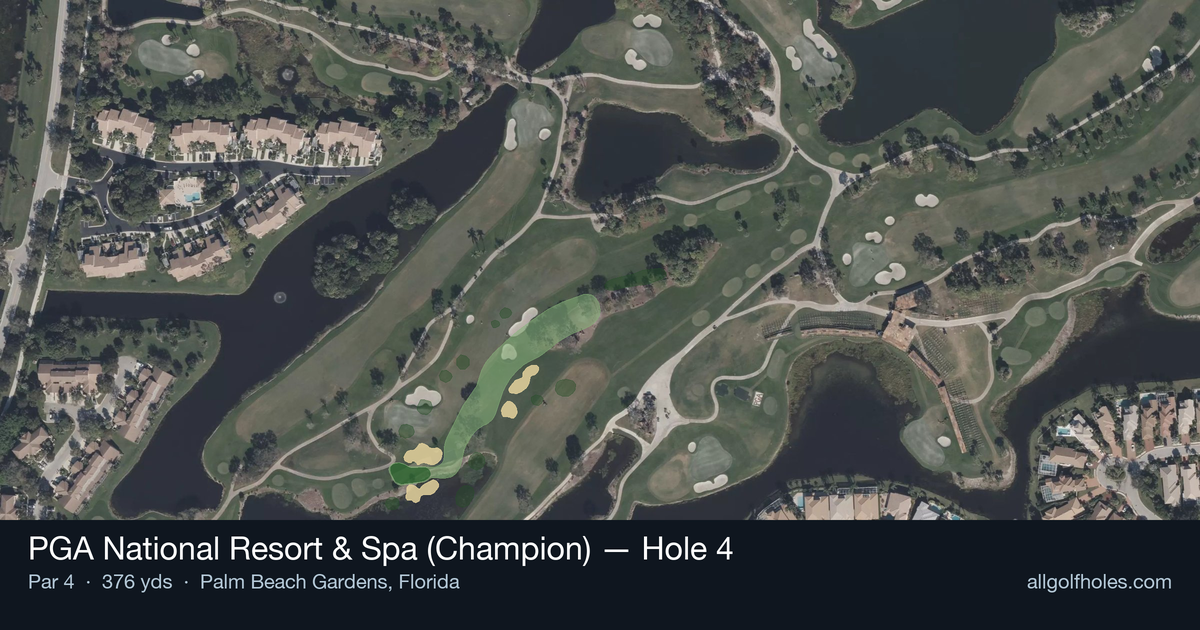
Aerial source not provided
Green size: 28 yds deep × 24 yds wide
Scorecard yardage is for Championship tees. The aerial shows its labeled reference position; distance rings measure to the green.
Championship tees · Par 4 · 376 yards
The plan for No. 4
PGA National Resort & Spa (Champion) hole 4 presents a deceptively straightforward par 4 that demands precision over power. This 376-yard test features a generous fairway that invites aggressive tee shots, but the real challenge lies in the approach to a small, well-guarded green complex. The straight layout allows players to see their target clearly, yet the compact putting surface requires careful club selection and accurate iron play. Without major hazards to navigate, this hole rewards golfers who can execute fundamental shots under pressure. The elevated green and surrounding slopes create subtle collection areas that can turn a seemingly routine approach into a delicate recovery shot, making this an excellent scoring opportunity for those who respect its understated demands.
Off the tee
The tee shot strategy here is all about setting up your approach. With 376 yards to work with, most golfers won't need driver to reach an ideal position. Consider hitting a 3-wood or hybrid to the 100-150 yard range, which puts you in prime scoring position with a comfortable wedge or short iron in hand. The straight layout means you can aim down the center of the fairway without worrying about doglegs or corner-cutting opportunities. Focus on finding the fairway rather than maximizing distance - accuracy off the tee is crucial for setting up birdie opportunities on this hole. ## APPROACH The approach shot is where this hole can make or break your score. The small green requires precise club selection and committed execution. From your ideal tee shot position, you'll likely have a wedge to 8-iron depending on pin position and conditions. Pay close attention to pin placement, as the compact green leaves little margin for error. When the pin is tucked, consider playing to the center of the green rather than firing directly at the flag. The green's small size means even a center-of-the-green approach will leave you with a makeable birdie putt. ## ON THE GREEN While specific green contours aren't detailed, small greens at resort courses like PGA National typically feature subtle breaks that can be tricky to read. Take extra time to study your putt from multiple angles, as the compact surface means every foot of break is magnified. Focus on speed control above all else - with limited green real estate, running putts too far past the hole can leave difficult comeback attempts. Lag putting to the center of the hole is often the best strategy on smaller greens. ## RISK VS REWARD This hole's risk/reward calculation is straightforward: the reward (birdie opportunity) is high, while the risk is relatively low due to the absence of major hazards. The biggest risk is being overly aggressive with your approach and missing the small green entirely. The smart play is conservative aggression - be aggressive in your intent to score, but conservative in your execution. This means taking enough club on your approach and aiming for safe areas of the green when pins are tucked in difficult positions.
Approach & recovery
The approach shot is where this hole can make or break your score. The small green requires precise club selection and committed execution. From your ideal tee shot position, you'll likely have a wedge to 8-iron depending on pin position and conditions. Pay close attention to pin placement, as the compact green leaves little margin for error. When the pin is tucked, consider playing to the center of the green rather than firing directly at the flag. The green's small size means even a center-of-the-green approach will leave you with a makeable birdie putt. ## ON THE GREEN While specific green contours aren't detailed, small greens at resort courses like PGA National typically feature subtle breaks that can be tricky to read. Take extra time to study your putt from multiple angles, as the compact surface means every foot of break is magnified. Focus on speed control above all else - with limited green real estate, running putts too far past the hole can leave difficult comeback attempts. Lag putting to the center of the hole is often the best strategy on smaller greens. ## RISK VS REWARD This hole's risk/reward calculation is straightforward: the reward (birdie opportunity) is high, while the risk is relatively low due to the absence of major hazards. The biggest risk is being overly aggressive with your approach and missing the small green entirely. The smart play is conservative aggression - be aggressive in your intent to score, but conservative in your execution. This means taking enough club on your approach and aiming for safe areas of the green when pins are tucked in difficult positions.
On the green
While specific green contours aren't detailed, small greens at resort courses like PGA National typically feature subtle breaks that can be tricky to read. Take extra time to study your putt from multiple angles, as the compact surface means every foot of break is magnified. Focus on speed control above all else - with limited green real estate, running putts too far past the hole can leave difficult comeback attempts. Lag putting to the center of the hole is often the best strategy on smaller greens. ## RISK VS REWARD This hole's risk/reward calculation is straightforward: the reward (birdie opportunity) is high, while the risk is relatively low due to the absence of major hazards. The biggest risk is being overly aggressive with your approach and missing the small green entirely. The smart play is conservative aggression - be aggressive in your intent to score, but conservative in your execution. This means taking enough club on your approach and aiming for safe areas of the green when pins are tucked in difficult positions.
Watch for
- Water influences line selection and recovery options on this hole.
Hole 4 Green Complex
Mapped green boundary
Green size: 2,549 sq ft
Course coverage
Tournament and creator videos about PGA National Resort & Spa (Champion) — shared course coverage, not hole-specific clips.
Tournament coverage
Cognizant Classic highlights
Cognizant Classic | Final Round Highlights
2025
Featured by these creators
Creator videos about this course
YouTube creators who filmed or featured PGA National Resort & Spa (Champion). · Stats as of Oct 12, 2026 · 5d ago
Has the PGA Tour wrecked PGA National? & FBF to Steve Pate's win in Palm Beach | The Shotgun Start
TGL's future & Todd Watch returns at PGA National for Cognizant Classic | The Shotgun Start
PGA National - Hole 5 - 238 yard par 3
How did Hole 4 play?
How did this hole play today?
Frequently asked questions
Yardage reference: Championship tees · 376 yards.
What's the best strategy off the tee?
↓
For this 376-yard par 4, most players will hit 3-wood or driver to set up a comfortable approach.
How difficult is hole 4?
↓
This hole is a good scoring opportunity for most golfers. Key challenges include: small green.
How big is the green on hole 4?
↓
The green is small and requires precision. The green is wider than it is deep, rewarding shots that find the correct tier. Expect challenging pin positions with limited room for error.
What's a good score on hole 4?
↓
This hole is a medium-length test where par is a solid result. A straightforward par 4 where course management pays off.