Hole 16 of 18 · Cromwell, Connecticut
Hole 16 at TPC at River Highlands
- Par
- 3
- Yards
- 171
- Handicap
- 14
- Bunkers, water
- 4
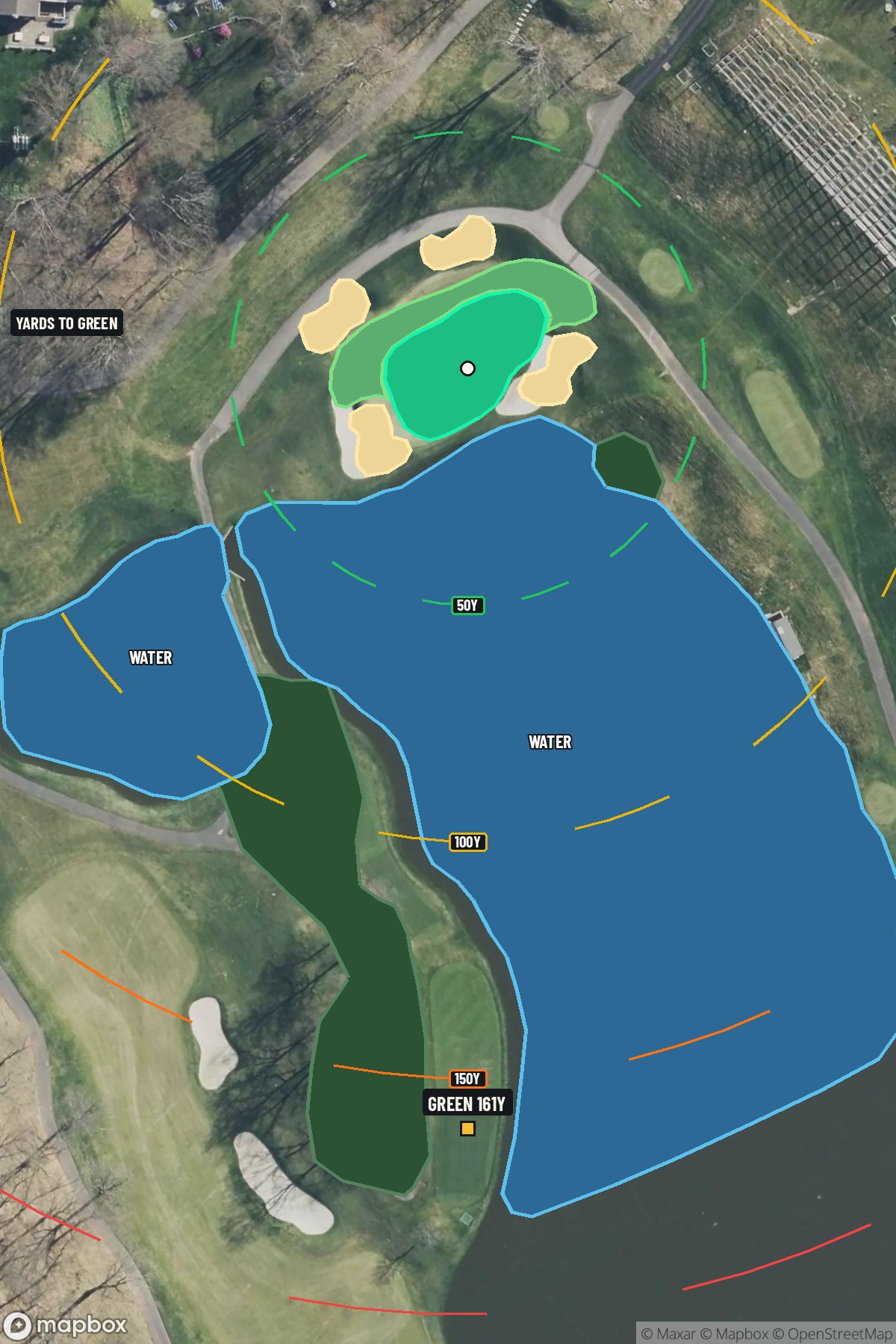
Map distances from Green tee · 161 yds
The map's printed distances are measured from the Green tee to the green; they do not move when you change tees. Your Gold yardage is in the tiles above.
Green size: 32 yds deep × 35 yds wide
Mapbox Satellite composite · capture date not provided. Green at the top.
Where this map comes from
- Satellite photo
- Date not published
- Mapbox satellite
- Green contours
- 2014 survey
- USGS lidar survey
The plan for No. 16
These notes were written before the current map. Where their distances differ, trust the map.
The play: A par 3 playing about 171 yards on the published championship card. Even with mid/short iron, scary if pin is on the rear shelf; swirling winds make distance judging hard; covering the lake is priority #1, but sunken chipping areas behind are also crucial to avoid. 16 punishes half-committed swings: water instantly changes club and target; indecision usually produces the worst outcome.
Shot by shot
The green on No. 16
Mapped boundary- Wide × deepyards
- 35×32
- Areasq ft
- 5,724
Gear for Hole 16
Waterin play on this hole
Pack extra balls
 Titleist Pro V1$55 MSRPCheck priceCompare all picks →
4bunkers
Bring a sand wedge you trust
 Titleist Vokey SM10 Tour Chrome$180 MSRPCheck priceCompare all picks →
We may earn a commission when you buy through these links.
How did Hole 16 play?
How did this hole play today?
Frequently asked questions
Yardage reference: Gold tees · 171 yards.
What club should I use on this par 3?
↓
At 171 yards, most golfers will need a mid-iron (7-iron to 8-iron) to reach this green. Adjust for elevation, wind, and pin position.
How difficult is hole 16?
↓
This hole is one of the tougher holes on the course for most golfers. Key challenges include: water in play, heavily bunkered.
What hazards should I watch out for on hole 16?
↓
Key hazards include: 4 greenside bunkers; water at 95.5 yards. Plan your shots to avoid these trouble spots.
How big is the green on hole 16?
↓
The green is medium-sized with moderate targets. The green is wider than it is deep, rewarding shots that find the correct tier. Pay attention to pin placement when selecting your approach club.
Where is the best miss on hole 16?
↓
If you're going to miss the green, favor the right side. The left (water) brings more trouble into play and makes recovery difficult.
What's a good score on hole 16?
↓
This hole is a solid par with birdie chances for precise approach shots. Making par is a good result here. Focus on hitting the green and avoiding three-putts.
Research notes
- 16 punishes half-committed swings: water instantly changes club and target; indecision usually produces the worst outcome. (Closing stretch 16)[1]
- 171-yard par 3 (3rd hardest in 2025): carry water to an elevated green between bunkers; false front can feed short shots back toward water; long finds delicate runoff recoveries. (Hole 16 narration)[2]
- Even with mid/short iron, scary if pin is on the rear shelf; swirling winds make distance judging hard; covering the lake is priority #1, but sunken chipping areas behind are also crucial to avoid. (Hole No. 16)[3]
- The 171-yard par-3 16th requires a well-struck mid-iron carry over water onto a narrow green. (Hole 16)[4]
- Hole 16 green has substantial slope; pin locations can be difficult. (Hole 16)[4]
- 2016 renovation focused on restyling bunkers course-wide with new drainage and sand; Weed consulted; McDonald and Sons constructed. (Lead / construction note)[5]
- Ahead of 2016, bunkers were rebuilt from flash-faced to flat-bottomed with steep grass faces and cut from 105+ to 67 — easier predictable lies for pros, harder for amateurs. (How the design has lost its way)[3]
- Framed as a less-than-driver venue: short card plus significant penalty for missing fairways; average driving distance ~286 yards and driver usage ~59.4%. (Course profile)[6]
- Good rounds look boring: conservative lines, approaches in preferred zones, and avoiding the one double that resets the card — take one less risk on the closing stretch. (What good players do differently)[1]
- Long rough and small greens averaging around 5,000 sq ft make fairway play a massive advantage — not a bomb-and-gouge track. (Course profile)[6]
- Pete Dye and Bobby Weed’s 1980s redesign prioritized stadium sightlines and late drama on the final four holes looping a four-acre lake before returning to the clubhouse. (Intro)[3]
- Position golf course above all: landing areas can look generous, but players must stay between trees and avoid tight drop-offs; poor tee shots find penalty areas and nasty places. (Course breakdown)[7]
- Primary defense is medium-sized greens that sit up a few feet above surroundings (short-grass chipping areas, rough, bunkers); perimeter pins punish misses by a yard or two, echoing Pinehurst No. 2 vibes. (Intro greens discussion)[3]
- Short parkland TPC (6,844 / par 70): tree-lined and positional with a premium on approach play; accuracy beats distance versus recent longer Tour stops. (Course profile)[6]
- Short Tour venue (~6,844) still pressures decisions more than length; GolfPass tips rating/slope 74.1/138 underscored as the clue that yardage understates the test. (Player's Guide intro)[1]
- Small putting-surface changes also made on holes 10, 13, 15 and 16; lake banks stabilized (incl. 8th) to reduce erosion. (Project details)[5]
- Tour tips play about 6,844 yards, par 70 — among the shortest courses the Tour visits — yet historically style-agnostic (bombers and tacticians both win). (Intro / Par 70, 6,844 yards)[3]
- Typical pattern: club down off the tee then approach from 100–150 yards (most common bucket ~33%); true club-down holes can leave 150–175 yards. (Approach distance discussion)[6]
- 2026 Travelers card: par 70 / 6,844 yards (two par 5s, four par 3s, 12 par 4s) — among the shortest Tour venues under 7,000 yards. (Scorecard breakdown)[7]
- 2026 Travelers described as a birdie-fest at River Highlands, with a Monday playoff after a −21 score; Sunday conditions noted as extra-soft after a lengthy rain delay. (Episode show notes / Travelers section)[8]
- Award-winning finishing stretch from holes 15–18; 15, 16 and 17 all play around a four-acre lake. (Finishing stretch)[9]
- Course chronology: Middletown Golf Club (1928) / Edgewood CC, completely redesigned by Pete Dye in 1982, then renovated in 1989 by Bobby Weed with PGA TOUR Design Services (Howard Twitty and Roger Maltbie consultants). (Course history section)[9]
- Founded as Middletown Golf Club (1928), became Edgewood CC (1934); PGA Tour took over in the 1980s; Pete Dye redesign reopened 1982 as TPC of Connecticut; Bobby Weed redesign as TPC River Highlands in 1989, with further Weed bunker/strategy work in 2016. (Lead chronology)[10]
GM David Corrado said the enhancement kept strategic integrity while giving a fresh look enjoyable for all skill levels.
— David Corrado (Corrado quote)[5]- Hosts debate whether TPC River Highlands leaves too much to be desired as a true test of professional golf within the Tour’s Championship Series model, even while praising the event atmosphere. (Episode show notes / Travelers debate)[8]
- Layout meanders over 148 acres with maple, oak, sycamore and eastern white pine framing bentgrass fairways/greens and bluegrass-fescue rough; lakes and ponds throughout; Audubon Cooperative Sanctuary certified. (Course description)[9]
- Official card cited as par-70, 6,841 yards for the championship course, with multiple tees for everyday play. (Intro / scorecard note)[9]
- Putting is crucial because winners typically need to go quite low. (Course breakdown)[7]
- Short by modern Tour standards: plays 6,844 yards, par 70 for Travelers week (2025 article). (Lead)[10]
Stewart Cink (2008 Travelers winner) called holes 15–18 “four of the most exciting finishing holes in a group anywhere in the world.”
— Stewart Cink (Finishing stretch quote)[9]
Sources
- TPC River Highlands Scorecard: Full Yardages & Guide (2026) — Live Tourneyhttps://www.livetourney.com/blog/tpc-river-highlands-scorecard
- TPC River Highlands Back Nine Strategy | Travelers Championship Holes 10–18 — Common Sense Golfhttps://www.youtube.com/watch?v=caZN-ZnnRMI
- Travelers Championship: A hole-by-hole guide to TPC River Highlands — GolfPass / Tim Gavrichhttps://www.golfpass.com/travel-advisor/articles/tpc-river-highlands-hole-by-hole-travelers-championship
- Featured Holes — TPC River Highlands — TPC Network / TPC River Highlandshttps://tpc.com/riverhighlands/featured-holes/
- Renovation work complete at TPC River Highlands — Golf Course Architecturehttps://www.golfcoursearchitecture.net/content/renovation-work-complete-at-tpc-river-highlands
- Horses for Courses: Why Sam Burns is built for Travelers Championship — PGA TOUR / Brad Thomashttps://www.pgatour.com/article/news/horses-for-courses/2026/06/24/travelers-championship-tpc-river-highlands-scottie-scheffler-brooks-koepka-matt-fitzpatrick-odds-betting-fantasy-picks-advice
- TPC River Highlands: Scorecard and course breakdown for the 2026 Travelers Championship host — Golf News Net / Ryan Ballengeehttps://thegolfnewsnet.com/golfnewsnetteam/2026/06/25/tpc-river-highlands-scorecard-and-course-breakdown-for-the-2026-travelers-championship-host-143601/
- A heated Travelers debate, LPGA coverage windows, and the continued fall of Phil Mickelson — The Shotgun Start / The Fried Egghttps://www.thefriedegg.com/podcasts/a-heated-travelers-debate-lpga-coverage-windows-and-the-continued-fall-of-phil-mickelson
- Golf at TPC River Highlands — TPC Network / TPC River Highlandshttps://tpc.com/riverhighlands/golf/
- Check the yardage book: TPC River Highlands for the PGA Tour's Travelers Championship — Golfweek / Jason Luskhttps://golfweek.usatoday.com/story/sports/golf/2025/06/18/tpc-river-highlands-travelers-championship-course-guide-yardage-book-pga-tour/84257802007/