Hole 12 at Rustic Canyon Golf Course
- Par
- 4
- Yardage
- 336 yds
- Stroke index
- 16
- Hazards
- 2 bunkers
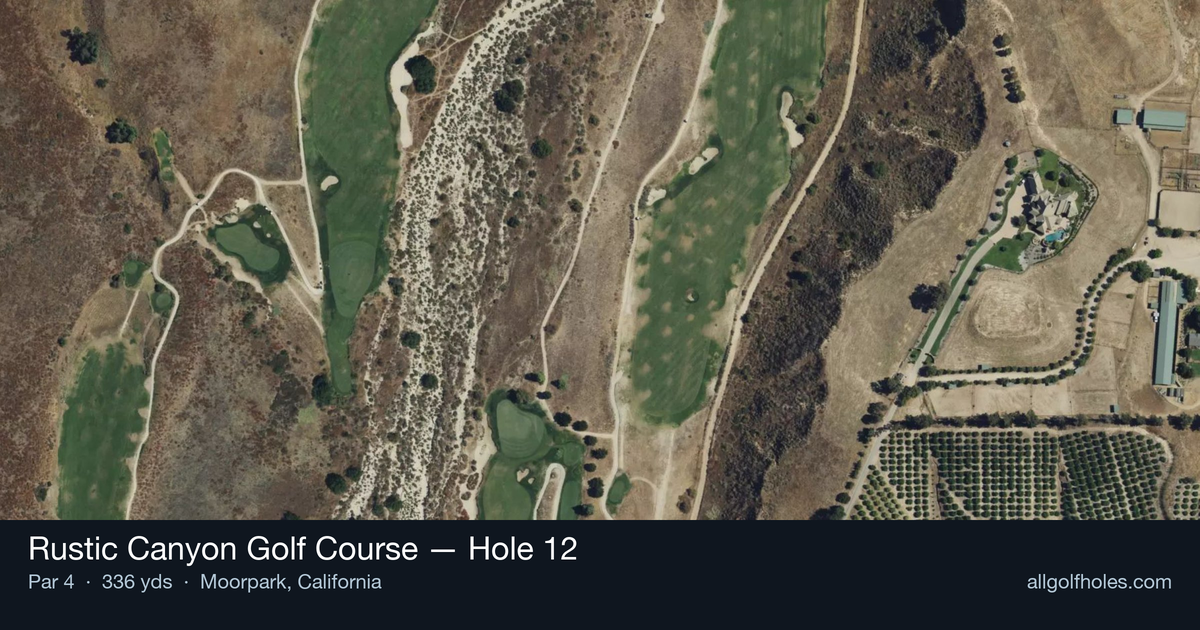
Aerial source not provided
Green size: 22 yds deep × 28 yds wide
Scorecard yardage is for Black tees. The aerial shows its labeled reference position; distance rings measure to the green.
Black tees · Par 4 · 336 yards
The plan for No. 12
The 12th hole at Rustic Canyon epitomizes strategic golf design, offering a seemingly straightforward par 4 that rewards thoughtful course management over raw power. With quick-running fairways and a small target green, this hole demands precision rather than distance. The absence of major hazards might suggest an easy birdie opportunity, but the compact green and firm conditions require careful club selection and approach strategy to avoid leaving yourself with difficult recovery shots.
Off the tee
Despite the temptation to attack this short par 4, the tee shot strategy should focus on optimal positioning rather than maximum distance. The wide fairway provides ample landing area, but your target line should be determined by the day's pin position and wind conditions. A controlled drive with a fairway wood or long iron, leaving yourself around 100-120 yards to the pin, often proves more effective than an aggressive driver that brings the green into play but leaves an awkward distance. The firm fairways will provide additional roll, so club down if conditions are particularly fast.
Approach & recovery
The approach shot is where this hole reveals its true character. With Rustic Canyon's emphasis on the ground game, consider a bump-and-run approach when conditions permit, especially to front pin positions. The small green demands precision - missing the putting surface can leave challenging recovery shots from the native areas. A controlled wedge or short iron, played to the center of the green when the pin is tucked, provides the best scoring opportunity. Pay close attention to the firmness of the greens, as shots that land short and release onto the putting surface often finish closer to the pin than aerial attacks.
On the green
The small green at the 12th requires careful speed control and precise line selection. While specific break patterns depend on daily conditions, focus on getting your first putt close rather than being overly aggressive. The compact size means most putts will be relatively straight, but the firm surfaces can make distance control challenging. Leave yourself below the hole when possible, as uphill putts on firm greens are more manageable than downhill sliders.
Watch for
- Crossing behind_tee
Hole 12 Green Complex
Mapped green boundary
Green size: 3,163 sq ft
How did Hole 12 play?
How did this hole play today?
Frequently asked questions
Yardage reference: Black tees · 336 yards.
What's the best strategy off the tee?
↓
For this 336-yard par 4, most players will hit 3-wood or driver to set up a comfortable approach.
How difficult is hole 12?
↓
This hole is a good scoring opportunity for most golfers. Key challenges include: small green.
How big is the green on hole 12?
↓
The green is small and requires precision. Expect challenging pin positions with limited room for error.
What's a good score on hole 12?
↓
This hole is a birdie opportunity if you find the fairway. This shorter par 4 rewards accuracy off the tee with a short iron approach.
Research notes
- Captions mention another drivable par 4 where players debate aggression versus laying back. (Reviewed English auto-captions)[1]
- GCA notes the twelfth tee offers almost no hazard signals—players must learn through experience where to place a tee ball on the huge fairway left of the open-front green. (Holes to Note)[2]
- Short par 4: play right and wedge close; misses right face a severe slope and tight pitch; default miss is left regardless of pin. (Hole #12 flyover blurb)[3]
- County operator describes year-round fast, firm greens maintained by the on-site crew (conditions framing, not a dated agronomy certification). (About Rustic Canyon)[4]
- County parks copy notes expansive fairways, large greens, few trees, and surrounding mountains that can distort depth perception and distance judgment. (About Rustic Canyon)[4]
- Course marketing cites Golf Magazine Top 100 You Can Play (#45, 2024–2025 list) and Golfweek #5 public course in California (2024) as published accolades. (Welcome / accolades)[5]
- Episode 135 is billed as a Geoff Shackelford deep-dive on Rustic Canyon's design alongside municipal-golf and superintendent themes (companion to Fried Egg drone photography of the property). — Geoff Shackelford (Episode summary (2019-05-01))[6]
- Golf Club Atlas describes a 350-acre sandy canyon floor routed around a central wash, with minimal earthmoving (~17,000 cubic yards) and a front nine of three par 3s, three par 4s, and three par 5s. (Course overview)[2]
- Hanse Golf Course Design lists Rustic Canyon (Moorpark) as a 2002 original design credited with Geoff Shackelford. (Project header)[7]
- Hicks reports strong front-nine vs back-nine microclimate splits (coastal influence vs hotter/dryer) and common 30°F day swings across the 1.5-mile property. (Geography / weather Q&As)[8]
- Hicks states fairways shifted from ryegrass to bermudagrass after the ~2009 drought to support firmer, faster surfaces under heavy public play. (Turf evolution Q&A)[8]
- Maintenance goal is a bouncy, links-like presentation where shots roll into intended (or unintended) areas on fairways, approaches, and greens. (Daily surface Q&A)[8]
- Official copy describes wide fairways, firm bump-and-run greens, and strategic positioning on expansive corridors rather than forced aerial golf. (Welcome section)[5]
- Opened in 2002 as a lay-of-the-land Gil Hanse design built without detailed blueprints; native barrancas were preserved and folded into routing and bunkering. (Welcome section)[5]
- Profile notes bentgrass greens with matching bent approaches extending 20–30 yards short of greens to invite ground-game options, especially when southwest canyon winds blow. (Maintenance / presentation)[2]
- Published show notes place Rustic Canyon among Gil Hanse's early-2000s municipal portfolio discussed at the National Links Trust symposium. — Gil Hanse (Episode description)[9]
- Superintendent Jeff Hicks describes sandy, gravelly soils that drain extremely fast—often playable off paths days after heavy rain—but retain little moisture, shaping daily irrigation demands. (Soil profile Q&A)[8]
Sources
- Rustic Canyon Golf Course | LA's Best Public Golf? — YouTube (course vlog)https://www.youtube.com/watch?v=NNMTRZBXoKQ
- Rustic Canyon — Golf Club Atlas course profile — Golf Club Atlas / Ran Morrissetthttps://golfclubatlas.com/countries/rustic-canyon-golf-course/
- Hole by Hole Flyovers — Rustic Canyon Golf Course — Rustic Canyon Golf Coursehttps://www.rusticcanyongolfcourse.com/golf/flyovers
- Rustic Canyon Golf Course — Ventura County Parks — Ventura County Parkshttps://parks.venturacounty.gov/county-parks/rustic-canyon/
- Rustic Canyon Golf Course — Home — Rustic Canyon Golf Course / Ventura County Parkshttps://www.rusticcanyongolfcourse.com/
- Geoff Shackelford on Rustic Canyon, Municipal Golf, and Photography — The Fried Egg Golf Podcasthttps://thefriedegg.podbean.com/e/episode-135-geoff-shackelford-rustic-canyon-municipal-golf-superintendents-and-photography/
- Rustic Canyon — Hanse Golf Course Design — Hanse Golf Course Designhttps://www.hansegolfdesign.com/projects/original-design-projects/rustic-canyon/
- Q&A: Jeff Hicks, Superintendent at Rustic Canyon Golf Course — The Fried Egg / Cameron Hurdushttps://www.thefriedegg.com/articles/superintendent-jeff-hicks-rustic-canyon
- Gil Hanse Talks Municipal Golf — The Fried Egg Golf Podcast — The Fried Egg / National Links Trust Symposiumhttps://open.spotify.com/episode/1qukW4ih8QmZj1U3BvkJTI