Hole 14 at PGA West (TPC Stadium course)
- Par
- 4
- Yardage
- 389 yds
- Stroke index
- 12
- Hazards
- 5 bunkers
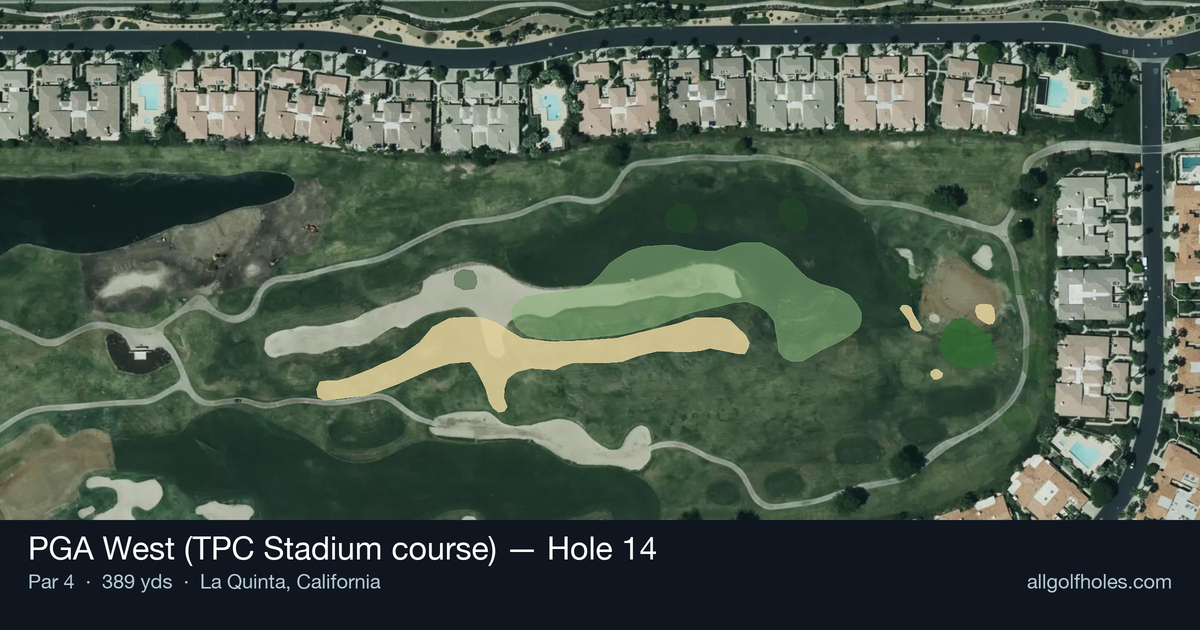
Aerial source not provided
Green size: 27 yds deep × 25 yds wide
Scorecard yardage is for Championship tees. The aerial shows its labeled reference position; distance rings measure to the green.
Championship tees · Par 4 · 389 yards
The plan for No. 14
The 14th hole at PGA West's TPC Stadium course serves as a deceptive breather before Pete Dye's notorious finishing stretch. This straight par 4 of 389 yards appears straightforward, but Dye's architectural genius lies in the subtleties that demand precision over power. The generous fairway invites an aggressive tee shot, yet the small green complex requires surgical accuracy on the approach. Without significant hazards guarding the hole, success depends entirely on execution and course management. Players often underestimate this seemingly benign layout, making mental errors that can derail momentum heading into Dye's famously brutal final holes. The 14th rewards strategic thinking and solid fundamentals, serving as the calm before the storm that defines PGA West's championship pedigree.
Off the tee
The tee shot strategy revolves around finding the optimal position for your approach to the small green. Most players should focus on the center of the fairway with a controlled swing rather than trying to gain every possible yard. A driver is certainly playable for longer hitters, but consider a 3-wood or hybrid if you tend to spray drives under pressure - accuracy trumps distance on this hole. The key is avoiding the rough, which can make club selection for the approach more difficult. Target the middle of the fairway and commit to a smooth, controlled swing. The relatively straight layout means you don't need to work the ball, making this an ideal hole to play conservatively and build confidence.
Approach & recovery
The approach shot is where this hole reveals its teeth. The small green demands precise club selection and commitment to your target line. Study the pin position carefully - with limited green surface to work with, being on the correct level or section of the green is crucial for avoiding three-putts. Favor the center of the green regardless of pin position, as the small target leaves little margin for error. A mid-iron to long-iron (depending on your tee shot position and conditions) should be struck with confidence. Avoid the temptation to get too aggressive with pin hunting - the small green means even center-green putts are makeable.
On the green
The putting surface, while small, can present subtle challenges typical of Pete Dye designs. Read putts carefully as even slight slopes are magnified on a compact green. Focus on speed control above all else - with limited green space, pace becomes more critical than line on longer putts. Pay attention to the grain and wind conditions, as these factors become more pronounced on smaller putting surfaces. Conservative lag putting is often the best strategy, as getting close from anywhere on this green gives you a reasonable birdie chance. ## RISK VS REWARD This hole offers a genuine scoring opportunity if played intelligently. The risk/reward calculation is straightforward: play for the center of the green and take your birdie chances with the putter. The small green penalizes aggressive pin-seeking, making course management more valuable than heroic shot-making. The real reward comes from positioning yourself well for the challenging holes ahead. A solid par or opportunistic birdie here provides crucial momentum before facing the Stadium Course's notorious finish. ## DIFFERENT SKILL LEVELS **High-Handicap Players:** Focus entirely on finding the fairway with your most reliable club off the tee, even if it's a hybrid or long iron. For the approach, aim for the center of the green with whatever club gets you there comfortably. Don't worry about pin positions - the small green means any part of the putting surface gives you a reasonable chance at par. **Low-Handicap Players:** You can be slightly more aggressive with driver off the tee to shorten the approach, but maintain discipline on the approach shot. Consider pin position but don't force difficult shots. Use this hole to build confidence and rhythm before the demanding finish. A birdie here is valuable, but don't risk dropping shots by being overly aggressive. The 14th hole exemplifies smart golf course architecture - appearing simple while rewarding thoughtful play and punishing carelessness. Treat it as an opportunity to gather yourself mentally and physically before Pete Dye's closing examination begins in earnest.
Hole 14 Green Complex
Mapped green boundary
Green size: 3,584 sq ft
How did Hole 14 play?
How did this hole play today?
Frequently asked questions
Yardage reference: Championship tees · 389 yards.
What's the best strategy off the tee?
↓
For this 389-yard par 4, most players will hit driver to set up a comfortable approach.
How difficult is hole 14?
↓
This hole is a good scoring opportunity for most golfers. Key challenges include: small green.
How big is the green on hole 14?
↓
The green is small and requires precision. Expect challenging pin positions with limited room for error.
What's a good score on hole 14?
↓
This hole is a medium-length test where par is a solid result. A straightforward par 4 where course management pays off.