Hole 2 at Pine Valley Golf Club
- Par
- 4
- Yardage
- 368 yds
- Stroke index
- 9
- Hazards
- 21 bunkers
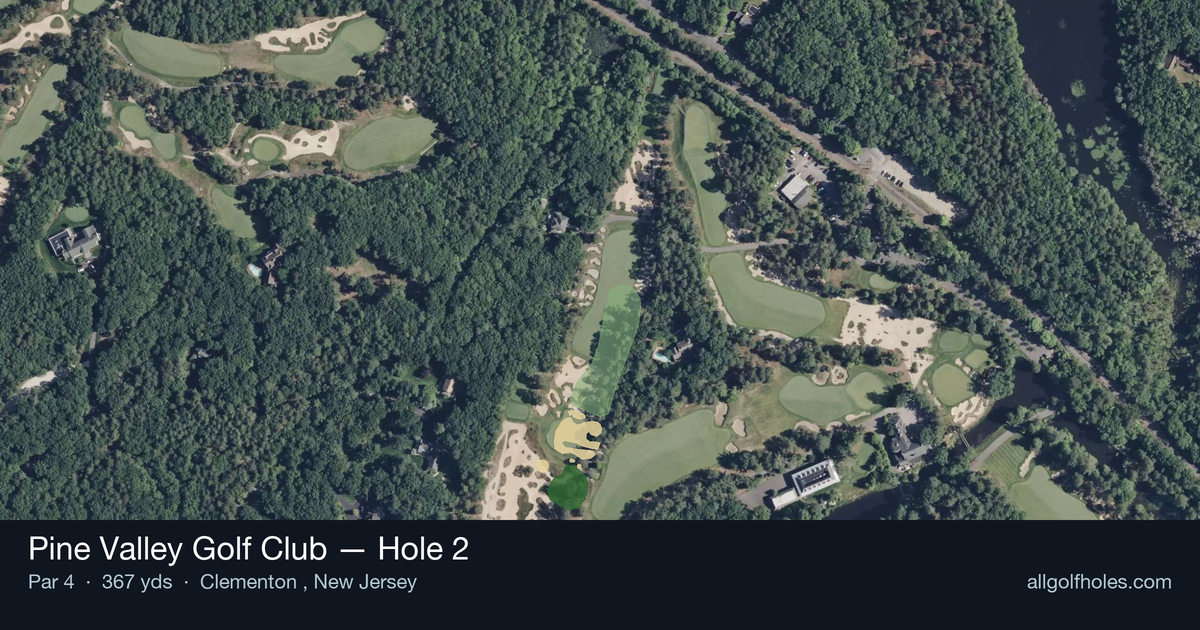
Aerial source not provided
Green size: 43 yds deep × 38 yds wide
Scorecard yardage is for Championship tees. The aerial shows its labeled reference position; distance rings measure to the green.
Championship tees · Par 4 · 368 yards
The plan for No. 2
A par 4 and stroke index 9. Herringbone bunkering runs up both sides of the fairway to a rising hill, and from below you see only the top of the flagstick (Golf Digest). Golf Club Atlas holds that the putting surface, not the drive, is the real test.
Off the tee
The fairway must be found: sand on the right usually forces a lay-up rather than an attacking second (Top 100 Golf Courses).
Approach & recovery
The second climbs over a huge sand hazard cut into a steep ledge to a plateau green (Planet Golf; 1962 broadcast).
On the green
An enormous surface that slopes sharply to the front, with ridges running through it (Planet Golf). The surface runs 42 yards from front to back; read the contour panel for slope.
Watch for
- Five bunkers left
- 16 bunkers right
Hole 2 Green Complex
Mapped green boundary
Green size: 9,718 sq ft
Course coverage
Tournament and creator videos about Pine Valley Golf Club — shared course coverage, not hole-specific clips.
Featured by these creators
Creator videos about this course
YouTube creators who filmed or featured Pine Valley Golf Club. · Stats as of Oct 12, 2026 · 5d ago
PGA Tour's Pine Valley fallacy, Rory’s membership rules, & Rahm’s nomadic summer | The Shotgun Start
Pine Valley Open | SGT Tour | Ep 5 Autoputt Week 11
The final group are underway at Reignwood Pine Valley🏆#StaysureLegendsTour
How did Hole 2 play?
How did this hole play today?
Research notes
- 1962 broadcast: the 2nd climbs to a plateau green perched on top of a steep upswing of sand and bush. (00:09:47)[1]
- Sand right on the 2nd usually forces a lay up rather than an attacking second.[2]
- The 2nd approach crosses a huge sand hazard cut into a steep ledge to an enormous green that slopes sharply to the front, with ridges running through it. (review)[3]
- The 2nd demands the fairway off the tee (about 32 yards wide), with herringbone bunkering up both sides to a rising hill; from below you see only the top of the flagstick. — Jerry Tarde (narration) (00:02:12)[4]
- The 2nd's putting surface, not its tee shot, is the hole's real test.[5]
- A 12-handicap guest: every drive has a forced carry and the landing area is rarely visible, but a roughly 230-yard driver carried them all from the men's tees and found generous fairways beyond. (playing the course)[6]
- About half the approaches need a carry, and anything short is punished; laying up on the par 4s and going in with a wedge is no disgrace. (playing the course)[6]
- Eight of the 10 short-course holes replicate approach shots on the main course (2, 3, 10, 13, 14, 15, 17 and 18), with the same elevation change and direction. (short course)[6]
- Greens can reach 12 to 13 on the Stimpmeter at tournament time, and the aim of a putt may be 90 degrees from the straight line to the hole. — Jerry Tarde (narration) (00:06:41)[4]
- On the 4th, 6th, 8th, 9th, 11th, 13th, 16th and 17th the player is unlikely to see the drive land. (Holes to Note: 9th)[5]
- Recent Tom Fazio work has removed trees, exposed more sand and moved tees back; hard holes got harder. — Jerry Tarde (narration) (00:07:31)[4]
- The landing areas off the tee are more generous than the reputation suggests; about half the greens need an all-carry approach and the rest accept a ball bounced in from the front. (review)[3]
- Crump died suddenly in early 1918 with only fourteen holes open; the 12th through 15th were built the following year by Hugh Wilson and William Flynn to his plans. (review)[3]
- Crump insisted on keeping each hole isolated and on a routing that regularly changes direction. (review)[3]
- Harry Colt had a large input into the final routing; Crump consulted many leading architects but held strong views on how the course should be arranged. (review)[3]
- Hotelier George Crump bought the land in 1912 and spent the next six years living at Pine Valley, searching out the holes. (review)[3]
- Pine Valley has held the No. 1 spot in GOLF's world ranking for decades, with a routing that hopscotches between islands of turf across sandy ground. (3 things to know)[7]
- The par 3s ask for roughly a three wood, 4 iron, 9 iron and 6 iron into the 3rd, 5th, 10th and 14th for a good player. (Holes to Note: 10th)[5]
Sources
- Byron Nelson vs Gene Littler at Pine Valley | 1962 Shell's Wonderful World of Golf — PGA Tourhttps://www.youtube.com/watch?v=1XdVWUTLhdI
- Pine Valley Golf Club — Top 100 Golf Courseshttps://www.top100golfcourses.com/golf-course/pine-valley
- Pine Valley Golf Club — Planet Golfhttps://www.planetgolf.com/courses/usa/pine-valley-golf-club
- Every Hole at Pine Valley Golf Club — Golf Digesthttps://www.youtube.com/watch?v=gVL-gbO0fLU
- Pine Valley Golf Club course profile — Golf Club Atlashttps://golfclubatlas.com/countries/pine-valley-golf-club/
- Pine Valley Golf Club review — UK Golf Guyhttps://www.ukgolfguy.com/pine-valley-golf-club
- Pine Valley: GOLF's Top 100 Courses in the World 2025-26 — GOLF.comhttps://golf.com/courses/pine-valley-golf-top-100-courses/