Hole 14 at Olympia Fields Country Club (North Course)
- Par
- 4
- Yardage
- 438 yds
- Stroke index
- 2
- Hazards
- 4 bunkers · Water
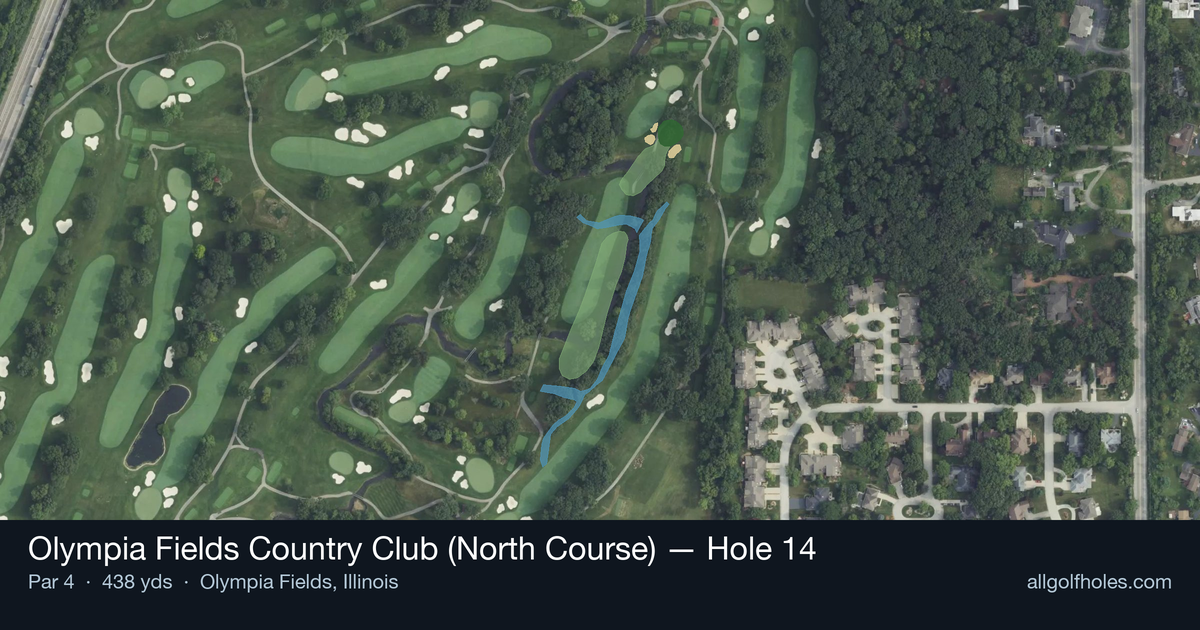
Aerial source not provided
Green size: 30 yds deep × 28 yds wide
Scorecard yardage is for Championship tees. The aerial shows its labeled reference position; distance rings measure to the green.
Championship tees · Par 4 · 438 yards
The plan for No. 14
The second-most difficult hole at Olympia Fields Country Club (North Course), this demanding 438-yard par 4 represents classic championship golf at its finest. From an elevated tee, players face a straight, uncompromising test that has challenged the world's best during major championships, including the 2003 U.S. Open where Tiger Woods claimed victory on this storied layout. The tee shot must find the fairway's sweet spot to set up the crucial approach to a small, well-protected green that demands precision over power. Without significant hazards to distract, this hole's difficulty lies in its relentless demand for accuracy and distance control. The compact green complex punishes anything but the most committed approach shots, making par a genuine achievement. This is strategic golf in its purest form—a hole where course management and execution determine success on one of Illinois' most prestigious layouts.
Off the tee
The tee shot strategy centers on finding the optimal position for your approach angle while maximizing distance. With the hole playing straight, focus on the center-left portion of the fairway to set up the best angle into the small green. Driver is likely the right choice for most players to leave a manageable approach distance, but accuracy must take precedence over pure distance. The key target line runs down the middle of the fairway, avoiding any rough or subtle slopes that could leave an awkward lie. Players should commit fully to their swing while maintaining control - this isn't the hole for tentative golf.
Approach & recovery
The approach shot to this small green demands surgical precision and smart club selection. With limited green surface to work with, favor taking one more club and swinging smoothly rather than forcing a shorter iron. The center of the green should be your primary target unless the pin position clearly favors one side. Pay close attention to wind conditions, as they'll be magnified when attacking such a small target. Consider the green's firmness - if conditions are firm, plan for some roll-out and potentially aim short of aggressive pin positions.
On the green
Putting on this small green requires reading subtle breaks and controlling speed meticulously. With limited surface area, three-putts can happen quickly if you're not careful with lag putting from longer distances. Focus on getting your first putt within a comfortable two-putt range rather than being overly aggressive. The small size means that even seemingly makeable putts can have more break than expected, so take extra time to read the slopes around the hole. ## RISK VS REWARD This hole offers a classic risk/reward scenario in club selection and aggression level. The reward for precise execution is a legitimate birdie opportunity, but the risks of missed fairways or approaches are magnified by the small green. The strategic decision comes down to whether to play conservatively to the center of targets or attack pins when they're accessible. Generally, the percentages favor conservative play unless you're striking the ball exceptionally well. ## DIFFERENT SKILL LEVELS **High-handicap players** should prioritize finding the fairway with whatever club gives them the best chance of accuracy, even if it means laying back with a 3-wood or hybrid. On the approach, aim for the center of the green regardless of pin position and focus on two-putting. **Low-handicap players** can be more aggressive with driver off the tee and should look to attack pins when conditions allow, using their superior distance control to take advantage of scoring opportunities on this challenging hole. The key to mastering this hole lies in disciplined course management and accepting that par is often a good score on one of Olympia Fields' most demanding tests.
Watch for
- Course conditioning and mapped hazards may affect line selection; confirm from the aerial.
Hole 14 Green Complex
Mapped green boundary
Green size: 4,834 sq ft
How did Hole 14 play?
How did this hole play today?
Frequently asked questions
Yardage reference: Championship tees · 438 yards.
What's the best strategy off the tee?
↓
For this 438-yard par 4, most players will hit driver to set up a comfortable approach.
How difficult is hole 14?
↓
This hole is a moderate challenge for most golfers. Key challenges include: water in play.
What hazards should I watch out for on hole 14?
↓
Key hazards include: water at 203.7 yards. Plan your shots to avoid these trouble spots.
How big is the green on hole 14?
↓
The green is medium-sized with moderate targets. Pay attention to pin placement when selecting your approach club.
What's a good score on hole 14?
↓
This hole is a demanding hole where bogey is not unusual. This longer par 4 will test most golfers. Focus on position over distance.