Hole 16 at Cypress Point Club
- Par
- 3
- Yardage
- 231 yds
- Stroke index
- 6
- Hazards
- 6 bunkers · Water
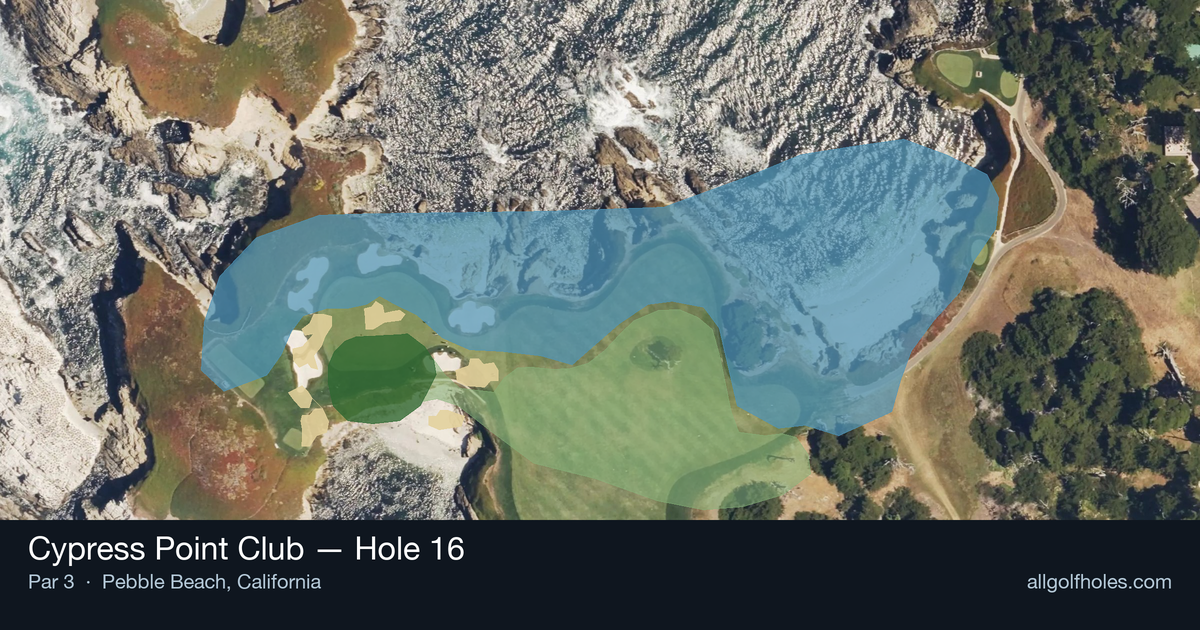
Aerial source not provided
Green size: 38 yds deep × 33 yds wide
Scorecard yardage is for Pro tees. The aerial shows its labeled reference position; distance rings measure to the green.
Pro tees · Par 3 · 231 yards
The plan for No. 16
Cypress Point Club hole 16 stands as one of golf's most breathtaking par 3s, demanding both precision and nerve from its clifftop perch above the Pacific Ocean. At 231 yards, this iconic tee shot plays across a dramatic chasm where crashing waves and jagged rocks create nature's most intimidating water hazard. The small, elevated green sits precariously on the far promontory, surrounded by native vegetation and offering little margin for error. Wind conditions constantly shift the challenge, requiring golfers to club up or down significantly. While the hole lacks traditional sand bunkers, the Pacific Ocean serves as the ultimate penalty for any mishit. This legendary hole epitomizes Cypress Point's reputation as golf's most scenic and strategically demanding course, where spectacular beauty meets unforgiving consequences.
Off the tee
Your primary focus should be wind direction and strength, as conditions can vary dramatically throughout the day. The prevailing wind typically comes off the ocean, but crosswinds and gusts are common. Take extra time to assess conditions by watching the flag, feeling the wind at tee level, and observing how it affects the cypress trees. Club selection ranges from mid-iron to hybrid depending on conditions - err on the side of taking more club rather than less. Aim for the center of the green regardless of pin position, as the margin for error is minimal. Commit fully to your swing once you've made your club selection; tentative swings often lead to disaster here.
Approach & recovery
Since this is a par 3, your tee shot is your approach. The key is accepting that the center of the green is always the best target, even when the pin is tucked in a corner. The green's small size means any shot that finds the putting surface gives you a reasonable chance at par or better. When the pin is positioned near the ocean side, resist the temptation to attack it directly. The risk-reward ratio heavily favors the conservative play to the middle or back portion of the green. Remember that professional golfers often aim away from sucker pins here, and recreational players should follow that same strategic approach.
On the green
The green features subtle undulations that can be difficult to read due to the dramatic surroundings. Generally, putts break away from the ocean side, but the grain and wind can influence ball roll. Focus on speed control, as the firm conditions typical of seaside courses can make distance control challenging. When putting, try to leave yourself below the hole when possible, as uphill putts are more manageable in windy conditions. Don't be overly aggressive with birdie attempts - two-putting for par is an excellent score on this hole.
Watch for
- Crossing center (center)
- Crossing center (center)
- Crossing center (center)
Hole 16 Green Complex
Mapped green boundary
Green size: 7,095 sq ft
Course coverage
Tournament and creator videos about Cypress Point Club — shared course coverage, not hole-specific clips.
Featured by these creators
Creator videos about this course
YouTube creators who filmed or featured Cypress Point Club. · Stats as of Oct 12, 2026 · 6d ago
NLU Film Room: Randy Plays Cypress Point Club
How did Hole 16 play?
How did this hole play today?
Frequently asked questions
Yardage reference: Pro tees · 231 yards.
What club should I use on this par 3?
↓
At 231 yards, most golfers will need a fairway wood or hybrid to reach this green. Adjust for elevation, wind, and pin position.
How difficult is hole 16?
↓
This hole is one of the tougher holes on the course for most golfers. Key challenges include: long par 3, water in play, large green requiring good lag putting.
What hazards should I watch out for on hole 16?
↓
Key hazards include: water at 146.6 yards. Plan your shots to avoid these trouble spots.
How big is the green on hole 16?
↓
The green is fairly large with multiple pin positions. Lag putting becomes important on longer putts.
What's a good score on hole 16?
↓
This hole is a challenging par where bogey is acceptable. This longer par 3 will test your long iron or hybrid game. Par is a good score.